

photo courtesy of Universal Music
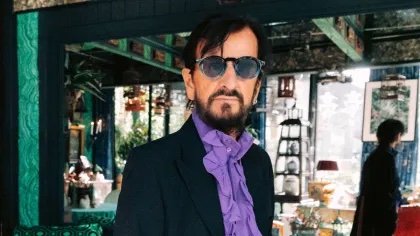
Legendary drummer Ringo Starr is sitting with the legendary T Bone Burnett at Los Angeles’s legendary Village Studios, discussing his Burnett-produced forthcoming Americana record, Long Long Road, at a press event moderated by Jeff Bridges.The always affable, 85-years-young former Beatle jokes that he’s never felt the need to write an autobiography, because he “doesn’t remember most of the good parts anyway.” But in many ways, his new album serves as an unofficial memoirs collection.
“I was just thinking about the road I’ve taken… it’s so far-out,” Starr marvels. “I mean, what would have happened? Because when I was 18 and a half, I wanted to emigrate to Houston, Texas, because of Lightnin’ Hopkins, the blues player. … I can’t answer these questions, but here we are today, and it worked out really well.”
Obviously, Starr remained in Liverpool, where at age 22 he received a fateful phone call from Beatles manager Brian Epstein asking him, “Would you join the boys?” Starr, who’d been drumming for Rory Storm and the Hurricanes, played his first gig with those boys four days later, and the rest was rock ‘n’ roll history.
“That was one of those lucky decisions, I would say,” he laughs. “I always feel I didn’t go [to Houston] because God’s on my side, but I didn’t go because of the embassy. They gave us forms. They gave us a list of factories we could phone to see if we could get a job [in Texas], because we came from the factory. And then I went back with those forms and they said, ‘Oh, thanks — here’s some more forms!’ And excuse my language, but when you’re 18, it’s: ‘Fuck off, I’m not gonna do that!’ I just ripped them up in front of the guy. But that’s another path I could have taken. Who knew? I took this path, and I ended up here.”
And decades later, Starr ended up L.A. and Nashville, making a country album — actually his third country album, following 1970’s Beaucoups of Blues and his previous Burnett collaboration, Look Up, which was released just last year. And even Starr and Burnett’s clearly prolific partnership came “out of the blue,” when the two old friends crossed paths at Hollywood’s Sunset Marquis hotel back in November 2022, at a private event celebrating George Harrison widow Olivia Harrison’s poetry book.
“This was another great plan that I had nothing to do with,” Starr says. “[Burnett] sent me a great, beautiful country song, and it blows my brain out today. I was like, ‘Country?’ You know, I was expecting him to send a rock/pop song; I didn’t even think it would be a country song. And that’s put us on the path that we’re sitting here tonight. Now we’ve done two albums together. How great is that?”
“All of us have been listening to [Starr] play drums for 50 years, and his feel is in my DNA at this point. It’s in my cells. I always felt we played with a similar field,” explains Grammy/Oscar-winner Burnett, whose pages-long résumé includes Robert Plant’s two collaborative bluegrass albums with Alison Krauss and the soundtracks for O Brother, Where Art Thou?, Cold Mountain, Walk the Line, and Bridges’s film Crazy Heart. Burnett isn’t the least bit surprised to learn of Starr’s long-ago Houston aspirations, saying, “I’ve always thought of him as a Texas musician, because he played so Texas. He’s the swinging-est drummer in the history of the United Kingdom, I can tell you!”
“With the snare drum, or the beat, and I play on the back of that; a lot of the drummers play in the middle, and some drummers play in front of it, and it just feels right to me to play on the back of it. So, there’s always sort of a swing feel to it,” Starr says of his signature style. “I was given a gift. It just came to me. I didn’t make it up. When I was playing, it was always like a body move for the off-beat. … I didn’t read a book or have somebody come over and show me things.”
That swinging style was another happy (or initially, not-so-happy) accident for Starr. “I only do what I love to do because I was very ill,” he explains. “I had TB, tuberculosis, and I was in hospital for about a year. In those days, they put you in bed and let you lay there. There were teachers who’d come around, and they had this music teacher come and she’d have little drums, little maracas, all percussion. She’d point to yellow and you hit the drum, or to red and you’d hit the tambourine or whatever. I remember it like it was yesterday. I was 13 years old and I had this little drum for the first time, and from that, I only wanted to be a drummer. That’s all I wanted to do. I didn’t want to be a guitarist or piano player. I wanted to be a drummer. Our family was not a rich family, but I would go to Liverpool city and look in the music stores, and I only looked at the drums.”
And then other surprise development occurred. When Starr’s grandfather lent him the money to purchase his first drum kit (which Starr paid back at one British pound, or about $1.50, a week), Starr played the kit right-handed, even though he was born a leftie. This was because his grandmother “didn’t like me being left-handed, so she made me right-handed … in the ‘40s [lefties] were sort of [considered] in line with the devil, so she made me change. … I just sat on it, not knowing any better, and started playing. If you look at any left-handed drummer, it’s like [the kit is organized] in reverse. And so, I can’t play left-handed, and now it’s been a hundred years. That’s not a plan I could make. I could have sat on the drums the ‘wrong’ way.”
There is, perhaps unsurprisingly given its title, a lot of nostalgia on Long Long Road, which features Billy Strings, Molly Tuttle, Sara Jarosz, St. Vincent, and Sheryl Crow, the latter guest star being longtime Crow fan Starr’s personal request. For instance, there’s the pre-Beatles skiffle vibes of “Baby Don’t Go”; a doo-wop/Merseybeat-inflected cover of Charlie Rich’s “I Don’t See Me in Your Eyes Anymore” with Ringo in full crooner mode; the Everlys-esque harmonies on “Why”; the mix of vintage gospel and ‘60s psychedelia on “My Baby Don’t Want Nothing”; and the Cash/Carter-style interplay with Tuttle on “She’s Gone,” a classic cry-in-your-beer country waltz (featuring a line, “You never read my letter,” that amusingly but probably unintentionally references the plot of Starr’s Simpsons episode).
And there’s also a lot of sing-songy simplicity and positivity on this album — silly love songs, if you will — particularly on the three tracks co-written by peace-and-love ambassador Starr himself. A countrified update of his 2005 song “Choose Love,” with St. Vincent art-rocker Annie Clark doing harmonies, mentions the “long and winding road” Starr has journeyed; another sweet Tuttle duet, the Fleetwood Mac-like “You and I (Wave of Love),” is unabashedly Starry-eyed in its sentimentality, indicating that he still really believes all you need is love; and the reflective title track and coda, featuring Crow, shifts from lush harmonies evoking the Beatles’ friendly rivals the Beach Boys to positive-affirmation spoken-word that feels like a motivational-speaker mantra.
At one point in that latter song, Starr confessionally sings, “I look in the mirror, and wonder where I’ve been.” And his deeply felt drumming throughout Long Long Road underlines every meaningful word. “When we were recording this stuff, Ringo would play a fill and I would think, ‘Oh, he’s gone into the chorus too early,’ or ‘He’s gone into the chorus too late.’ I would always think he was doing something ‘wrong’ until he finished,” Burnett chuckles. “And then I realized, oh no, he was just playing. And it is emotional. I feel that. [He’s] playing the lyrics, playing the feeling of what’s going on.”
“[That’s] the interesting thing about the way I play, because it’s an emotional moment to do a fill,” adds Starr. “And I can’t ever double-track it. I don’t do it twice, what I’ve done, because it’s feeling to the song to where I am at the time. In that space… my playing is an emotional state of mind.”
As Starr prepares to release his introspective new album — as well as appear on his former bandmate Paul McCartney’s own upcoming nostalgic album, The Boys of Dungeon Lane, on a duet title “Home to Us” — he has many reasons to feel emotional, and much to celebrate.
“The Long Long Road is me going through my things about my life, how it started out and where it ended up. And some of it’s bad, of course, but for most of it, I’ve been a lucky human being,” he grins. “I got to do what I love to do.”
This story originally ran on Gold Derby.