
UPDATE: On June 20, the day after the release of his comeback single “Reverse!!” discussed below, MNEK posted on social media alerting fans that at the “literal 11th hour,” clearance for the song’s interpolation of Lethal B’s “Pow! (Forward)” had been “formally denied” — despite him and his team doing everything right over the past year and a half, and being under the impression that it was OK to proceed. He explained that many of the “Pow!” writers apparently had issues with his single’s queer lyrical content, and while he had hoped to “bridge a gap” by interpolating the 2004 grime classic, and was disappointed that he was unable to move forward with that plan, he acknowledged: “It’s not surprising, as I knew what I could possibly be up against; it’s a little edgy to sing/rap about turning straight men gay on a pop song.”
Instead, “with hours to spare” before his new single dropped (and less than two weeks after the exclusive Lyndsanity interview below, during which he spoke at length about the significance of “Pow!” and his connection to the formative grime/garage music of his youth), MNEK sprang in into action and “decided to swap out the audio, granting this an entirely original work.” However, the bold spirit and intent of “Reverse!!” remain intact.
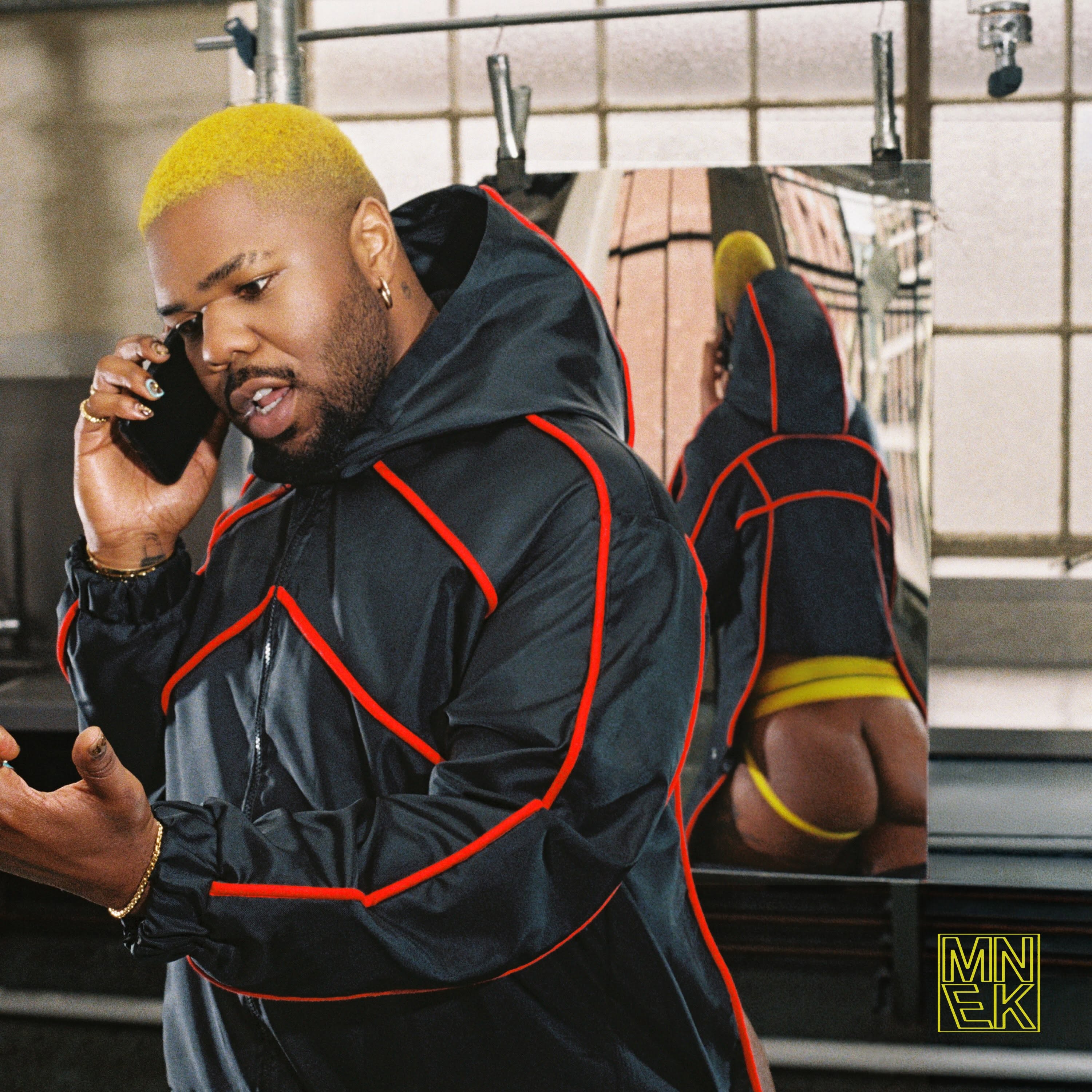
The cheeky cover art for MNEK’s grime-influenced comeback single, “Reverse” (photo courtesy of Chaos Label)
British-Nigerian pop wunderkind MNEK (real name: Uzoechi Osisioma Emenike) is sitting backstage at West Hollywood’s 2026 Outloud Pride festival, getting ready to play his first U.S. concert since 2019. It has been even longer since the singer/rapper/songwriter/superproducer released his acclaimed debut album, Language (a top 10 album pick for in 2018), but he most certainly hasn’t been idle during that time.
On the contrary, MNEK’s career has exploded exponentially since then, as he’s worked behind the scenes with longtime collaborator Zara Larsson (co-writing every song on her recent breakthrough album Midnight Sun, and co-producing seven of its 10 tracks), FLO, Måneskin, Adam Lambert, Jade, Jax Jones, Craig David, Galantis and David Guetta, and many other pop, EDM, and R&B luminaries. He’s won multiple ASCAP Awards and garnered Grammy, BRIT, and BET nominations along the way, and he even got to guest-judge the greatest musical challenge in RuPaul’s Drag Race herstory, the U.K. series’ RuRuvision Song Contest, which would be a major career highlight for just about anyone.
But now that MNEK is finally putting himself back out there, centerstage, and gearing up to release his sophomore album, Bulldozer!!, on Sept. 18, he is admittedly feeling the pressure.
“This has been something that I’ve not done for a while,” he tells Lyndsanity, sitting at a West Hollywood Park picnic table with his highlighter-yellow buzzcut glowing in the afternoon sunlight. “This year in particular has been a lot of me being outside again. I feel like I’ve been a bit hiding and not really wanting to showcase myself, just out of fear of, I don’t know, not doing well or not being accepted. I think a lot of this album is about me breaking through that wall that I built up of fear and lack of confidence. If I fail, I fail, you know what I mean? But at the same time, I have to give it a shot.”
It’s downright shocking that an artist with such an impressive, multi-page CV would suffer from any sort of impostor syndrome or self-doubt. Years before MNEK broke out with Language at age 23, he’d already proven himself as an in-demand producer and songwriter — after being discovered via Myspace, landing his first publishing deal when he was just 14 years old, and collaborating with the likes of Madonna, Kylie Minogue, Dua Lipa, Diplo, and Julia Michaels. He even co-wrote “Hold Up” off Beyoncé’s landmark Lemonade album. His reputation is so solid by now that midway through his Lyndsanity interview, one of Outloud’s other Saturday performers, Cain Culto, excitedly approaches our table to tell him, “I love you! You’re an inspiration. I write too, and I just love your writing.”
“I feel the love in a way that I wasn’t able to receive in my twenties,” MNEK says with a grin, as Culto walks away and the interview continues. “I feel like I can receive the positive love that people give me, and see that they respect what I do, and that we can win together.” And that is what really matters to MNEK when it comes to his solo career, rather than trying to the compete with the astoronomical streaming and chart numbers of the A-listers he has worked with.
“The way I measure the success of my music has to be different. I’ve been blessed to see success in streams and global this and global that, and that’s one way of measuring success. But if I use that same metric with my own stuff, I will always be disappointed,” he reasons. “So, I have to measure my success in, OK, did people listen to it? Did people come to my show? Did people come up to me and say, ‘Thank you so much for making this album, and thank you for existing, and thank you for doing what you do’?”
When MNEK he first started putting out his own music, he “made a very conscious decision to be out,” and back in 2018 he caused a bit of a stir when he cast a male love interest in his sexy music video for “Tongue.” But the video’s largely positive response confirmed that he was on the right path. “That was the first time, I guess, that I saw lots of messages from Black gay kids saying, ‘Thank you for doing that,’ and ‘It’s helped me talk to my parents or talk to my friends about it,’ or ‘It’s been cool to see someone that I can relate to on that thing.’ And I think that I always wanted that,” he recalls. And now that he’s about to release his new single, “Reverse!!,” MNEK is pushing things even further.
“Reverse!!,” out June 19, is “a very British record” and MNEK’s “love letter” to U.K. dance music, and it samples 2004’s “Pow! (Forward)” by British MC Lethal Bizzle, “one of them records that people hold near and dear to their hearts as this pillar of grime.” While the grime and U.K. garage scenes have at times been known for deep-rooted homophobia and have “definitely had some challenging language and ideologies,” with “Reverse!!” and his other upcoming tracks, MNEK is flipping that script.
Some of the single’s bold lyrics include: “I could turn a bad boy to a bad bitch in seconds/I can make a thug really twerk/I can make a thug really switch… I can turn his duffel to a purse/He ain’t never been about the booty/But the booty go berserk.” And when MNEK performs “Reverse!!” on Outloud’s main-stage, the wall-sized video screens behind him depict tough guys posing stoically in tracksuits, parkas, and do-rags — black-and-white footage that bursts into rainbow-bright color when the chorus kicks in and the men begin twerking and gyrating all over each other.
“‘Reverse!!’ and a few other songs on Bulldozer!! touch on more grime and garage and that kind of world, and I think it’s a cool juxtaposition,” MNEK says. “You think of grime and garage as being very hyper-masc and very bro, so I wanted to add a bit of flair to it. I’m happy I just get to do my thing on it and bring people into this conversation on this album. This is a space that one would assume that I don’t belong in or I don’t exist in, but I grew up in Southeast London. I’m British-Nigerian. I grew up with grime and garage music all around me. It’s not something that I am a guest of. I grew up with Channel AKA/Channel U [a now-defunct British satellite TV channel that focused on the grime scene], and that was our community. That was us discovering underground music before there was peer-to-peer sharing and internet and pirate radio and all that stuff. So, I feel proud to get to share it with the world in this way.” (Side note: MNEK isn’t worried about his new sound being “too British,” because “we’re in a world now where music is global, so there’ll be someone who is the most Yankety Yank ever who’ll listen to it and be like, ‘Oh, this is my jam!’”)
View this post on Instagram
MNEK also grew up loving American ‘80s/‘90s R&B — like the Jam & Lewis, Rodney Jerkins, and Timbaland catalogs, and especially Mariah Carey, who still tops his wishlist of dream collaborators — and he’s grateful that his family fostered his creativity from an early age. “They’ve been a lot more supportive than I give them credit for. Music is all I ever wanted to do. It’s all I ever felt very good or skilled at. And they saw that it was something that whatever it is, if I’m able to apply myself and really give it my best, then that can’t be a bad thing,” he says. “I mean, I often make a joke about my parents, because I come from a Nigerian background and there’s a stereotype in the Nigerian community that all of us are gonna be doctors and lawyers and that’s just how it is. But upon reflection, my parents were always really supportive of me doing music. … My parents did a good job. They wanted me to win. They let me do all these things. If some old guy came to the house asking, ‘I want your kid to sign a contract,’ they were so open to it. I credit them loads.”
MNEK’s family has also been supportive of him living as an openly gay man, although he reveals that when he came out at age 19, the experience “had its challenges. … My mom has reacted well. My dad has reacted well. The thing is that it’s an ongoing thing. … There’s so many facets to this. It’s one thing coming out to [my father] one-to-one in our house, but then it’s different when I’m being open and showcasing parts of myself to the public. And so, it’s him dealing with that. It’s him reading a newspaper and me being like, ‘I want to be a Black gay role model.’ He wasn’t ready [years ago]. This is stuff that I’m aware he has to kind of grapple with, but at the same time, he is aware that I have to do this just for myself and that it’s important. He doesn’t disregard it.”
MNEK says he’s become “definitely more at peace” over the years with being a Black gay role model in the music space, although he admits he has mixed feelings about that, because his success is, sadly, still the exception to the rule. (One of the ways he has helped to expand opportunities for young, rising queer artists is his Proud Sound songwriting camp, in association with Warner Chappell and Pride in Music.)
“The idea that I’ve had impact and that I’m a rare case in a lot of ways, me being a Black, queer music person… if you ask a bunch of people to name a Black, gay, U.K. singer/songwriter/producer, I think a lot of people would pick me in some way. And that’s cool, but it’s also like not, in that I don’t think it should be that way,” MNEK muses. “I think there should be more of us who are at a certain level of success that we can all share. A lot of my peers are white, and I can be friends with everyone of course, but it’s always nice to see other people from disenfranchised groups be acknowledged and understood and see that level of success.
“I think there’s a level of responsibility that I have in a lot of ways, but also, I still want to have a good time,” he continues. “I still want to enjoy it and figure it out. I think that when I released Language, it was such a long time ago. And since then, Lil Nas X has come out and he did his thing, and there’s been a bunch of pieces of multimedia that have pushed the conversation along. This [new music] is me adding my part, at least from where I’m at right now in my life. And hopefully it does add to the conversation.”