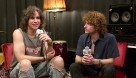


Acclaimed singer-songwriter Grace Cummings is back in the San Fernando Valley, a long way from her native Melbourne, Australia. She’s relaxing at Studio City’s Licorice Pizza Records after delivering a stunning acoustic performance of two songs from her ambitious fourth album, BLOODHORSE!, which she recorded in the West Valley’s Topanga Canyon with producer Jonathan Wilson (Father John Misty, Angel Olsen, Dawes, Margo Price, Conor Oberst). The record was made during a transformative “big shift” in the 34-year-old Cummings’s life, after she quit drinking two years ago. “I don’t need fucking enhancement,” she chuckles while discussing her sobriety during her LPTV interview. “I’m nuts!”
One of BLOODHORSE!’s key tracks is actually titled “I’m Not Crazy” [italics mine]. But Cummings, who’s quick to embrace or even celebrate her perceived flaws and discuss her mental health journey, has certainly conjured some BLOODHORSE! lore had could be described as nuts, or at least eccentric. There’s the grandiose, The Sound of Music-inspired opening track, “The Hills Are Alive With the Sound of Morphine,” for starters. Cummings deliberately recorded another track while suffering from pneumonia, and another while (at Wilson’s behest) brandishing an actual scythe. And then there’s that outlier filthy fake bro-country track, which serves as a jolting needle-scratch at the end of side one.
Cummings confesses that she’s still figuring out her path, joking, “I don’t think I’ll ever receive a diploma from wherever for getting life right. … I don’t really think that I’m a straight up-and-down person, and sometimes that’s the biggest pain in my ass, but that’s just the way it is.” But she knows her rawness is connecting with fans, which makes it all worth it. “If I can muster up a little courage to rip off a layer of my skin and do that, then that makes me really happy,” she says.
And all this, of course, makes for an incredibly compelling interview, as evidenced by the video above and edited-for-brevity-and-clarity Q&A below, both laced with her self-deprecating, oh-so-Australian, sharp-as-a-scythe wit. Here, Cummings opens up about all of the above and much more, including the inspiring conversation she had with her ATO Records label-mate and tourmate Jim James; her love for Harry Nilsson, David Lynch, and John Lennon; and her relatable struggles with people-pleasing, impostor syndrome, and self-image.
LPTV: There’s a lot to unpack with this album. It made sense when I found out you’re a trained stage actress. There’s a lot of drama on this record, and seems like sometimes you inhabit some characters in the songs.
GRACE CUMMINGS: I think that it goes without saying that the album is dramatic. I’m not going to pretend that it’s not. But that is the way I experience life on the inside. It is dramatic. It’s intense. … There are a lot of different kind of sounds or characters, if you will, but I think that that’s all just different parts of myself. I don’t really think that I’m a straight up-and-down person, and sometimes that’s the biggest pain in my ass, but that’s just the way it is.
I imagine it would be easier to act in a play onstage than perform music, because with a vulnerable and personal record like BLOODHORSE!, you are yourself, singing about yourself, in front of an audience. There’s no character to hide behind. But before we get into all that, I actually did not know the term “bloodhorse” before. I’m fascinated by how you might relate to that animal, or how it is a metaphor for something. A bloodhorse is a racehorse that is expected to win, but then maybe it gets broken and doesn’t succeed.
I thought a long time about the name of the record and I had many different titles, which happens all the time, I think, that didn’t quite fit. And then BLOODHORSE! just fit — with an exclamation mark, which is important to me. But I suppose if I were to go and analyze it, which I didn’t really do at the time, a bloodhorse is an archaic term for a purebred racehorse. It has been pointed out to me that I do reference animals a lot in a mythological way, and it’s just a really strong image, an almost mythological image that I think holds the grand nature of what I wanted the album to be. I think that it encapsulates so much strength and determination and rigor, but fight-and-flight and vulnerability and temperamental and afraid.
When I was talking to my friend Simone about the meaning of the album… she looked at me and was like, “I just realized something. There are some people that walk into a David Lynch film and go, ‘What the…?’ And then there are people like you that walk into a David Lynch film and go, “Yep, that’s perfect.’ So, to quote David Lynch, life does not make sense. People are asking me if I am the bloodhorse, and I could be, in a way. I think something that really does make me feel like that is sleep. There’s a lot of talk [on the album] of dreams and sleep and nightmares and things like that, and maybe when I go to sleep, I feel like I shut my eyes and I don’t really rest. It’s kind of like I’m waiting in the stalls, and then I open my eyes and you just fucking run away from something — to something, for something. I don’t know. That was a long answer, wasn’t it?
I like your long answers! You said the exclamation point in the album title was important to you. Why so? It makes it seem I’m the title, which is also in all caps, should be shouted.
I did that! I was very nervous at a show the other day, for whatever reason, and I was talking about the album and I just started shouting and I said, “Everyone must shout it!” … I don’t know, it’s kind of unapologetically obnoxious, really, now that I think about it. But I would be lying if I were to say I wasn’t influenced by “The Point” by Harry Nilsson.
That’s interesting, because just now when you were performing your original song “John Lennon,” someone at the store mistook it for a Nilsson cover. He must have picked up on your Nilsson influence.
I love Harry Nilsson. … When I made this record, actually on the piano the whole time was a picture of Harry Nilsson. I looked at him every day when I wrote this record. Not for any particular inspiration; he was just there and I was just like, “Hey, dude.”
I know BLOODHORSE! was made while you were dealing with some big life changes. What was going on, and how did that affect the record?
I’ve had a big shift in my life in the last almost two years, maybe. A big thing was me quitting drinking, which is something that holds a terrifying mirror up to you, but still a mirror. And I’ve been able to see myself in a way that has helped me a lot. I am getting older, as we all are, but for me, that experience and that growth has led me to be the person that I recognize — which is the person I was when I was a child, really. There’s a little layer that I’d like to get more and more off, a layer of care or of worry about who I am that has just been removed. … For me that takes a lot of strength, because I have spent a lot of my life trying — I think sometimes consciously, and most of the time unconsciously — to not be myself, for a number of reasons. So, with this one, I just thought, “You know what? I would like to live in a way that if I got hit by a bus in three weeks, I’d go down proud.” And in order to do that, I’ve got to do a few things that might seem scary to me. And the first one is to be myself in a kind way, I think. … It does come from a personal experience, but nobody is that fucking unique. Certainly not me.
You’re very unique!
Nobody is, really. And the response that I got kind of taught me that you can write about personal things and it’s actually not all about you. It’s about giving it to somebody else that might be held by it or feel more understood by it, or something like that. So, if I can muster up a little courage to rip off a layer of my skin and do that, then that makes me really happy.
Is the drinking culture in Australia similar to drinking culture in the U.K.? I have not spent much time in Australia, but I know in England, Scotland, and Ireland, drinking is so woven into everything in society that I imagine it’d be near-impossible to get and stay sober.
I find it harder in Australia. It’s a big drinking culture. I don’t know if you’ve ever seen that film Wake in Fright; it is a terrifying Australian film about a teacher who gets stuck in the Outback, and sometimes pub culture could feel like that film. But also, it’s very much like I did it myself,. I don’t think that he would mind me talking about this because I know that he publicly talks about it, but I was and still am a big My Morning Jacket fan, and I was lucky enough to go on tour with those guys last year. I was still drinking at the time, and [My Morning Jacket frontman] Jim [James] said, “Do you want to go out?” And I said, “Yeah, let’s go to a bar.” And the drinks came around and I was [buying shots for everyone, and I said, “Jim, what do you want?” He said, “I’ll just have a sparkling water. I don’t drink.” And I said to Jim — who is now my friend, but then was somewhat of an idol – “What are you doing here?” Now I can’t believe that I said that to him. But the real thing that turned me, that should have turned me many years ago, was he looked at me and he said, “I’m here talking to you!” And it was kind of the first time that someone, especially someone that I knew from afar as some kind of unicorn, just wanted to be in my company, just because. And that was a big deal for me. And now I get that. “What are you doing here?” “I’m just having a good time.” And also, I don’t need fucking enhancement. I’m nuts!
Well, you do have a song called “I’m Not Crazy” that you performed at Licorice Pizza, and we’ll get to that. But I’m going to ask lightning-round questions, in roughly chronological order, about various BLOODHORSE! tracks stood out to me. Let’s start with track 1. It is a pretty bold and attention-grabbing opener to have the album’s first song be “The Hills Are Alive With the Sound of Morphine.”
I think it is fine for me to always start on a bold note. It’s kind of like, “Here’s the show!” … I think about the order and curation of the album a lot; to keep the whole thing flowing and remain interesting and have a little odyssey is important. I always love an album to start with something strong like that. And “morphine” doesn’t mean the drug for me. It’s a strong word for something that takes pain away. And also, to quote The Sandman, it’s Morpheus, the God of Dreams.
Well, I don’t know if you were on literal morphine, but you might’ve been on some drugs when you recorded “My God,” because you literally had pneumonia at time! Tell me about that ordeal.
Well, I recorded the song in Topanga and got back home to Australia. I did not have pneumonia [during the Topanga recording session], but I got home to Australia and I wanted to change it. I got pneumonia and was really interested by the sound of my breath and my chest whilst I had , and I wanted to use it because I thought it was interesting. And I used my breath that I had with pneumonia in a percussive way. I just thought it was an interesting sound and I wanted to capture it. It was also a struggle to do, and it’s a bit of a struggle song, so I was like, “Well, I guess it sounds like it.”
Now when you perform “My God” in concert, presumably when feeling well, are you trying to recapture that pneumonia vibe, as it were?
I don’t want to really recapture a “pneumonia vibe,” but I do use my breath. I’m really interested at the moment in songs that I’m writing that aren’t on this album, but that I’ve been writing after the album. I’m using a lot of breath and different ways of using my voice and my body as an instrument. … I just think that that’s really interesting, so I snuck it in there on “My God” with the pneumonia lung.
I mean, there’s a song on this album, “I’m Not Crazy,” that I purposefully did it in a different voice, and it’s funny to me because people are like, “Whose voice is that?” And I’m like, “It’s mine.” I made effort to make it sound a certain way, but just like a guitar or a different amp or a different pedal or whatever, it’s still your voice and you can do many things with it. And I get excited with this letting a certain level of care go away. I can use my voice in so many different ways, so why am I just singing in this one way when it’s my voice? Anything is my voice, if it comes out of my mouth.
That song and “Fake” seem to touch on a theme that’s woven through the album, about minimizing yourself or being a people-pleaser, adapting or changing to meet expectations. Tell me about that.
“I’m Not Crazy”… if we were talking about characters, that’s probably one that does have a character in it. The person who says that is the person on the other side, and the voice that I’ve got in that song is “follow the rules” – a pretty unassertive, people-pleasing girl that doesn’t want to poke the bear, if that makes sense.
Am I correct in saying that’s a recurring theme? Is that something you’ve struggled with?
I mean, I don’t think I’ll ever receive a diploma from wherever for getting life right — which is something that I’m grateful to know because that’d be fucking awful, to try and think that you could get yourself right. I’ll be working on that every day. I’ll try my best. But yeah, of course I do feel like that. I feel like that all the time. As a child, as a teenager, pleasing-people to fit in or to be safe or maybe protect something about myself that I’m not sure what it is. I think a lot of the time you can find yourself in situations where being small is just a safety mechanism, and I think that’s a thing that is unfortunately known by many women, many people. It’s painfully ordinary experience.
There’s a line in “Fake” about being a “good girl,” but I think you actually removed that lyric.
I don’t sing it on the record. I haven’t written the lyrics down in the sleeve of the record, either. Actually, when I was writing it, I couldn’t do it in the privacy of my own home alone. I couldn’t say the words. But in the song it kind of comes out a little bit. It’s a sick feeling, so I kind of just turned it into a bit of a percussive, guttural wrench. … I think that the suggestion of it is strong enough for me.
I took the title track to also be about that, but more pertaining to the music industry. Entertainers of all genders, but it’s probably worse for women, are told to look, act, and sound a certain way, to change things about themselves to be more palatable and marketable.
[“Bloodhorse!] originally came from me being unhappy with my appearance. Again, that’s not a unique experience. It’s OK right now, but I’ve had acne forever and it’s not going anywhere; the amount of money I’ve spent on trying to fix stuff like that, it’s just not going anywhere. But I went to go get a facial, and after the facial, my skin’s all red and puffy and whatever, the nurse handed me a mirror and I guess it was an upselling thing that I wasn’t into. And he told me to look into the mirror and tell him what I didn’t like. And I was not in a good headspace either at the moment. I didn’t like my physical appearance. I have a lot of trouble with my appearance and looking in the mirror and going shopping. I don’t like it. I’m getting a better relationship with knowing what’s looking back at me, but I’m not really there. But this particular experience was horrendous, because I was asked that question and my answer in my head was, “What don’t I like? Everything!” I was also about thinking about getting a nose job and making my nose a little less Italian, which is something that I’ve thought about. … I felt terrible and I thought, “OK, maybe I’ve got this frown line, I guess.” It was two weeks before my birthday and I was getting older, blah, blah, blah. And he said, “Grace, nobody needs to frown.” And then I just found myself in the chair getting Botox, which is totally fine, I would never judge anyone, go for it, I don’t care. But for me, the next three to five months, I not only had feelings about myself kind of trapped in the basement or trapped in my head. I literally had them trapped in my body! I found it very distressing to have that kind of heavy, unmovable face that made it hard to cry.
I bet it made it hard for you perform, too. Your face is very animated when you sing. There are times when you need to frown!
I need to frown. I’m an expressive person. After that I was like, “Well, I need to frown.” It’s a part of life. We all need to be sad. You’re supposed to be sad, you’re supposed to be angry, you’re supposed to be hurt. I’m not saying that I’m there, because I’m not; that would be a lie, and I don’t want to lie. But I would love to start worrying more about things that actually fucking matter, not something that I’m uncomfortable with seeing in the mirror.
If you’ve had issues with your appearance for whatever reason, how do you handle all the looks-centric things that come with your career, whether it’s being onstage, doing an on-camera interview like this one, photo shoots, red carpets, music videos, et cetera? How do you cope with literally putting yourself on display?
Well, my mom said something really great to me recently. She said, “Grace, you know how lucky you are that someone’s taking photos of you when you’re this young and beautiful?” I mean, it doesn’t seem like it, because I’ve just talked a hell of a lot about how I don’t like my appearance, but I love nice things. My friend and manager and stylist, Simone, she’ll dress me up like a little dolly and I fucking love it. It makes me feel really special, and it’s a really special thing to have that feeling on the outside. Vut there was something else that was a bit scary for me. For the song “Fake,” I did a film clip. It was the one out of however many I did that I directed myself, and it is raw. It shows me with no makeup on, all exposed, and I am really proud of it. It’s my favorite one that I’ve made. … I’m proud of showing the rawness of myself. So, I love to dress up and look lovely, but I love to feel comfortable showing the other side as well, because that’s what people look like.
There’s another track, just 45 seconds long but long enough to make an impression, called “Bloodhorse! (take two),” which frankly is bonkers. And it definitely does not sound like the rest of BLOODHORSE! It basically sounds like a bro-country song, like it could be Luke Bryan or Blake Shelton, but it’s robotic, kind of Autotuned, maybe even AI. On first listen, it just sounds like a generic modern country song about trucks, beer, fishing, or tractors, but it’s actually very sexually explicit. When it pops up halfway through in the album, it’s jarring; if you’re listening on a streaming service, you’d probably think it skipped to another artist. Please tell me why you decide to put this on the record.
First of all, I think people, rightly so, think that I’m a very serious person and just down in the dumps all the time. I am sometimes, but I also have a good sense of humor and I’m quite light and childish and fun and playful. It makes me laugh. … The “take two” is a part of “Bloodhorse!,” and it is an Autotuned, pornographic bro-country song off the back of “Fake” being so raw and real and “Bloodhorse!” being a race to change yourself. And the end of that is a bro-country song that’s kind of like, “Well, you want me to bend, you want me to change? Let’s go. This is bending all the way back, and this is what you get.”
Who’s singing that? Is that you with some distortion on your voice? Is it a country robot man?
It’s a country robot man. But I created him. I suppose I have to talk about it now in the way of it being a statement, which it is, but it wasn’t my biggest intention to make a statement. I just thought it was fucking funny, really. But it does come in the middle of a record where you have a number of incredible people — there’s 140-something tracks on BLOODHORSE!, of real people playing real instruments so magnificently all together in a real room, on analog gear… and then there’s that.
And it’s very male, and very sexually aggressive.
Yeah, yeah. I did do that on purpose, and it does come with me very uncomfortably dancing in the video clip. The one person I was afraid to see this was my grandmother, and she texted me and said, “Gracie, I wish I could dance like that, I tell you what.” So yeah, thumbs-up from everyone.
Grandma wasn’t offended by the X-rated lyrics?
No, she rules.
Do you put this song in your live shows, and if so, do you sing it in your own voice?
Me and my incredible band back home have put that into our shows now, in a different way. It’s kind of anything goes. Recently, it’s been a heavy kind of grunge thing.
I wonder if any country fans have stumbled upon “Bloodhorse! (take two)” on Spotify and thought, “Grace Cummings, that’s a strange name for a guy, but this is a great country song!” Has it accidentally been served up to anyone who thought it was a real country dude singing about country sex?
Well, I can’t remember what platform, but it’s the most-listened-to song off the album, which I find quite funny. And it’s potentially the most catchy song on the album.
It doesn’t bother you that with all these other more serious, well-made analog songs on your album, that is the one with the most streams?
No. I could get bothered about a lot of things, and I am bothered about a lot of things. But that’s not something that I can control with being bothered. I think it’s a waste of my energy.
Fair enough. Moving on, along with “I’m Not Crazy,” the other song you played at Licorice Pizza is “John Lennon,” which seems to have your most literal lyrics. I assume John Lennon was your favorite Beatle and had a big influence on you.
Well, I don’t have a favorite Beatle, but John Lennon means a great deal, and the Beatles a great deal to me and my life and my childhood. The Beatles are the soundtrack to everything that made me happy when I was a kid. I wrote that actually because [producer] Jonathan Wilson, when I was recording [previous album] Ramona, I was recording my guitar and he said, “Try play it like John, John, Lennon, Lennon.” I was like, “That is the coolest thing I’ve ever heard.” I couldn’t get it out of my head. Again, this is not unique, but I was really, really, really obsessed with the Beatles when I was a kid, and went through the thing of my parents telling me what happened to John, what happened to George, stuff like that. And it’s kind of a song to see what’s up. Like, “John, if you were here, I wonder what you’d think of us all.” And also, “Help me, please.” Yeah.
The most childhood-inspired song on your record seems to be “WITCH! WITCH! WITCH!” — that’s three exclamation points, and all in caps. And apparently, you recorded it with a scythe in your hand.
Yeah. Jonathan and I work really well together, are really good friends, and not to blow smoke up my ass, but I’ve never been in the booth singing and him being like, “Dude, no.” But he said, “Gracie, this isn’t working out,” and I was like, “Oh no, what have I done?” And he wasn’t even listening to it, because he was outside getting a scythe. Because he’s Jonathan Wilson.
So, he literally was like, “Hold on a minute, what this song needs is more scythe”? Sort of like “more cowbell,” but with a scythe?
Yeah. I went into the control room and it was lying on the desk, and he was like, “Take this, go back in there.” I was like, “OK.”
But why a scythe?
Why? Just because it came into his head. And it was right, and we both knew it. Why does he have one? Don’t ask questions.
“No time to explain! Take the scythe!”
Yeah, if anyone were to just have one lying around, it would be Jonathan, for whatever reason. I have no idea.
Are they dangerous?
This one was pretty rusty. I mean, it could hurt someone, I suppose. But that’s not my intention.
Do you ever sing with a scythe onstage? Has it become a thing where fans are bringing scythes to shows? I supposed they wouldn’t be allowed. Venues would have to add that to the list of prohibited items.
“No scythes.”
“No bags bigger than six by nine inches. No scythes.”
I might steal that. That’s actually quite good.
So, how did holding a scythe, as in the pointy thing the Grim Reaper carries, improve whatever wasn’t quite working yet with “WITCH! WITCH! WITCH!”?
I think that the thing that makes everything great is joy and playfulness. I love recording in the studio with Jonathan, because it’s full of play and full of joy. I just felt silly, in a good way. Silliness is my favorite way to do anything.
You should sell branded scythes as merch.
Yea, we could get a side thing going!
The last song on the album is “See You in Fifty Years.” That could be interpreted as you’re literally retiring or going away. Or it could also be interpreted optimistically, about where we’ll be at in 50 years and that it’ll hopefully be somewhere good.
I think it was all of those things. Every time I do something, I’m like, “Well, that’s it. That’s the last thing I’ll ever do. I can’t do it again.” I mean, if I’m lucky to live another 50 years, what will it be like? But also, “See you in 50 years” is almost like saying, “It’s not going to be today. It’s not going to be tomorrow.” Fifty years may as well be never. And we might be floating around orbiting the Earth in some kind of nightmare. I might be a monkey. You might be a man. Who knows? It’s kind of that too. It’s kind of like a lost friendship, I guess. It’s a bit silly, but there you have it. There’s the album. See ya maybe again, later.
Since you say every time you make an album you think that might be it, have you ever thought music won’t be a career you do for very long — that you’re going to stop and do something else?
No, I don’t think about it in that way. I don’t picture a life without music at all. I don’t think I would be able to manage one without it. Whether that’s in front of people or not is OK, but yeah, I’m not doing that. It’s more like, “Well, someone’s going to bust me now and figure out that…”
Some imposter syndrome type of thing?
I guess so. Or that I’ll never be able to do that again, or I don’t know how I did that. I don’t even know what I’m saying talking to you, because I can’t live life without music! But then it’s like, “I can’t do it.”
It doesn’t have to be 50 years from now, but since we’re ending this interview looking vaguely towards the future, what do you think is next for you? Or what do you hope will be next?
I would love to keep making and playing music. That’s a given. I’m always going to do that. I would like to just try my best every day to be a good presence for myself in the world, and keep continuing to change my visions and goals in life and what success looks like, and have music and art as a great accompanying gift to my very small bit part in nature’s great epic. Keep looking for things I don’t know about yet, figure out a bunch of stuff, take away layers of judgment about things I may have judgment about, and keep going down that path. Trying my best, and not looking for a diploma anywhere.