

Deb Never is living the dream — even if it’s a dream that she never imagined when she was growing up all over the world, from America’s Pacific Northwest to East Asia, as Deborah Jung, the shy but rebellious youngest child of a pastor and a nurse. The indie-rock/alt-R&B singer-songwriter is at Studio City’s Licorice Pizza Records celebrating the release of her much-anticipated stellar debut album, Arcade, and like many things in her career, the day hasn’t gone as planned… but in the best possible way.
Deb had intended to perform at the store acoustically, but then someone unexpectedly handed her one of Prince’s guitars, so she of course had no choice but to go electric. Sitting with LPTV after her Prince-ly performance and fan autograph signing, Deb is still in awe, as she gazes down at the (no pun intended) symbolic instrument.
“All I know is, nobody has played this [guitar] except for Prince, Billy Corgan… and now me, which is crazy,” she marvels. “I felt a little the star power from it. But yeah, honestly, I was holding it and like, I felt not worthy of playing it.”
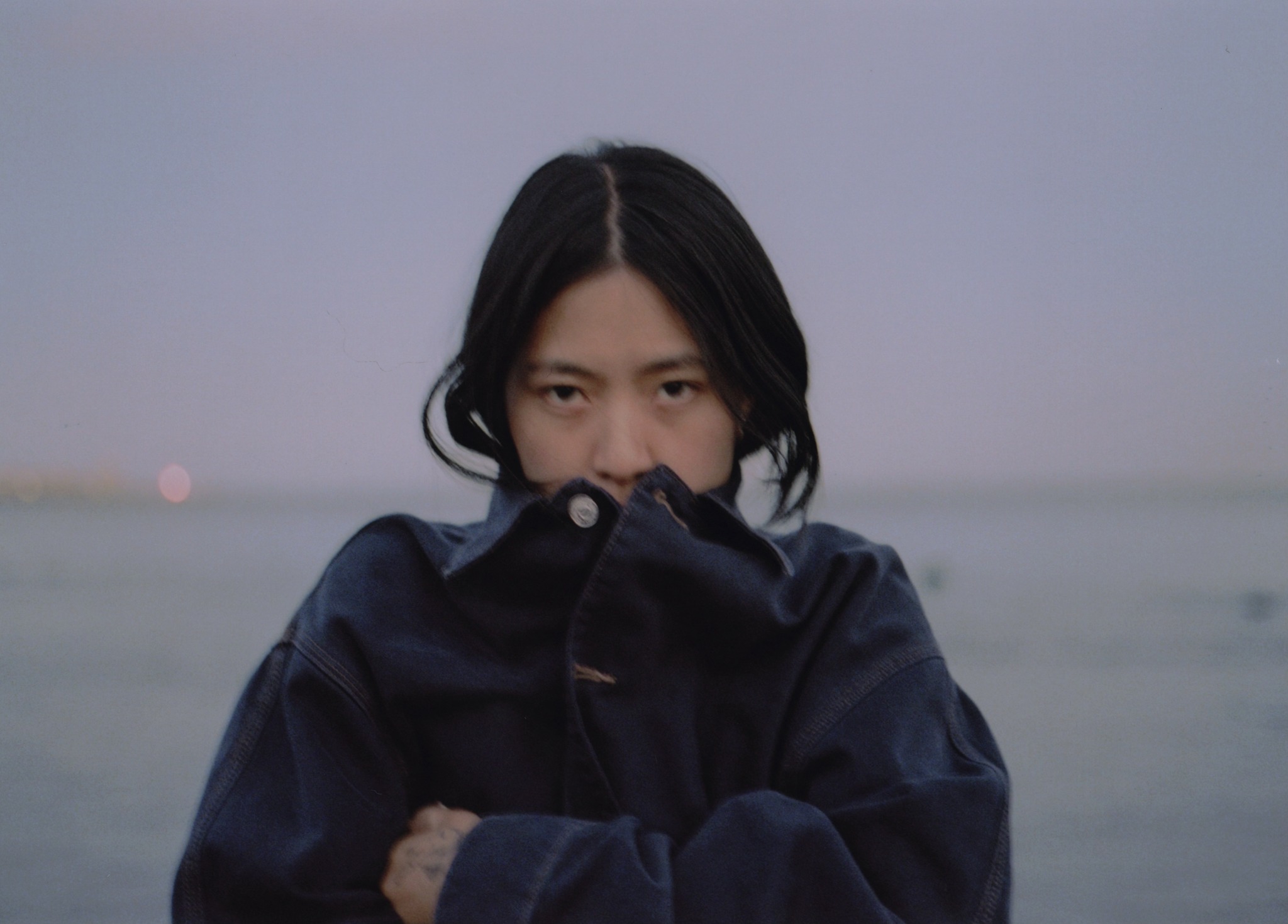
photo courtesy of Giant Music
Deb is in good company and is indeed worthy. And she doesn’t need any superstar’s borrowed guitar to radiate star power on her own — even if she once suffered from such extreme stage fright that at her first gig at a Spokane coffee shop, at age 19, she froze mid-song and “just literally walked off and then walked home.” (She only very recently returned to doing intimate stripped-back or acoustic shows, like the rare one she just played at Licorice Pizza.)
Incredibly, there was a time when Deb “didn’t really see a career in music.” In fact, she only moved to Los Angeles as “kind of an accident” and as a “very last minute, on-the-win decision” when, during a summer vacation before returning to college, she made some new friends who hooked her up with work as a session guitarist. (This eventually led to her collaborating with the likes of Brockhampton, Dominic Fike, Tommy Genesis, and Omar Apollo.) And even when she began to realize that a career in music actually “could be a thing” for her, she still expected to remain mostly behind the scenes, writing songs for other artists, before a music manager that knew her then-girlfriend discovered Deb’s home recordings via SoundCloud.
“I didn’t have it in my mind to put out music as an artist at first, and then I worked with him and he kind of uploaded a song for the first time on Spotify. And it just kind of snowballed from there,” Deb shrugs.
But there’s one endearing, amusing story that Deb shares, about her religious upbringing, that proves that even from an early age, despite any shyness or social anxiety, she knew who she was, she had a specific point of view, and she was always in control of her own destiny — and that the Arcade singer was always going to play the game of life her way.
“I remember when I was 13, I made a whole presentation [for my parents] for some reason. I was like, ‘I don’t want to go to church anymore, and here’s why,’” she laughs.
So, was this a PowerPoint? A diorama?
“Basically,” she chuckles. (Sadly, Deb doesn’t have this audiovisual display anymore, otherwise it could be an awesome stage prop during her more elaborate concerts.) “I got really into Greek mythology, and I would just be online just researching a bunch of other stories. Everyone has their own beliefs, but I came to my own conclusion of why I didn’t believe in the same thing as my parents, and I feel I had to present that to them, to have a valid argument and be like: ‘This is why.’”
Deb says her family — even her pastor father, with whom she had traveled throughout China, Malaysia, and South Korea when he was doing missionary work — were quite understanding and accepting. But perhaps they weren’t surprised, since Deb had already “gotten in trouble a lot in church as a kid” for always questioning what she was taught in youth group.
“I told my mom one day, ‘I don’t want to go to church anymore. I don’t believe in the same thing that you believe,’” she recalls. “And then there’s just a conversation, like: ‘Why?’ And I was like, ‘From what I’ve researched, there’s all these different stories or mythology or whatever that all feel similar, so I don’t believe in one thing. I feel like there is maybe something, but I don’t believe in the one specific thing that you do.’ And it was valid enough that they were like, ‘OK.’”
It was actually two years earlier, while an 11-year-old Deb was living with her father in Korea for a full year, that these rebellious seeds were planted — when, after watching videos online by “one of the biggest inspirations,” her Seattle hero Kurt Cobain — she taught herself how to play a guitar that she’d stolen from the local church. “It had a missing high E-string,” she laughs, only realizing literally in the middle of her LPTV interview that that five-string setup might have influenced her unique playing style, “because I do have a habit of playing a lot on the top four, and I think it maybe comes from that! … I initially wanted to play drums, but then I saw the guitar. It was kind of janky. There were multiple guitars, and I took the one that was broken because I was like, ‘No one’s going to miss this.’ And I took it home with me and taught myself how to play.”
That broken guitar was Deb’s salvation, so to speak, during a difficult year of isolation abroad. “I didn’t know how to speak the language; I am Korean, but I grew up mostly in Seattle and Spokane, so I didn’t know the language. I got thrown into a Korean school in not even a main city,” she explains. “So, [playing music] was kind of my way to feel some type of ‘home’ or comfort. I kind of used the guitar to be able to express, I guess, a lot of the feelings that I had, because I couldn’t speak and I didn’t know what was going on.”
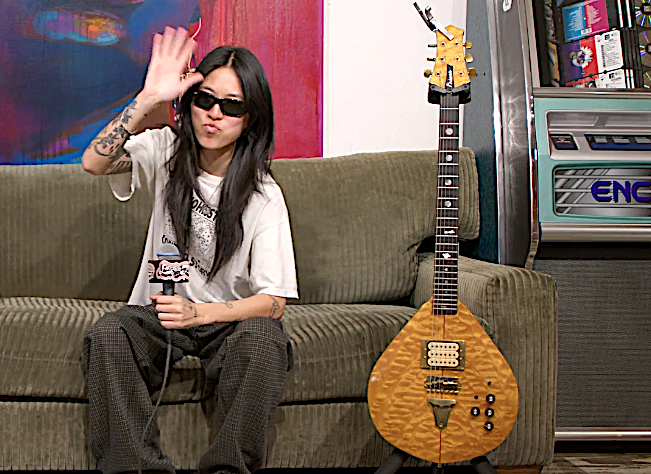
Deb Never poses next to Prince’s guitar
Deb admits that she still deals with imposter syndrome, saying, “I just feel inadequate. … One of my biggest insecurities is playing guitar because I don’t think I’m a good guitar player, since I was a kid.” And she still describes her playing style as “self-taught,” after all this time, because, as she chucklingly explains, “I don’t know chords. I technically don’t know keys. I don’t know notes. I don’t know shit! I’m just playing by ear. So, when someone’s like, ‘Oh, can you play the C-sharp’ or whatever, I’m like, ‘I don’t know what that is. But play it for me, and I’ll figure it out.’”
When Deb decided to stay in L.A. to pursue studio work — it should be pointed out that if other artists were so willing to hire her for their sessions, then she’s absolutely not an “inadequate” guitarist — her parents harbored even more doubts than she once had about music becoming her full-time career. But just like that time at age 13, when she convinced them that organized religion wasn’t for her, they let her find her own way, and she feels “very, very lucky for that. … It was mostly my mom a lot of my life, but she was very understanding of me and what I wanted to do or what I believed in. She was just kind of like, ‘Whatever, OK. You’re going to do what you’re going to do.’ … My parents for some reason have been very lenient. I think in the beginning they didn’t understand — same as me. ‘What are you doing with music? How are you going to survive?’ But I was just like, ‘I’m going to figure it out.’”
That whole “figuring it out” attitude obviously figures heavily in Deb’s story. Looking back on working for two years — a much longer creative process than usual for her — on Arcade, and the whirlwind of four EP releases and nomad living that led up to the album, including spending five months in her “second home” of London during the COVID-19 pandemic, she muses: “I feel like it’s one of those things where you just have to jump into it. You know when you learn how to swim and your parents just push you, and you sink or swim and survive? That’s kind of how it felt when I got pushed into [music]. And then I just had to survive. I think I was on this snowball of constantly having to release music and not having really any time to think about what I wanted to make, so for the album I kind of disappeared for a couple years. I needed that time to catch up with myself, because it had been nonstop.”
Deb approached making Arcade with “intentionally less production,” going back in some full-circle ways to her stage fright-stricken coffee shop roots as she placed her vocals more front-and-center than ever. “It was really vulnerable and exposing for me. But I wanted that,” she asserts. “I wanted it to feel like you’re in the room with me when you listen to these songs.”
One Arcade track, “Deign,” was so vulnerable, however, that Deb actually considered taking it off the album. While she’s reluctant to get too in-depth regarding the song’s backstory, she notes, “I think you could probably pick up from lyrics what I’m talking about.” Some of the most telling lines include: “Remove the pressure from the room/One hit could knock the wind out/Too young to notice that my lips are turning blue/Laying with my face down/Think I finally found some peace that afternoon/Didn’t want it to end/If I ever come down, will I feel this good again?”
“It was purely just like, oof. You could hear everything that I’m saying about a certain thing, and I’m like, ‘Eh, I don’t know…’” Deb says, when asked why she considered leaving “Deign” off Arcade. “I think that was the most exposing for me, because I don’t think I’ve ever talked about my past, whether it was drugs or life experience. That was the first song where I didn’t talk about love or relationships. It was just a very specific moment of something that happened in my life.”
Deb also tapped into her long-held agnosticism on “Deign,” contemplating at one point, “If there’s a God, why does He only talk to me when I’m high?” But she says it’s Arcade’s slightly “Purple Rain”-esque heartbreak ballad “Heavensake” that has garnered the most fan feedback. “It’s a yearning song about somebody. And, oh — actually the chorus has to do with maybe the God thing!” she points out. “The chorus is literally: ‘Heaven’s so far away/I don’t believe in a god/But tonight I think I’ll pray.’”
Deb says she’s “more like spiritual” these days, but whether it was kismet, divine intervention, luck, talent, hard work, or a combination of any of the above, it seems Deb’s prayers (or dreams) have been answered when it comes to her blossoming career. Besides releasing a critically acclaimed album (which will later come out as a deluxe edition, featuring all-star collaborations to be announced), she has mostly conquered her shyness through music, she has her own Arcade-themed video game, and now she can even add “played Prince’s guitar” to her ever-lengthening list of accomplishments. So, now there’s only one (game-related) prayer that needs to be answered.
“My favorite video game right now is Fortnite,” Deb says. “I would always make a joke. It’s not a joke, though! I’m so serious about this: Once I get a Fortnite skin is when I’ll know I’ve made it, literally. That’s when I’ll stop.”