
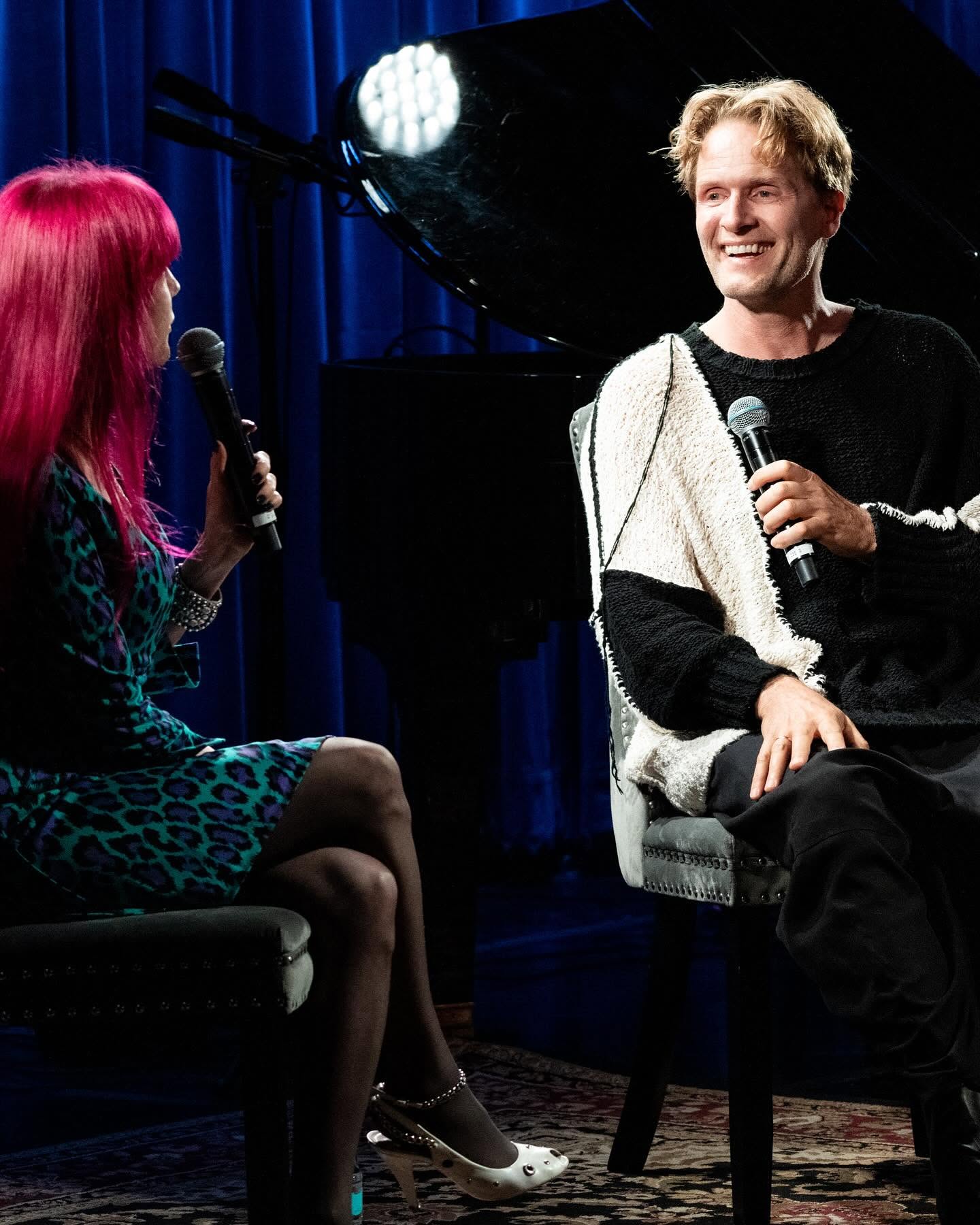
Toby Gad in conversation at the Grammy Museum (photos: Timothy Norris/Getty Images)
Toby Gad has co-penned some of the most enduring pop hits of the 2000s, including John Legend’s “All of Me,” Beyoncé’s “If I Were a Boy,” Fergie’s “Big Girls Don’t Cry,” and Demi Lovato’s “Skyscraper” — the artistic process of which is detailed in his new behind-the-scenes coffee-table book, Becoming Toby Gad. But becoming Toby Gad, songwriter to the stars, wasn’t an easy evolution.
From forming two adolescent bands with his older brother (with whom he often butted heads), to contributing three tracks to the infamous first Milli Vanilli album All or Nothing (only to have those songs replaced on the revamped U.S. version), to struggling for years in a “prison cell” of a New York City apartment after moving from his native Munich, Gad hustled hard to get where he is. But his all-or-nothing strategy eventually paid off.
Gad sat down with me for a delightful, discography-spanning discussion at a star-studded Grammy Museum event celebrating his career, available in the edited Q&A below. He dished about all of the above, and much more — including how he got over impostor syndrome and stopped worrying about being “cool”; his successful sessions with the Veronicas, and Jessie J; his “most embarrassing story,” which took place a decade ago at Clive Davis’s Pre-Grammy Gala; and even the wild five weeks he spent with Madonna crafting her Rebel Heart album. (Yes, this is the man responsible for “Bitch I’m Madonna,” the song in which the pop queen demanded respect long before her Confessions II renaissance!)
To loosely quote Madonna: Bitch, he’s Toby Gad.
LYNDSANITY: Let’s start from the beginning, because I feel like you were born to do this. You were born into music. Your parents had a band, the Jazz Kids…
TOBY GAD: Yes, I think already in the womb of my mom, I learned all their repertoire. It was a Dixieland jazz band and they had about, I don’t know, 40 or 50 songs. And I think in my mom’s womb when they were playing these songs, I really memorized everything. I guess back then I decided I want to be a songwriter.
Didn’t they want you to join the band? They wanted you to learn how to play banjo or something like that.
Yeah, I hated banjo! I wanted to play piano, but they already had a piano player with my mom, so there was no room for me in the band. My brother played drums as a young kid; he was already the drummer of this band. But then early on, my brother and me, we started doing our own songs, playing during the intermissions of my parents’ gigs. And when my parents went back onstage, we went through the audience and said, “We’re collecting money for us. Do you have some?” And from that money, I bought my first Smurf Village, which was incredible. I felt rich.
Did you ever do any music for any of the Smurf films or TV shows later on?
No, that’s still on my bucket list, I guess.
Tell me about Q, the band you started with your brother Jens. You guys were quite young.
We were first called the Gad-Rollers. This was our first television show. I must have been 10 or 11. The music wasn’t very good, but we had fun.
How did you end up on television at such a young age? The footage from that show kind of has an Osmonds/Partridge Family vibe.
Well, we played wherever we could and for anyone who wanted to listen to us, and I guess someone called my dad and said, “Do the kids want to be on a TV show?” We were on three radio shows and quite a few TV shows too. It was a lot of fun.
It seems there was never really any possibility you were going to go into anything else. Did you ever consider a different career?
When I was 10, on one of the radio shows they asked me, “What do you want to be when you’re grown up?” And I said, “I want to be an ice cream salesman, because then I can eat ice cream!” I mean, that shows the level of education of a 10-year-old from so long ago, compared to now when you just have the knowledge of the world on your phone. I was so dumb back then.
Obviously you weren’t that dumb, because you knew this was your calling! You and Jens later formed a more grown-up band, Q. When did Q get a record deal and start putting out music?
We always felt we were close to it, but it took many years until we actually got a real record out. I think probably one of the first records was with Peter Schilling at the time…
As in the “Major Tom” Peter Schilling?
Yes. That wasn’t our song, but we had the B-side of the follow-up single. That was our first record that came out. I was 15.
Peter claimed that he didn’t know the David Bowie song about “Major Tom”…
Not possible.
I know! Did you ever ask Peter about that?
No, never. He was so upset because we were wearing these neon clothes and we actually got them [from being] sponsored by a surfwear manufacturer, and he felt so [underdressed] because the camera was just on our crazy [clothes]. We had the stupidest outfits.
How did you link up with Peter Schilling?
There was a guy who let us have his studio, my brother and me, when he wasn’t working. And he wasn’t working anymore — he started drinking and doing a lot of stockbroking. He had one of these Fairlight [synthesizers], which was one of the $100,000 computers at the time, and we were able to use it. We dreamt of making our own record, and he was producing that Peter Schilling record.
Q eventually put out one self-titled album. You were working with the legendary and notorious Frank Farian, who’s probably best known as the man behind Milli Vanilli. How did that come about?
We heard from a friend that Frank Farian, who had just had a hit on the radio with “Girl You Know It’s True” with two dancers who didn’t sing — which we didn’t know at the time — needed songs for an album that had to come out in like a week from then. I don’t know, it was some Coca-Cola promotion deal where he had to deliver an album really fast. And we were lucky. We sent the songs in and an hour later, or very quickly, we got the call that we had to come to Frankfurt to record three songs. And then a week or two later, the album was No. 1 in the charts. And that was Milli Vanilli.
Whoa. So, you had three songs on the first, controversial Milli Vanilli album?
Yes, the European version [titled All or Nothing], not the American one [Girl You Know It’s True].
Did you do any singing on your tracks?
No, the other people they’d hired did the singing. They said, “These two boys don’t want anyone in the studio when they sing!”
Did you know, or at least suspect, that Rob and Fab didn’t actually do the vocals?
Oh, we were just happy to have a record out! And then I went to Thailand, I remember, and I heard it on the radio and I was like, “Wow.” To hear your own song in a different country on the radio is such an insane feeling.
Which were your three Milli Vanilli songs, by the way?
“Boy in the Tree,” “Is It Love,” and “Can’t You Feel My Love.” Not very good songs.
Well, it was a pretty wild start to your songwriting career. How did you react when the lip-sync scandal went down and Milli Vanilli’s Grammy was taken back? You were young and new in the business, and suddenly you’re witnessing all this craziness.
At the time, Frank Farian was one of my early mentors; for seven years, I worked with him at his studio quite a bit. He had a heart attack just before that thing with the Grammys happened. He couldn’t even hear the words “Milli Vanilli” anymore. He had to come to America to accept a Grammy, which was all he ever wanted, but it was all a lie. … At the time they told us there’s problems, and we were totally on the other side. We were kind of “Camp Frank.”
But didn’t the Milli Vanilli scandal tarnish your reputation in the business in any way, or were you afraid that it would?
We had no reputation at the time! This was amazing! … No, I was super-proud, because people loved the music. And you could just separate the music from the scandal and all of that.
Tell me about the Q album.
It was our big dream to have a record together, but we were just fighting all the time and couldn’t wait to separate. There were radio interviews where [Jens] said one thing and then I proved him wrong right after.
What is it about brothers in bands? There’s Oasis, the Black Crowes, the Kinks… a long list of feuding brothers in bands. Why did you and Jens have that friction?
We had no respect for each other. He was really talented, a great musician. We could have really done so much together. It just didn’t happen. … We did a second [Q album] that never came out.
Is Q’s debut album from 1990 in print or available to stream?
And how do you feel it’s held up?
It’s embarrassing. It’s not good. I still had a thick German accent, but we were trying to sound American, I guess. And the lyrics are not good either.
So, you decided to go solo.
Yes, my big dream was always to come to America. In Germany, to listen to music that comes from America is like listening to something that’s the truth, that’s so unreachable and everyone tries to copy it. That was the holy grail. It took me 10 years until I finally dared to move to New York. My apartment had a toilet in the corner. It was more like a prison cell. … It took me three years before I really made money. At the end of the first year, I was running dry on money because some money was held up, and I lived for months on instant soup and bagels. It was pretty tough. … But it didn’t matter. It was all about the music.
When you moved to New York, was it with the intention of being a songwriter for other artists?
Yes. Well, after that Q record. I did an album myself and I spent a year recording all the live instruments, and then when it was finished, I made demo cassettes. I looked at the best managements in London and I sent these demo cassettes to 20 of them, and a month later I had 10 of them returned and I thought, “Wow, 10! There’s hope!” So, I went to London and knocked on the doors of the ones that hadn’t sent them back. And one by one, rejection after rejection. Some of them said the songs were good, but nobody liked my singing or my voice. So, that was the end of my singing career.
Obviously the Milli Vanilli thing was a bit of a break, but as a songwriter in New York, what was your real first success?
In 2002, I had the chance to work with a girl who had just left a girl group called Wild Orchid [Fergie]. She came into the room in tears, and I was wondering what’s wrong. She said, “I just broke up with my long-distance boyfriend.” I said, “Did you love him?” She said, “Yeah, very much.” I suggested maybe she write him a goodbye letter and explain why she broke up with him. She was sitting down on the carpet with lots of papers around her, and she started writing. A little bit later she hands me this thing she’s written. I read it and it says: “The smell of your skin still lingers on me now/You’re probably on your flight back to your hometown/Fairytales don’t always have a happy ending, do they?” I felt chills, and I got the guitar out and said, “Can we maybe sing this to these chords?” She sang this very unorthodox melody. Then for the chorus I suggested a melody, and the words were just flowing out of her; it was everything very personal to her. We got through the chorus at the end, and it was just a lot of words and nothing repetitive or memorable. I usually have a clipboard with titles I collect, and I had written down “Big Girls Don’t Cry” somewhere. I saw it and suggested it to Fergie. And she thought that was the perfect ending for the chorus. And so, we wrote “Big Girls Don’t Cry.” It still took years and years and years [for it to come out]. After this, she joined the Black Eyed Peas.
You two held onto that song the whole time? Until 2006?
Yes. Well, I recorded it with two other artists, but they fell through as well. There was Meleni Smith on Columbia Records, who got dropped before her album could come out, and then with Jordan McCoy from Dream.
I guess it all worked out.
Yes… and it wasn’t [Fergie ‘s] first single. It wasn’t her second. It was her fourth single! And it ended up being her biggest song — and the song that put me on the map. She was already on the map by then. She was a superstar by that time.
Didn’t you work with a few other rising Y2K pop stars before “Big Girls Don’t Cry” came out?
Willa Ford was one of the first I worked with. We had a song called “Fuck the Men (A Toast to Us).” … It wasn’t big, but it was one of my first records in America. I was very proud of it. There were lots of records, but maybe the first one that got on the radio was Jaci Velasquez’s “Unspoken.” Madeline Stone was a songwriter who took me under her wing early on, and she had a friend, Orrin Hatch, who was a senator. I never met him, but he added some lines to it and pitched it to Jaci Velasquez. And it was in the Christian radio charts for six months.
I’d love to do a lightning round of some of your biggest hits. Let’s start with Beyoncé’s “If I Were a Boy.”
So, in 2007, “Big Girls Don’t Cry” was the ASCAP Song of the Year. I thought now that everyone has heard this song, Beyoncé must’ve heard it too! I tried to research who’s her manager, who knows her. It took me six months until I finally got the call that Beyoncé wants to work with me. She booked me in Jay-Z’s studio for six days, and the first day, she didn’t show up. Second day, no. Third day, she briefly walked in and showed me a few of her demos that she had done. One of them was “Single Ladies,” which floored me — I thought, “Oh my God, the bar is high!” And then the next day she came in and I played her a song that I had just written with an artist named BC Jean, who’s a very good writer. I met her on Myspace.
BC Jean and I had written this song, and Beyoncé listened to it and said, “Play that again, Toby.” I played it again, and then she stood up and says, “You won’t believe this, but I want to sing this song right now!” We got in the vocal booth and I recorded her for an hour and a half, and she sang every take maybe five, six times. She was in incredible control of her voice and such a boss. Then after that, we sat at the couch for another half-hour. She asked me about my family, and I showed her how to play the song on the guitar, and it was just a wonderful time. And that was the last time I ever saw Beyoncé!
That’s too bad, although that song has been recorded by other artists too. Reba McEntire had a hit with it. Alex Newell sang it on Glee. Mickey Guyton covered it. But let’s move on to “All of Me” by John Legend, which is not only your biggest hit, but overall the fifth-highest certified single in RIAA history.
I must say, I’d always wanted to work with John. And after three years in New York, I found my first manager, David Sonnenberg, who was instrumental to my career — a real pitbull manager, respected everywhere, great guy. And he managed John Legend early on. I said, “Why can’t I work with John?” David said, “John doesn’t want to work with you.” I was kind of the European pop kid, and John was the Philadelphia neo-soul, cool Kanye West guy. After “Big Girls Don’t Cry,” I kept asking, “Can I work with John?” And John still didn’t want to work with me! But after Beyoncé, finally John says, “OK, I’m going to work with Toby.”
I think [“All of Me”] was the third song we wrote, and that day he came into the room and went straight from the door to the piano, which is rare. He said, “Toby, I have an idea. I need to write a love song today.” And he sat at the piano and was like, “All of me, loves all of you…” And he said, “That’s all I have.” He didn’t know what to do next. I said, “Can maybe I sit at the piano?” So, we traded places, and I was thinking of my wife who I love very much, and I thought of her “edge and curves and imperfections.” And then he was like, “I’ve got to get back to the piano!” We were going back and forth; it was really exciting. I think in an hour or an hour and a half, we had finished the song.
Does your collaborative process vary a lot from artist to artist?
I do like to start the song with something that is authentic and urgent to the artist. With “Big Girls Don’t Cry,” that’s just out of Fergie’s journal, basically. BC Jean in the moment just really felt this: She thought if she were a boy, she would be a better man. And with John, he was so in love with [his future wife] Chrissy [Teigen]. I think at the Grammy performance from John, there’s a moment where they caught him looking at Chrissy — they had them both in the [camera] frame. At the time the song had been in the urban chart and kind of got stuck there, but from that moment on, it started climbing in the pop chart; it was the second-slowest climb, I think, in the history of Billboard. It took six months to go No. 1.
Obviously you’ve had so many hits, but what do you think it is about “All of Me” that made it your biggest one in your entire discography?
My music was never “cool,” and for the longest time I wanted to be cool and trendy. And I just never managed to be that. These are kind of, I don’t know, old-fashioned or timeless or just simple songs, that aren’t necessarily beat-driven or anything. But maybe that’s why they survived.
Why didn’t you feel you were cool? And why or how did it eventually become no longer important for you to chase coolness?
It’s kind of a simple question that goes very deep, because my brother early on was kind of the older one who was better at everything, until I was maybe 12, 13. I was always trying to catch up, and he was getting the pretty girls and he was the one who would play in the band with my parents. I guess it was imposter syndrome. Or second-sibling syndrome.
Jens still does music as well, right?
Kind of, yeah.
Ha, OK. Let’s move on to “Skyscraper” by Demi Lovato. Here’s another very personal song, deep, and meaningful song. Demi seems to be in a really good place now, but she’s had many trials and tribulations in life. She’s the kind of artist that her fans root for, and then she released this triumphant anthem of the spirit. How did “Skyscraper” come about?
Lindy Robbins is a songwriter I love writing with. I’ve written a lot of songs with Lindy. Lindy is an amazing songwriter. And that day she came into the room with [Estonian pop artist] Kerli, who was signed to L.A. Reid at the time. She was cool. So, I always teased Lindy and would say, “Why don’t you come in the studio with a list of titles or some ideas?” And that one day she said, “I have a title, and it’s ‘Skyscraper.’ I was like, “Skyscraper?” I just didn’t think that was a word that you could sing in a song. We were trying a little bit on the piano, and… when these words came up, I thought, “Wow, we have an amazing song.” But until then, I thought “skyscraper” was the dumbest word ever for a song. A lot of that lyric is Lindy’s genius, I must say.
Was Demi involved with the writing, or was this something you presented to her?
This song was for Kerli. And she showed it to L.A. Reid and according to Kerli, they threw that record in the trash bin and said, “This is horrible. We’re going to drop you.” And she got dropped! We recorded [“Skyscraper”] with Kerli as a demo, and then Jordin Sparks recorded the song too in the meantime. And her label wasn’t going to have her have it on the record, [even though] she’d killed it! And then Benjamin Grofff at [music publishing company] Kobalt at the time played it to Jon Lind. Bless John Lind. He passed. He was an amazing A&R person. And Jon Lind convinced Demi that this was going to be her first single off her new album — which is rare, to have a ballad as a first single.
Did the song’s message resonate with Demi?
Yeah, Demi came into the studio and she was sitting on the edge of the seat. She said she was going to rehab the next day or so, but she’s going to give it a quick try. And she sang it and she poured her heart out. We were all sobbing. It was so brutal and excruciating. And then she went to rehab, and she came back two or three weeks later and said, “Toby, I feel great. I want to sing this again!” We spent three days recording a “perfect” vocal — and it had no emotion. So, we went back to that first “excruciating “vocal performance. I believe in first-demo magic.
Let’s talk about another female empowerment anthem that you cowrote with Shelly Peiken, Jessie J’s “Who You Are.”
Jessie at the time was an unknown. All we knew that she had just got signed to Universal Republic and had done this incredible audition where she sang “Mamma Knows Best.” That blew me away. Jesse came into the session and I saw a little tattoo lurking, and I said, “Can I see that?” And she pulled the pants down a little bit and it said, “Don’t lose who you are in the blur of the stars.” And it was misspelled! I said, “First of all, why do you have such a big tattoo — and then it’s not even spelled right?” And she’s said it was her first time coming to Los Angeles and she was worried that she would lose herself in Hollywood amongst the stars. So, it felt right, and that led to the song “Who You Are.” We wrote it then.
Did Jessie get the tattoo corrected?
No, it’s still there.
Let’s discuss “Untouched,” by Australian sister duo the Veronicas. This is actually one of your more upbeat songs.
That’s my coolest song!
It’s definitely the Veronicas’ biggest hit in America.
It went double-platinum in America, but in Australia when they perform it, the crowd goes crazy. They know every word. I’m proud of this one. At the time Veronicas were a new signing and David Sonnenberg said, “They only work with Max Martin and the big shots. … If you follow them to Australia on their Christmas break, maybe they will write with you.” So, I booked a ticket to Australia, and the moment I landed in Sydney, the girls knocked on the door and said, “Toby, we’re ready to write!” I was super-jetlagged, but they really just wanted to quickly get it over with, so they could go to Brisbane and spend Christmas with their parents. I had to really convince them for every little bit that we would write together, but we ended up writing 10 songs and hit it off. I had three songs on their first album and then there was the second album, which I would say is the fastest album we’ve ever written — in two weeks we wrote 13 songs, and I think 11 were released from those. And “Untouched” was among them.
You’ve done many songs with the Veronicas, so what was it about “Untouched” that made it their biggest international smash? Was it the lyrics again? I feel like the lyrics have a lot to do with why people connect to your songs.
Funnily enough, in this song, the lyrics don’t really make a lot of sense! And the verses are kind of crazy. When I had the idea for some of the chorus words, I thought of the Rolling Stones’ “(I Can’t Get No) Satisfaction.” I don’t know if you hear any similarities, but for me, that feel led to this hook. I had prepared a lot of tracks for the Veronicas because they had very clear ideas of where the second album was going to go, very much like Muse and a lot of more heavy rock bands, so this was one of the tracks I had prepared before the session. I was just humming this melody and they loved it. Writing with them those two weeks, that was magic. Everything went so quick. And the third album took four years!
Do you find it easier to write ballads or upbeat pop jams?
Well, with a ballad, I can just play it on the piano and we can sing along, and it can have a great emotion. I think with [upbeat pop], we have to do a track and I have to program it, and it has to be cool and trendy. I feel more challenged if it’s with a rhythm. And then sometimes there’s another person in the room who is better at that than I am.
I don’t know about that, but there is a very cool artist that we must discuss. You spent five weeks with Madonna working on Rebel Heart, and you cowrote 11 of that album’s 20 tracks — including “Bitch I’m Madonna,” which is most definitely not a ballad! What was it like working with the queen of pop?
Well, it started when Neil Jacobson from Interscope asked if I want to do a writing camp for Madonna. I usually always said no to any writing camp, because you sit in some dark room and give your best ideas and the artists never show up. And that also happened! I was at Interscope for a whole week writing lots of ideas with writers, and Madonna did not show up. And the next week Neil calls again and says, “Do you want to do a writing camp with Madonna in New York?” And I was like, “Fuck no!” But then he called my management and said, “Toby must come. Madonna really wants him to come.”
They persuaded me, and the first day she showed up, [songwriters] MoZella and S1 and I had prepared some ideas. … She would come a few hours later, but first the assistants would come and put in incense and candles, and declare the bathroom off-limits. Everything has to be really nice and the lights get dimmed. And then finally she walks in and everyone’s trembling — there are rumors that if she doesn’t like you or you say something wrong, she will excuse herself to the bathroom and then someone will walk out with a ticket and say, “Here’s your ticket. You’ve got five minutes to clear the room. She does not want to see you anymore.” So, we were all terrified. But luckily, she liked that first idea we had prepared.
What was that first idea? What song did that become?
I think it was “Iconic.” I thought, “Madonna’s iconic, so let’s write a song called ‘Iconic.’”
You ended up being all over Rebel Heart, so I guess Madonna liked a lot of your ideas.
Yeah, we did a lot of songs. … It was a lot of work. On the second day we wrote another song; I think it was “Illuminati,” because there were speculations on the internet. Then it came time to record Madonna these three demos; I was at the mixing board and she was in the vocal booth. Madonna, as much as she’s an incredible performer, and I thought vocally, if we try harder, maybe she can make it more emotional and make it better. And so, she sang it a few times and I was like, “OK, now sing it with more emotion and put more grit to it.” And at some point she was like, “Fuck you, Toby. I’m not singing this anymore.” And I was like, “Fuck you, Madonna. You’re going to sing this now.” And there was silence in the room, and I was waiting for her to go to the bathroom and for someone to hand me the ticket. But that didn’t happen. She started smiling, and from that moment on, something happened and we bonded.
It seems like she respected you, not only because you knew what you were talking about, but because you stood up to her. You weren’t a yes-man.
She was so sweet. She invited us to her birthday party in France and wanted me to go on tour with her, which I really wanted to do. At first I said yes, and then she said, “OK, the next two weeks we’re going to rehearse for the Grammys.” And then I thought, “Wow, every day I need to play the same song, the same bit.” And I just cannot do repetition. For me, it’s all improvisation. I can’t even read notes. Everything’s always different, whichever way I feel it at the moment. So, I was a complete mismatch to play with her on tour, and I canceled.
Can we talk specifically about “Bitch I’m Madonna”? It’s such snarky and silly song, and the whole idea of it is just so fun.
That was a track that Ariel Rechtshaid and Diplo brought in. They had already started a few bits and couldn’t finish the song, and I had the challenge to look at those half-finished songs and tell Madonna, “These lyrics aren’t great yet. Let’s try to do this better.” She was like, “No, I like it.” I said, “No, let’s try it again. We can fix this and make it better.” That probably one of the hardest songwriting challenges for me, to tell Madonna that she could do better.
But again — she didn’t give you the ticket! Was there any reason why she wanted to do this song, which was sort of a reclamation of her legacy, demanding respect?
Well, there was some alcohol involved in the session. I remember she was finishing the bottle and Diplo took a photo and posted it in that moment. Until then, we’d kind of had an agreement that no one’s going to post anything, but he didn’t care. He was getting very famous at the time.
Did he get a ticket after he did that?
No. It’s Diplo!
OK, then. Are there any other songs that you’re really proud of that you’d like to discuss?
No, but do you want to hear my most embarrassing story?
Absolutely!
I had just changed management [around 2016/2017]. … I’d switched to the management that managed U2 and Madonna. David Sonnerberg had always gotten me into the Clive Davis’s pre-Grammy party, so I asked the new management, “Are you going to get me in?” And he said, “Sure.” And then a day before the party, I said, “Where’s my [party] ticket?” Usually, I got a ticket by this point. He said, “Just see me at the door.” So, I was there at the party and people were about to walk in, and I couldn’t find him. Finally I see him, and he acted like he didn’t want to see me. I pushed myself in front of him and he’s like, “OK, OK, just wait a minute.” He went somewhere and brought back a little piece of paper where he wrote a number and said, “That’s your ticket.” I walked through the door and sat down at the table with that number, and then after some talk and some food, the lights went dim and the show was about to begin. I was sitting next to Pharrell and Ryan Tedder — everyone who was somebody was at my round table in the front row — and then security walks in. They started checking Pharrell; he showed his ticket. Ryan Tedder showed his ticket. Me, I show this little piece of paper. And security walked me out, in front of everybody who was somebody at Clive Davis’s party.
Oh no! Well, I’m sure you’ll never get kicked out of any Grammy parties ever again. And you don’t have much else to be embarrassed about, with your stellar career. You’ve worked with so many greats. But who are some dream artists that you’d love to write with or for one day?
[That answer] has actually changed quite a bit now, because now I really enjoy being onstage. It’s brand-new for me in my old age, to be onstage as a “new artist “and perform with incredible singers. … I want to do that more. David Foster is a great inspiration — what he is doing is insane, filling out the Hollywood Bowl for his 75th birthday just recently with [famous guest] artists. I’m very inspired now to work with people who also like to perform with me — and that is very different from back when I would write with anyone who’s a household name.