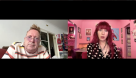


They say every picture tells a story, and that a photo is worth a thousand words. But no one tells a story quite like legendary photographer Henry Diltz, who had fans hanging on his every priceless word when he recently sat down for two career-spanning “Vinyl & Vision: The Golden Era of Rock ‘N’ Roll” live Q&As at Studio City’s Licorice Pizza Records — just ahead of both the 60th anniversary of the Monkees (the TV band whose career he closely chronicled on-set and off) and his own 88th birthday.
“I didn’t go to photo school. I didn’t know how to use lights. I never developed a roll of film,” Diltz revealed with a good-natured shrug during the course of his nearly three combined hours of LPTV conversation. “All I knew was to look through the little hole, and when it looks good, push the button. And then you got it.”
Nothing about Diltz’s career was ever typical. The stepson of a U.S. State Department diplomat, he spent his childhood playing in post-WWII, bombed-out Tokyo and his teen years in Bangkok and Germany, and he’d planned to become a forest ranger before studying psychology and briefly attending West Point. But then the mail-order Pete Seeger albums he got from the Columbia Record Club inspired him to quit West Point after a year, buy a banjo, and move to Hawaii. Somehow this all led to Diltz becoming a member of the Modern Folk Quartet (a supergroup of sorts that also included future Monkees record producer Chip Douglas), and it was on tour with that band, while under the influence of “God’s herb,” that he impulsively purchased a secondhand camera for $20 in a small-town Michigan thrift shop.
And whether it was God’s plan or because of God’s herb, the rest was fateful rock ‘n’ roll history. “On that tour, we had about two weeks driving back to L.A., doing gigs along the way, and we took pictures of each other,” Diltz recalled. Upon the band’s return home, Diltz suggested they throw a slideshow party to watch the results. “When I saw the first slide glowing in the dark, eight feet wide, I said, ‘Oh my God, this is really something.’ That’s when I became a photographer: the first time I projected the pictures to all my stoned hippie friends.”
It was the keen eye for detail he’d developed while living and studying all over the world, along with his knowledge of psychology and ability to capture his fellow trusting musicians in unguarded moments, that helped Diltz launch a whole new unexpected career at the relatively advanced age of 27 (after he sold a Redondo Beach snap of his friends the Buffalo Springfield to Teen Set magazine for a cool $100).
“Look, I was a musician; if you’re a musician, you belong to the club and you know how to hang out,” Diltz explained at Licorice Pizza. “That’s what it was. They were all friends of mine, because I lived in Laurel Canyon as a musician, and so did Stephen Stills and Mama Cass and Joni Mitchell and Mickey Dolenz and all those people. Long before I took pictures, they were friends of mine… so, I wasn’t perceived as a ‘photographer.’ Otherwise, I would’ve gotten kicked out. Photographers are pushy, like, ‘Look over here! Smile! Stand over there!’ I never did that. I would just sit and look at my friends, and when it looked good, I’d take a picture.”
Diltz went on to shoot more than 250 album covers for many of his friends, serve as the official photographer for The Monkees and the Woodstock festival, and even become one of very few photographers to receive a Lifetime Achievement Grammy. And he still did things the unorthodox way, his way, creating several “accidental album covers” (like James Taylor’s Sweet Baby James, which was initially intended to be a black-and-white publicity headshot) and shooting in forbidden buildings that were later torn down (like an abandoned Hollywood house for the Crosby, Stills & Nash rogue album cover shoot, or Downtown Los Angeles’s long-gone Morrison Hotel, where he snapped a quick roll of film of the Doors while the “slumlord” was away from his post for five minutes). A day-drinking session with Jim Morrison on the same afternoon as that stealth Morrison Hotel shoot actually inadvertently inspired the name of the Hard Rock Café restaurant chain — yet another amusing accidental tale that Diltz shared during his Licorice Pizza Q&A sessions.
Even Diltz’s arguably most famous portrait, of David Crosby aiming a prop American-flag pistol at his own head, was unplanned. Diltz was simply hanging with CSN&Y and Bob Dylan at a Minneapolis hotel room afterparty when Graham Nash handed Croz a toy gun — a random gift from a fan. And Diltz saw something that looked good, as he’d put it, and he instinctively reached for his camera. “I just took a couple of shots. Click, click, click, bang, and that was it. Just a total accident.”
During his two delightful conversations, Diltz also discussed how his jungle-themed, Grammy-nominated cover for Richard Pryor’s debut comedy album nearly got him sued by National Geographic; shooting what turned out to be the Mamas and the Papas’ final album cover; touring with troubled teen idol David Cassidy at the height of Partridge Family mania; getting high on a “basket of peyote buttons” in Joshua Tree with the Eagles, then engaging in a deep (if one-sided) chat with a few friendly cactus plants; literally riding through the desert on a horse (albeit a horse that did have a name: Frank) to photograph the band America; that time noted nudist Peter Tork showed up “totally naked” to a record-executives-packed Monkees tour afterparty at Chicago’s swanky Astor Tower; the one artist who was difficult on set (hint: his name rhymes with “Ron Gone Hovey”); the one living artist Diltz still wants to photograph (hint: her name rhymes with “Sailor Rift”); and one goosebumpy career highlight when, during an iconic Life magazine photo shoot at Paul and Linda McCartney’s Malibu home, Diltz heard the Beatle casually workshop an unreleased ukulele song by the pool.
Diltz exhibited the excitement and energy of a man one-fourth his age, whether he was talking about photographing Jimi Hendrix and Jimmy Webb, or discussing his many lesser-known photos of bicycles, fire hydrants, and especially chairs (he became fascinated with four-legged furniture during an acid trip with the Lovin’ Spoonful in 1966). Watch both Diltz Q&A sessions in full here, and enjoy all of his vivid photographic memories.