
Debbie Gibson has been a workaholic ever since she was a self-starting teenager lugging her own equipment and selling her own merch at club gigs, or somehow convincing a boardroomful of middle-aged, male Atlantic Records executives to grant her creative control. And that scrappy Long Island work ethic has clearly worked for her.
In 1988, at age 17, Gibson became the youngest female artist in Billboard history to write, produce, and perform a No. 1 single, with “Foolish Beat” — a record she holds to this day, although she almost beat her own record when “Lost in Your Eyes” topped the Hot 100 a year later — paving the way for teen singer-songwriters like Lorde, Billie Eilish, Olivia Rodrigo, and Taylor Swift.
Gibson, who in adulthood has dealt with Lyme disease, Epstein-Barr, and other autoimmune issues, is admittedly still figuring out how to manage the perfect work/life balance. (“I take a lot of naps,” she chuckles.) But four decades into her career, she’s ready to dive inro the busy holiday season as she releases the expanded edition of her 2022 Christmas album, Winterlicious D’Luxe, and prepares to fulfill yet another professional dream: playing a December residency at the STRAT Theater in Las Vegas, the city where she currently lives in a home appointed with her prized possession, a six-foot, mirrored grand piano once owned by Sin City legend Liberace.
“Liberace’s piano is definitely coming to the STRAT with me! Jeremy, who runs production for the room, was like, ‘I’ve already planned to put on a security guard costume and sleep under the piano for you, so nobody messes with it,’” Gibson laughs, sitting with LPTV before her Winterlicious autograph signing at Studio City’s Licorice Pizza Records. “I’m kind of crazy. I have the [STRAT] room for four days, so I’m like, ‘Can I throw a matinee in there?’ So, I’m doing five shows in four days. I think I just need to sleep on the stage under the piano.”
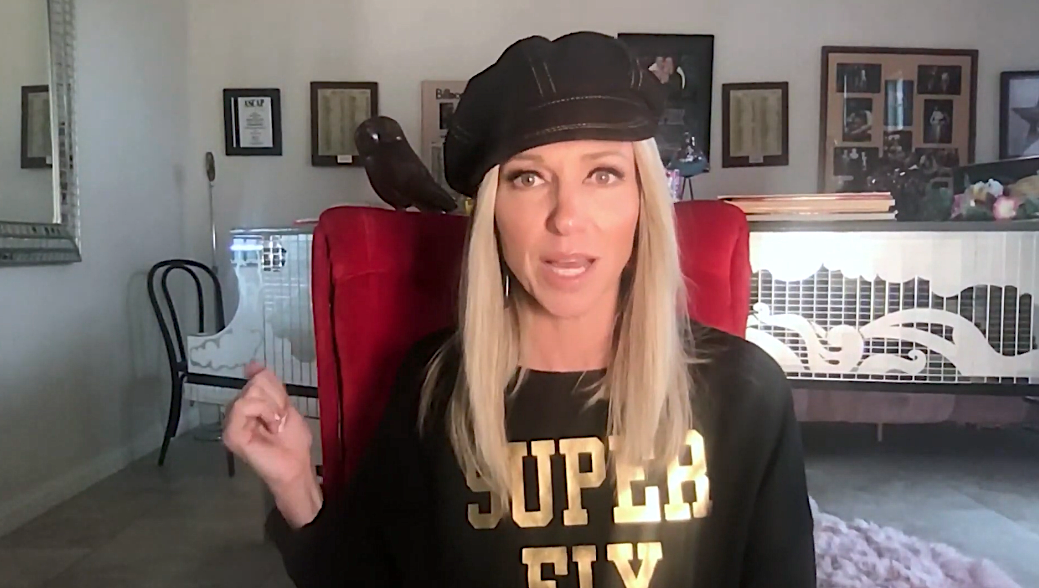
Debbie Gibson shows off Liberace’s piano via Zoom, n the “Totally ’80s” podcast
The now 56-year-old Gibson, along with many MTV queens she came up with in the ‘80s (her “Shake Your Love” video choreographer Paula Abdul, her teen-scene peer Tiffany, Cyndi Lauper, Janet Jackson, and especially Madonna), is redefining what it means to be a female pop star aging, and thriving, in the public eye. And she credits that longevity to a commitment to the showbiz hustle.
“I’m always doing vaudeville to some degree, and I am comfortable in that. I think there’s something about us gals who come from that ‘vaudeville’ club time, who had to get up in the middle of the night to perform and change wardrobe costumes in the car. We did it then, we can do it now, and we can do it again,” Gibson asserts. “I know how to be in the big machine when the big machine is working for me, and then I know how to self-motivate and be the machine when I have to. You have to be able to do both. You have to be able to do the vaudeville version when it’s time. I feel like we all came from a time and place where we built something and we built our fanbase, we built our audience, and those people who were there in those clubs in the middle of the night have not forgotten. Many of them will be here getting their vinyl signed tonight. They’re still with me.”
Gibson acknowledges that as a teenager, she probably had a tougher time than Madonna or Lauper (who were in their mid-to-late twenties when they landed record deals), and that she had to prove herself “a thousand percent” to earn respect from the older male producers, engineers, and musicians she worked with on her debut album, Out of the Blue.
“My late mom, she said to me, ‘You have to arm yourself to the tooth with knowledge, because you’re going to have to flaunt it more than the guys,’” she says of her mother Diane, who served as her manager for the first 25 years of her career. “As a young girl, I had to flaunt the musical knowledge I had.”
Thankfully, a “very, very lucky” Gibson says those studio dudes “were never condescending, and they were never creepy,” although she is well aware that many vulnerable young women in the industry weren’t so fortunate.
“I think back and I’m like, ‘How was I so lucky?’ Nobody has this story from that time,” she says incredulously, wincing a bit. “Like, Ahmet Ertegun was always lovely to me, and I know that there are people that he was not lovely with. That face I just made was my sensitivity to that. [Editor’s note: Music executive Dorothy Carvello has alleged that the Atlantic Records president sexually assaulted her in 1987, the same year as Gibson’s debut album release.] But everybody has different experiences, and I know of the reputation, and I feel for people that did not have that [positive] experience with him.”
Gibson credits her momager Diane with protecting her from the worst elements of child stardom. “My mom and I were glued at the hip, and she used to say, ‘I’m not always going to be popular, but that is not what I care about.’ And so, there were men that were… frustrated by her presence. She, from the great beyond, I’m sure is happy to know that I’ve turned out happy, healthy, mentally healthy. That’s really what she was out for.”
While Gibson emerged from teen idol-dom mostly unscathed, she does look back on psychobilly artists Mojo Nixon and Skip Roper’s skeevy college-rock hit, “Debbie Gibson Is Pregnant with My Two-Headed Love Child” — released when Nixon was 31, Roper was 25, and Gibson was just 18 — with mixed feelings.
“At the time, I think we probably all laughed, but now I look back on it and I’m like, ‘That’s kind of mean,’” she admits. “I always had a really good sense of humor and I was a good sport, but I also kind of didn’t understand it. It felt a little bit like, ‘I think he’s having a laugh at my expense, and I’m supposed to feel like that’s cool and I don’t quite get it. But I’ll go along with it.’ So, it was a whole lot of emotions.”
However, shortly after Nixon and Roper’s novelty song cracked Billboard’s Modern Rock chart, Gibson did receive an in-person apology from the ‘80s It Girl who’d portrayed her in the song’s 120 Minutes-popularized music video.
“I ran into Winona Ryder in the restroom at MGM Grand Air, which was the airline everybody flew, that went out of business because it was too expensive for them to fly 30 celebrities across the country,” Gibson laughingly recalls. “It was pretty funny and very glamorous — I mean, I met Sammy Davis Jr. in that lounge! And Winona was like, ‘Oh my God, oh my God, oh my God! I hope you didn’t get offended!’ She was so sweet. … I was flattered, though! I was like, ‘You played me?’ I actually thought that part of it was cool.”
If having one of the coolest indie actress of all time cosplay as her in a blonde wig wasn’t enough to give Gibson some punk cred, there was also that time when she sang backing vocals on the Circle Jerks’ cover of the Soft Boys’ classic “I Wanna Destroy You.” She chucklingly recalls that when their shared producer Niko Bolas sent her a “fluke invite” to join the punk legends in the studio in 1995, he probably didn’t think she’d take him up on it — and certainly no one imagined that she’d later accept the Circle Jerks’ invitation to perform that song with them at CBGB.
“MTV News was covering [the CBGB show], and I went around the back. They were like, ‘To get to the stage, you have to go around the back through an alley,’” the self-described good sport recalls of the hilarity that ensued. “I’m banging on the door and banging on the door, because they did not unlock the door! So, it was my Spinal Tap moment. I’m hearing, ‘Debbie Gibson!…’ and this punk intro beat is playing. And I’m like, ‘Let me in!’ Oh my God, it was so funny. And then I stage-dove, but headfirst, because I really didn’t know how to stage-dive. I just threw myself into the crowd.”
Spinal Tap moment aside, the Circle Jerks collab was another example of Gibson earning unexpected (but deserved) respect. But unfortunately, even now after her nearly 40 years in the business, that’s not always the case.
“There’s still a boys club,” she sighs, recalling a recent incident where she got a cold reception from an unnamed powerful man at an industry event and thought to herself, “If I were John Mayer and I went up to this person who was a big exec, he would’ve spent a little more time. It’s ridiculous, but there’s a regime, like an older regime.”
That being said, a wholesome recent encounter with the ultimate alpha-male icon, the Fonz himself, reminded her just how far she has come.
“I love Henry Winkler. I just ran into him at Fanboy Expo, and I reminded him of this — but he remembered, because he’s one of those guys who remembers everything. I was like, ‘You were so kind to me and my mom,’” says Gibson, who’d contacted Winkler as a teenager when she was trying to branch out into acting. “My mom and I were just looking to meet with people, just creatively and to get advice, and I don’t know what made us reach out to Henry Winkler. But he took the meeting and he was like, ‘You need to study. You need to learn your craft.’ He was so lovely and menschy. And so, when I recently saw him, I said, ‘You took the meeting!’ And he said, ‘And look what you did with all my advice. You have had quite the career, and I’m so happy for you.’”
Gibson gushes that she’s “enjoying this chapter of my career more than ever,” so after the holiday season and her Vegas run end, she doesn’t intend to slow down in 2027. She’s finally planning to follow-up her acclaimed 2021 comeback The Body Remembers (“I’m ready for that next pop album, for sure”), and she’s still having “weekly pow-wows” with her team in an ongoing effort to convince Revlon to revive her Electric Youth perfume, perhaps in time for next Christmas’s gift-giving season. In 1989, Gibson’s signature cherry-vanilla scent was only the second pop-star perfume to hit the market, following Cher’s Uninhibited fragrance in ’87, and it was so successful that Julia Roberts even tested it on Late Night with David Letterman; vintage bottles of Electric Youth now sell for $150 and up on eBay, and one cologne company has manufactured a dupe to meet current demand.
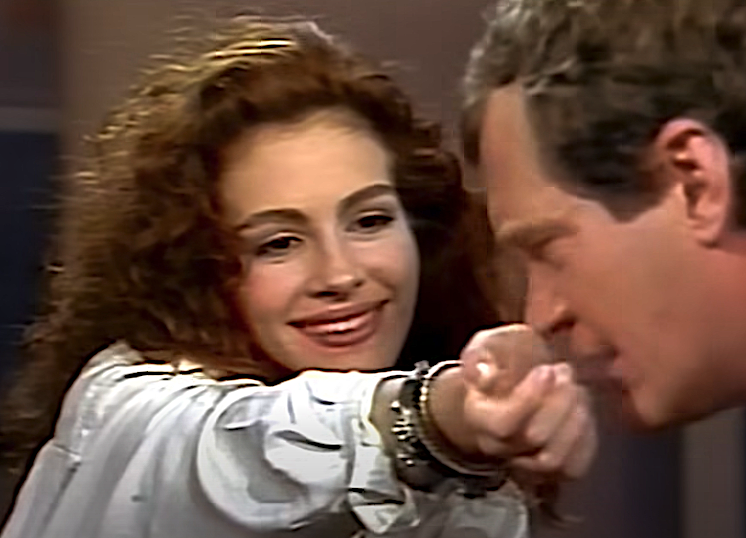
David Letterman sniffs Julia Roberts’s wrist after bandleader Paul Shaffer spritzes her with Electric Youth perfume
Looking back on her sweet-smell-of-success career, Gibson says one of her proudest achievements (besides having her own perfume, of course) was when she recognized by ASCAP as a Songwriter of the Year, alongside Bruce Springsteen, at age 19. “I was proud of my mom for that, because we fought for my creative freedom,” she says. But it’s difficult for her to single out just one career highlight.
“I’m going to give a little more esoteric answer, because the thing in general I’m most proud of is how much I keep bouncing back from things,” Gibson states. “It’s the resilience that I’m proud of. Because it’s that extra lap, when you are exhausted and you don’t know how you’re going to accomplish the things you want to accomplish. That moment where the exhaustion sets in and then the magic happens, and you feel, ‘OK, I did not have the machine doing this, but I’ve conjured up this energy and this strength to do this next lap.’ That’s the thing I’m most proud of.”