

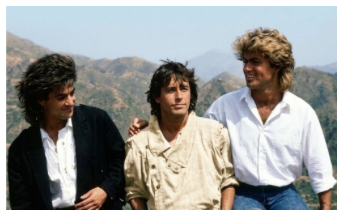
Martin Lewis with Andrew Ridgeley & George Michael
in China, 1985 (photo courtesy of Martin Lewis)
Last week, Wham! 10 Days in China — a new documentary about the British duo’s historic 1985 journey to the East, as the first Western pop act to play Communist China — premiered in theaters. The film is actually a third cinematic chronicle of George Michael and Andrew Ridgeley’s concerts in Beijing and Canton (Guangzhou), following Foreign Skies, which played before Wham!’s farewell concert at Wembley Stadium in 1986, and the shelved If You Were There…, which didn’t get an official public screening until 2024.
If You Were There… was directed by renowned British New Wave filmmaker Lindsay Anderson (If…, O Lucky Man!, This Sporting Life), but was scrapped — and later drastically reedited by music video director Andy Morahan, as Foreign Skies — reportedly because both Wham! and their management thought Anderson’s $1.5 million film wasn’t commercial enough and featured too little actual concert footage. A Guardian feature that ran decades later detailed the clash between the two camps, including Michael blocking the film’s release all the way up until his death in 2016, Ridgeley saying the decision to hire Anderson was “bonkers,” and Anderson disparaging the band and the film in his journal entries.
With Wham!’s Chinese tour back in the news and back in cinemas, Martin Lewis — the producer who came up with the ambitious If You Were There… concept, and hired his “hero,” Anderson, to direct — feels the need to speak out. Lewis (a showbiz lifer who got his start interning for Beatles publicist Derek Taylor, and whose dizzyingly diverse CV includes work with Monty Python, cast members of The Young Ones and Absolutely Fabulous, and far too many A-list rock stars to list here) is quick to praise 10 Days in China director Mike Christie. But he stresses that 10 Days in China “would not have been possible if [Christie] didn’t have 21 hours of stunningly brilliant [Anderson] footage by cameramen who were directed by one of the great British filmmakers.”
Lewis explains to Lyndsanity, “I love Lindsay Anderson, and I feel it’s my duty to stand up for him. I’m proud to do that. And I will do it also because I love Wham!, and I am exceptionally proud of the work I did with them. … [If You Were There… ] is a beautiful, beautiful film. It’s just not a pop documentary. It was never meant to be.”
In the exclusive Q&A below, Lewis gives his account of the making of If You Were There…, including why Ridgeley needed to be fitted for an emergency wig; why a related hair emergency prompted Michael to cancel a pickup shoot at the last minute; how Michael was convinced to be interviewed on camera during a naked massage; how under different circumstances, Michael and Anderson could have become friends and collaborators; what Lindsay’s original vision was; and why Lewis hopes that the famously “litigious” George Michael estate will one day greenlight an If You Were There… home video release.
And along the way, Lewis (a colorful character whose favorite catchphrase is “but I digress…”) shares anecdotes about third-wheeling on a steakhouse date with Michael and a certain ‘80s it-girl; why he went on TV to defend Michael after Michael’s Beverly Hills park restroom scandal; and much, much more.
LYNDSANITY: Please explain what exactly your role was during Wham!’s trip to China.
MARTIN LEWIS: For all my sins, I was the person who instigated the filming of Wham! when they went there. I hired the director, Lindsay Anderson. I pitched the project, and I produced the original film, If You Were There… I also was the listed producer of Foreign Skies, which is the adaptation from that.
It’s interesting that If You Were There… never officially came out, and that most of Lindsay’s footage was unseen and gathering dust in a warehouse until it was given to Mike Christie to make 10 Days in China.
I will say straight off, I’m a big fan of the film that Mike Christie has made. I think he’s done an extremely good job. It’s such a vast story, and I think given how broad the story is, Mike made very good choices about what to focus on. But the notion that it was a mistake to hire [Anderson] is absolutely, factually wrong. And the proof of that is how brilliant Mike’s film is, because Mike’s film is 75 percent, approximately, all footage that was shot by Lindsay. The film Mike made would not have been possible if he didn’t have 21 hours of stunningly brilliant footage by cameramen who were directed by one of the great British filmmakers.
Good point. But the argument has been made by some people — including Andrew Ridgeley — that Lindsay was not the right director for the job, because his film was very slow. Mike Christie described it to me as “ambient.” Basically, Lindsay did not make a pop movie.
It’s not a cutting-edge, fast-paced film. But it wasn’t ever designed to be. “Stately” is what I would call it. My original title for it was 10 Days That Shook the World: A Cultural Revelation. It was always supposed to be all about the cultural revolution — and this was a cultural revelation both ways. I know what the alternative was: The alternative was a music video director, like Andy Morahan. Andy is an extremely good video director and has even made some feature films, but do they match If…, O Lucky Man!, or This Sporting Life? You tell me. The height of Andy Morahan’s filmmaking career is Highlander 3. And Highlander 3 was definitely the third-best of the three Highlander films.
So, sure, you could shoot a bog-standard MTV travelogue and do all the beauty shots — Tiananmen Square, so instead of Club Tropicana, you got Club Tiananmen — but what would it achieve at the end of the day? You’d be preaching to the choir, preaching to the converted. You’d just be making something that would please Wham!’s existing fanbase. But if instead of doing a puff piece or vanity piece, you did a serious documentary about this bizarre cultural juxtaposition, that gets you something different. You’d have a film that could be in film festivals. You’d have a film that would elevate the conversation about Wham!, because at that time they were being considered as just the contemporaries of Culture Club and Duran Duran. This would elevate Wham! into a different dialogue. They would be seen as cultural ambassadors. I wasn’t necessarily thinking that we would win an Oscar, but this would be a classy, elegant film, not a pop confection for MTV — which is why it’s regrettable that this nonsense is being spouted. The band’s management loved this concept.
How did you pitch this high-brow concept to Wham!’s management?
I’d known [Wham! co-manager] Jazz Summers for 14 years. [Summers’s business partner] Simon Napier-Bell was already well-known; he’d been a character in the ’60s, an impresario who’d worked with Marc Bolan and the Yardbirds. Jazz Summers was a nobody, but he was really hard-working. So, the analogy is very simple: Simon was the show horse, Jazz was the workhorse. Fast-forward to February 1985. I’m living in New York and I get a phone call out of the blue from Jazz. I hadn’t heard from him from since the late ’70s when he was managing punk acts, and he’d tracked me down. He and Simon were managing a pop group called Wham!, and he invited me to see them. It was at the Beacon Theater, and they were pretty impressive. We went to dinner afterwards with George and Andrew, who couldn’t have been less interested in two old hippies talking about the good old days. Why would they want to listen to these two boring old guys going on about the ‘60s? So, George and Andrew sat at the table disinterested in us, but Jazz and I started chatting. He said, “Simon and I want to make Wham! the first Western group to go to China.” And a light bulb went off in my head, instantly. I immediately thought of Elton John going to Russia in 1979. I said, “That’s a film!” And Jazz said, “Great. Do you want to make it?” And I said, “Yeah.” That was the development process.
Were George and Andrew sold on this idea?
Well, George and Andrew were just a bubblegum act when Simon and Jazz came around, so that’s how Simon and Jazz treated them. Simon especially was from that era of the Idol Maker type of managers, the Colonel Tom Parker type, where the managers are the puppetmasters; it’s Pygmalion, and the artists simply do what they’re told. The best [Wham!] deal that Jazz and Simon had done up until China was the “Wake Me Up Before You Go-Go” video, which was genius: Wham! were wearing Fila sportswear, a branding opportunity and sponsorship deal that Jazz and Simon pulled together. And guess who told them to put shuttlecocks in their shorts?
Anyway, at that time, George had not expressed that he wanted to be a “serious” artist. He was a bubblegum act, and a consequence of that meant Jazz and Simon didn’t share every detail of their plan. They said, “We’re going to China. It’s a big PR scam to break in America.” That was it. They didn’t say, “We’re going to make a film of it, and we’ve got a good film director.” They didn’t go into granular detail. They didn’t explain any of that. And that’s where the breakdown happened. George and Andrew had a passion for music, for clubbing, for dancing, for fashion, stuff like that, but they didn’t have time to be interested in an auteur film director like Lindsay Anderson. They were just like, “Oh, all right, whatever you say.” And that was the seed of the problem, because there was a different agenda going on. George and Andrew were never in on the plan. When I had the conversations with George years later, he said, “They never told me that. They never told me anything about film festivals.”
It’s my understanding that George and Andrew didn’t want to go to China at all, let alone have camera crews trail them everywhere.
Yes, it was enough that they were having to deal with this tour, but actually the thing that irritated them most — but was an essential ingredient for which Jazz and Simon should be congratulated, not pilloried — was they took the press with them. Jazz and Simon understood that being the first Western pop act in China would be like catnip to the media, but George and Andrew resented having the press with them all the time, particularly because Andrew had become a “bad boy” in both the song title and reality. Andrew was being portrayed as “Randy Andy,” always chasing after girls. Wham! were in the front pages, and at that time, the British media had two things that sold newspapers: Princess Diana and pop stars. The British tabloid media are like piranhas, disgusting creatures; it’s very hard for Americans to understand just how virulent the British tabloid media really are. And they treated George and Andrew with such disrespect, especially for how young they were. Now George and Andrew had to be on a plane, and then for 10 days in China, with the very people they hated. So, there was a tension already set up.
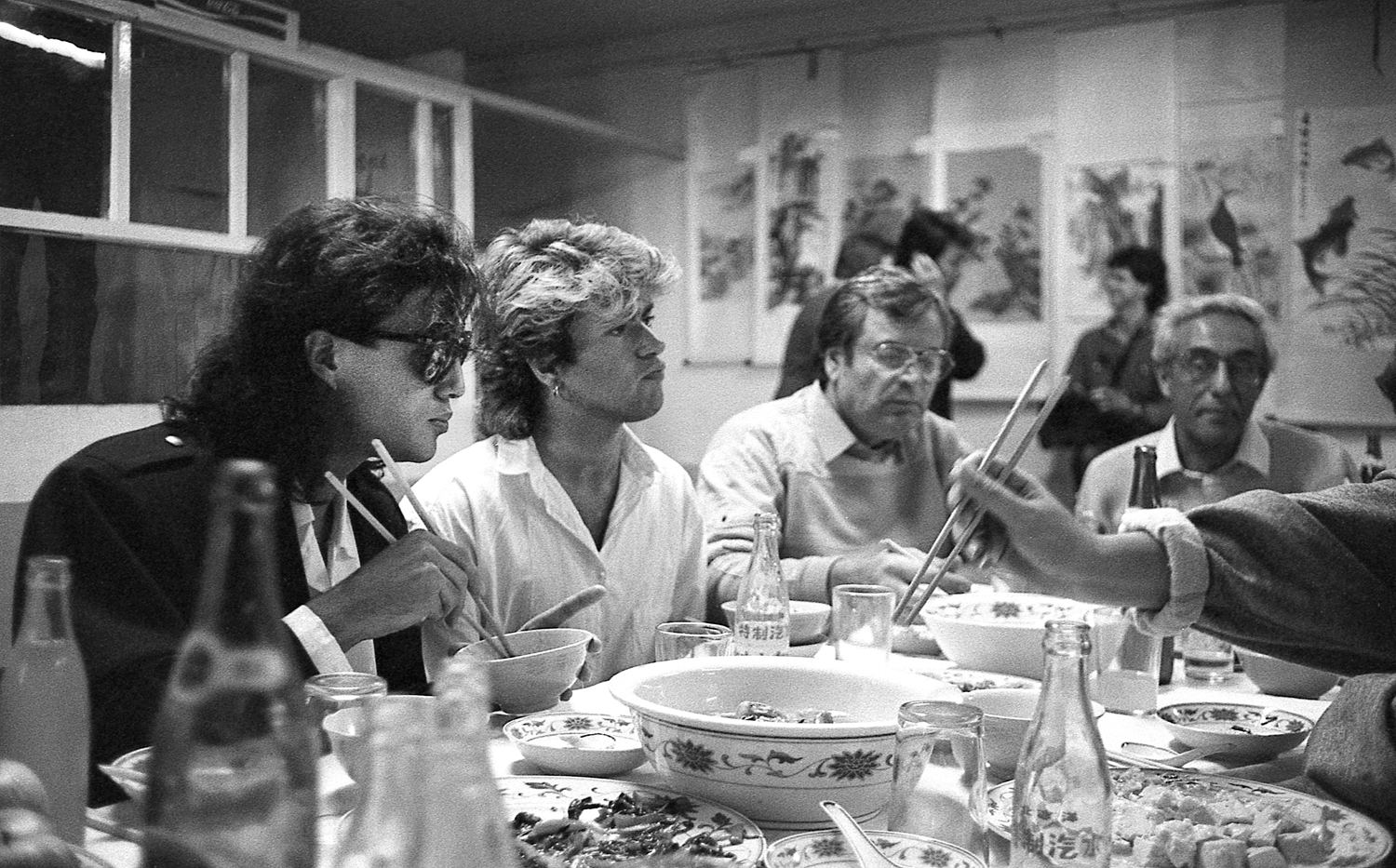
photo: Martyn Goddard
But some of the most fascinating footage that ended up in Mike Christie’s 10 Days in China documentary are the tense moments — like Andrew being surly during the awkward Beijing press conference, or that massage scene where George is lying on the spa table, trying to relax, but he’s disgruntled and venting about how he’s not enjoying this trip.
The massage scene, I’ll take full credit for! Lindsay didn’t approve that, and he told me off! What happened was George and I had developed a bantering relationship. I was 10 years older, so it was like an older brother/younger brother thing. I became the “George whisperer,” is how I regard it. He said, “No, no, I don’t want to do an interview. I’m off to have a massage.” And I said, “Well, you’ve got to let me film that, then!” And because we had a jokey relationship, he said, “You’re not going to show anything, are you?” But George gave me the green light and I grabbed [cameraman] Paul Cameron. I’m just loving it, thinking, “This is what the fans want! George being massaged!” I joke that I was a pioneer of reality TV. I whisper in Paul’s ear, “Ask George some questions! Ask him about China.” And George is so relaxed that he gives real answers, and it’s perfect. I mean, on one level, it’s bizarre, George offering his opinion on Communism, and that’s why Lindsay told me off. But it’s real. It’s natural. It’s authentic.
Didn’t some naysayers actually accuse Lindsay of having a Communist agenda?
Yes, he was pretty much a punching bag for people to say, “He was fired because he was a Communist,” because he was left-of-center, I mean, I literally read that! Simon said, “Oh, it’s his Communist point of view.” Listen, I love Simon. If you want to have a dinner guest to make you laugh, Simon’s your man. But his book [I’m Coming to Take You to Lunch: A Fantastic Tale of Boys, Booze and How Wham! Were Sold to China] should have won the Pulitzer for fiction. But I don’t condemn Simon. He was an incredible character.
Did Wham! butt heads with Lindsay from the beginning?
Lindsay hadn’t pissed them off. Lindsay had barely spoken to them. Lindsay and George and Andrew barely had any conversations. However, there was a cordiality that Lindsay expected. And there was a moment when it really turned. During the press conference, Wham! were asked, “Tell us about this film that’s being made,” and George, without a trace of irony and not trying to make a joke, said, “Oh, we’re making a film, and we’ve got a competent director called Lindsay Anderson.” Now, Lindsay at that time was 62. He’d won the Oscar in 1954 for Best Documentary Short. He was regarded in Britain as like a Martin Scorsese. He was a very respected filmmaker. Can you imagine if, when Martin Scorsese did No Direction Home, there’d been a press conference and Bob Dylan had said, “Oh, we’ve got Martin Scorsese, a ‘competent’ director”? Now, I don’t think George meant to be insulting; he just had no knowledge of how important and special Lindsay was. But Lindsay was really hurt by that. Lindsay understood it had come out of ignorance rather than meanness, but he was thinking that either George should have done some homework, or somebody should’ve informed him of how important Lindsay was. To be described as “competent” really hurt Lindsay’s feelings.
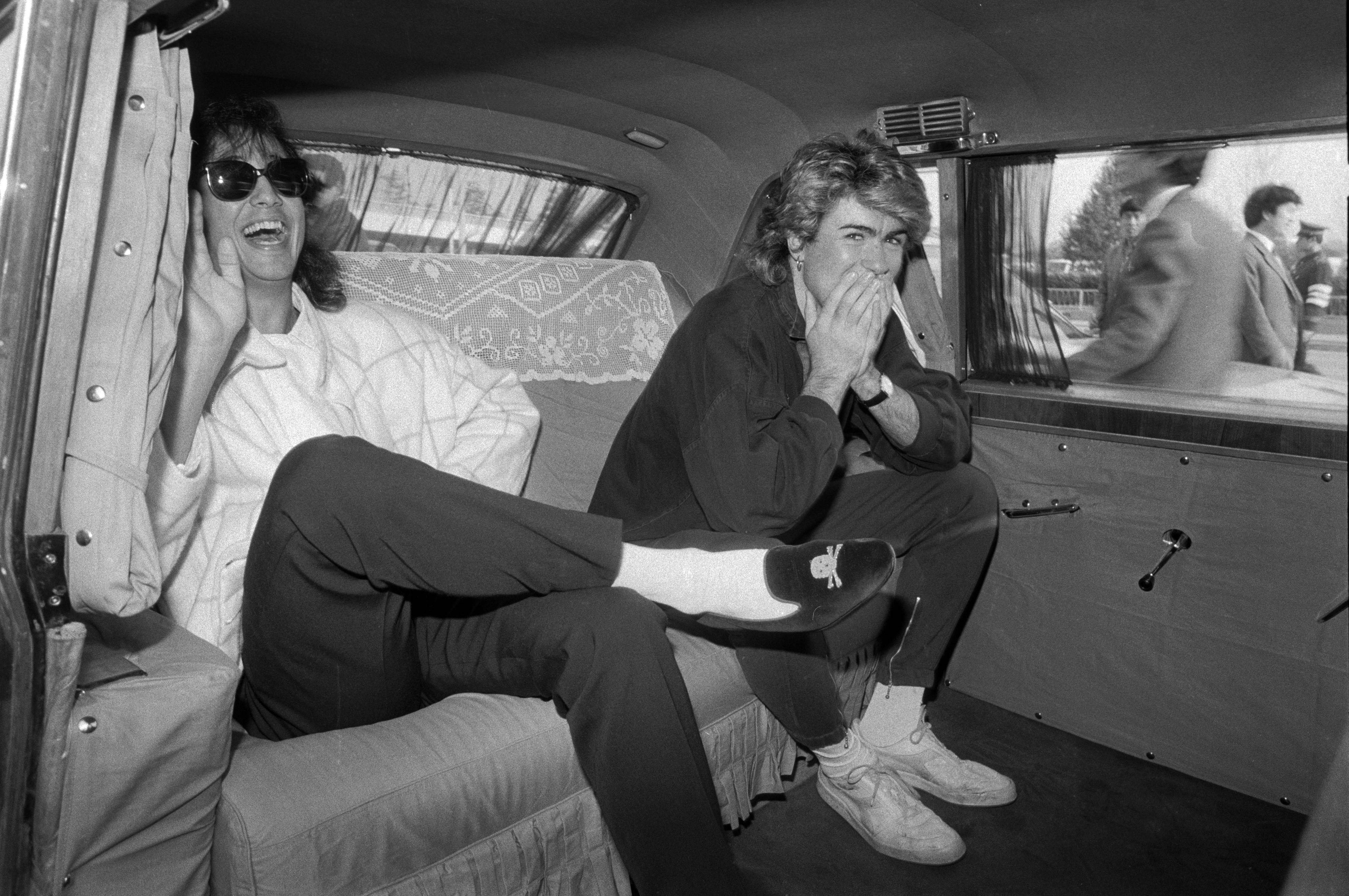
photo: Neal Preston
It seemed like George was already starting to bristle against the whole teenybopper thing.
Yes, and what I spotted was Jazz and Simon were in fear of George. I remember when I needed to get George to go to the Great Wall, no one would go to his hotel room, because they didn’t want to be the ones who George said “piss off” to. Nobody would do it! I saw that as a warning sign, that there was something amiss in this relationship. I later found out they were all frightened of George because he’d started to find his real self, even though he was only 21. Nobody wanted to ask him to do something he didn’t want to do, because he’d bite their head off and it would be a black mark against them. So, good ol’ foolish Martin, the designated George whisperer, is delegated to go up and knock on George’s door. He’s lying on his bed listening to Madonna on his Sony Walkman, and I say, “Come on, George, we’re going to the Great Wall of China.” He says, “I don’t feel like it. I’m not in the mood. Not interested.” I say, “Forget the fucking film, George! It’s one of the Seven Wonders of the World! It’s visible from outer space! Aren’t you just remotely curious to see this thing?” And he shrugged and said, “Seen one wall, seen ‘em all.” That actually had me in hysterics.
Even though If You Were There… was never conceptualized as a concert film, Lindsay did shoot the shows in Beijing and Canton. One of the criticisms If You Were There… received was its lack of live footage, which surprised people and apparently upset the band.
There was an implication back in the day that Lindsay had been so inefficient that they had to shoot more [live footage], that there wasn’t enough concert coverage in China because of Lindsay Anderson. And that got my blood boiling, because I know the truth. It was a fairly traumatic experience. As I said, there was no way that this was a concert film. No way at all. Not economically viable. A concert film would’ve been shot on video. We would have needed eight to 10 camera crews, multiple cameras, a big truck. It’s not functionally possible to take a video truck into China, not even remotely possible. So, we were going to do it old-school, with film. And since we had five cameras, that was the most the budget would allow. We would only be able to film a little bit of each concert. In Beijing, we only had that night to shoot, and of course, we did not want to obstruct the audience. We did reasonably well, but there wasn’t an opportunity to do any closeups, because you cannot put cameras in the way of paying audience members.
photo: Martyn Goddard
I sat down with Michael Owen, my associate producer, and he told me, “I’m worried about the coverage we’re getting. I think we need to do a second shoot in Canton. We need to shoot closeups.” Jazz agreed. So, the morning after [the actual Canton concert], the music crew assembled to play a whole [staged, audience-free] show. And suddenly George comes up and says, “I don’t feel like doing it today.” I thought he was teasing, but he said, “No, I’m serious. I’m not doing it. It’s too humid in here. My hair’s going to frizz.” He was petrified that his hair would go frizzy — there’s famous stories about how the “Careless Whisper” music video was re-shot because he didn’t like his hair.
I immediately did what any producer would do in that role, and said, “I’ve got it sorted. I’ll get some dehumidifiers in here.” Classic producer bullshit. How did I know how to get dehumidifiers on a Friday morning in Canton?” But George said, “No, I just don’t feel like doing it.” I said, “We need closeups,” and then he said, “Well, we could just do it all in [Surrey production facility] Shepperton.” I said, “Shepperton? We’ve got a vintage Chinese theater here. You want me to recreate the stage of a vintage Chinese theater and get all your musicians, dancers, everybody onstage looking identical, back in England? It’s not possible!” And he said, “Martin, anything is possible.” I was literally losing the battle with this 21-year-old. So, I thought, “I’ll play the trump card that cannot fail. I’m going to beat George on this.” I told him it’d cost about a half a million dollars. And George said, “All right, that’s what we’ll do, then. We’ll shoot it in England.” I said, “But it’s a half a million dollars!” And he said, “Yes. And it’s my money.”
So, you literally staged a whole reenactment of a Wham! Chinese concert at Shepperton Studios in England?
Yes. It wasn’t discussed with Lindsay, who was pissed off with me — and understandably, because he’s saying, “This is insanity!” Lindsay was not used to a youngster of 21 dictating the way things were done. This was a young pop singer wanting to spend half a million dollars of his own money because he was worried about his hair frizzing. But that was the world of pop music in 1985. What the star wants, the star gets. So, we tried our best to make sure that everything would be fine. We didn’t have an official continuity person, but we went around photographing everybody that was onstage [in Canton], taking a million Polaroids, so that when we regrouped in London, we could make sure everyone was dressed the same and the hair and everything looked the same.
And then, at Shepperton, Andrew saunters in, calm as anything — with a crew cut! A buzzed crew cut. He looked like an American astronaut circa 1965. His days of being a floppy-haired Hugh Grant were over. And Andrew’s wondering why all our jaws are on the floor. We say, “Don’t you remember that thing about showing up looking identical to the way you looked in China?” He’d completely forgotten. He’d just gone out and got a haircut because he felt like it. We had to cancel that day’s shoot and get a wig made. And fortunately, because my background was in comedy as well as music, I knew where to go. I went to Wig Creations on Portman Street, near Baker Street where Sherlock Holmes fictionally resided, and commissioned a wig for Andrew Ridgeley. They made a wig in 24 hours, and we reconvened the next day at Shepperton and shot a whole concert, like we would have done in Canton. And Lindsay is sitting there with a quizzical, wry look on his face. I think he was rather bemused.
You say you had no official crew member in charge of continuity, so was it at all obvious which shots were with Andrew’s real hair, and which ones had the wig?
When I’ve looked at both If You Were There… and Foreign Skies, I see the slippage, or the discrepancy. But the reality is, the average Wham! fan would be thrilled to see George and Andrew on the big screen and wouldn’t be paying that much attention. I don’t know if it pops up on IMDB where they have a “goofs” page or something like that, but I’m a detail freak, so I notice that sort of stuff anyway. I remember thinking, “Oh my God, look at that! That’s a wig!” That was not fun in the editing room, as you may imagine. I remember saying, “Look at Andrew’s hair. Will anyone notice? Can we get away with it?”
So, Lindsay finally began shaping these 21 or so hours of footage into his full-length film. What happened next?
When Lindsay got into the editing room, he was fascinated with the footage and started to get excited. When you’re directing a documentary in the verité or direct cinema style, you tell your cinematographers what to film, and really, you make the film in the editing room. That was his sweet spot. That’s a creative artist at his best, starting to really realize what he can do with the material. Lindsay kept reaching out [to Wham!], saying, “Come into the editing room and have a look at it. Let’s work on it.” But that was like salt in the wound for George. In George’s mind, he did this [China tour] so that he would break in America, and that’s the only reason he did it. Now Lindsay wanted him to go look at pictures?
But I also think that George was cut off anyway, because Lindsay was told, as was I, that we couldn’t have direct contact. We had to go through Jazz or Simon — which really meant Jazz, because Simon was off swanning around the world. Lindsay would send these beautiful letters encouraging George to come to the editing room and perhaps compose; Lindsay did appreciate George’s gifts as a writer, so he thought maybe George would like to compose some incidental music. Lindsay was not hearing back, I believe, because George was never getting the letters. But Lindsay didn’t know that, so when he was fired, he started saying these terrible things about George being conceited and stuck-up in an ivory tower. But I think that was just George being protected from anything to do with the China experience. And that was really painful for Lindsay. I think that broke Lindsay Anderson’s heart, so a lot of the mean-spirited things he wrote and said [later] came out of that. And I understand that.
Did you ever get a chance to discuss the film privately with George?
Yes, when I ended up being the third wheel on his date with Brooke Shields. I don’t know if it was to protect him from Brooke Shields. That was one of the weirdest experiences of my life. He called me when we were both in New York and said, “Do you want to get together to talk about the film, if there’s anything you need to talk about?” I loved it when he was on the road, because when he was on the road, he would call himself; it wouldn’t go through the managers. I said, “Well, there’s a bundle of stuff to talk about!” Because they hadn’t seen the film yet. We pick a day and a time, I walk over there… and he’s sitting there with Brooke Shields.
I say, “Oh, I didn’t realize you were having dinner with somebody. I don’t mean to intrude. Maybe we should just regroup tomorrow.” He says, “Oh no, Brooke won’t mind. Join us!” I thought, “Really?” Because I didn’t know if the supermarket tabloid stuff was true — that Brooke had a big crush on George — but if this was a date, you don’t need some boring old English guy talking about work. I’m feeling slightly uncomfortable, and Brooke, bless her, is very sweet, but she’s not understanding why George has invited me. We’re talking about the film, and Brooke is a little bit disappointed, and then she orders the equivalent of some dandelion fluff with some chard and some nectar and some daffodil seeds or something. It was like these vegan flowers on her plate. Meanwhile, George orders half a roast duck with roast potatoes. I’m thinking to myself, “I don’t know about the other aspects, but they’re not going to get along gastronomically!” I remember that because I pinched one of the roast potatoes from his plate, I’m afraid to admit.
It’s a shame that there was such a communication breakdown during this project, because if circumstances had been different, I feel there would have been a great deal of mutual respect between Lindsay and George. They were both true artists who took their craft seriously.
I think that had there been input, Lindsay would have included more music if they’d wanted that. Because we had it. But he was trying to keep a balance. The whole thing is, when he showed [a rough cut of If You Were There…] to them, it wasn’t for approval. We were anticipating another six months of editing. This was just to get input, to make it a collaborative process — if George and Andrew hadn’t had their minds misled by Jazz and Simon to expect something completely different. They were expecting a home movie of their Chinese vacation.
Had George got to spend time with Lindsay, they would have connected. If George had not been set against him by Jazz and Simon, I think George would have found Lindsay to be a fascinating person. Maybe at 21, it just wasn’t the right time for him to sit down with a guy from another generation who’s 40 years older than him. But he would have found an artistic camaraderie with Lindsay. Like I said, Lindsay reckoned that George would be interested in making incidental music, some sort of score, and that might have given George a creative avenue, a way to feel positive about what had been a bad experience. George wrote, sang, arranged, and produced everything was coming out of his head, and I don’t think that Jazz or Simon probably encouraged that enough, because they were thinking of collecting those golden eggs. But anyway, I was forbidden to contact George directly, as was Lindsay. I had to put it through Jazz as the gatekeeper. And I am virtually certain that what happened was Jazz shut it down. Jazz was clearly not wanting to give George another task, another chore.
I also don’t know if there was any tension also between Lindsay and George about the gay thing. Lindsay was from a generation of gay people when you could not even show it or discuss it — or, in his case, act upon it. Lindsay was gay, but he was never out and it was never discussed; it was assumed by people, but he never had a gay relationship. He was raised in an era where there was such negativity [towards homosexuality] that a lot of people never came out, or didn’t feel they could. George had come out to Andrew and [Wham! singer] Shirlie and others, but he was not definitively only gay at that point. I don’t know whether Lindsay had a gaydar, if he’d have suspected or felt that George was likely gay. And I don’t know that George would have necessarily sensed that about Lindsay.
Why was Lindsay’s footage ultimately re-edited to be more of a typical MTV pop doc, Foreign Skies?
Well, George was burnt by China. The experience of China, Wham! being turned into performing fleas and being thrust into that kind of artificial world, was not a comfortable thing. He was burnt by the British media. It’s important to note that a little bit after China, George was starting to make noise [about wanting to go solo]. They did a stadium tour, and then George said, “That’s it. I’m done. Wham! is over. Next year is the end.” Jazz and Simon were absolutely gobsmacked and really pissed off, because they’d thought they had another five years of Wham! So, Lindsay had done exactly what he’d been hired to do, which was to make a beautiful, real visual documentary about this fascinating juxtaposition, but Jazz took one look at it and said, “Oh my God, we can’t make this into a pop video. The word-of-mouth on it will be terrible. It won’t sell. We’ve got to change the film.” I said, “But this is what you agreed to!” They said, “I know that, Martin. But our plans have changed.” They weren’t exactly spelling out the financial reasons, but it was very clear that it was financial.
Meaning, now that Simon and Jazz realized Wham!’s days were numbered, they wanted to milk it as much as they could? So, they decided they now wanted a more mainstream, MTV-friendly film?
Yes, basically that. I said, “The film is not going to change. This is what you hired Lindsay for. If you’d wanted a pop film, you would have hired Andy Morahan.” I was appalled by all this. It just rubbed me the wrong way. I just ethically could not do it. Lindsay Anderson had been a hero of mine. I couldn’t fire him. I knew they had the right to do it, but it was wrong, morally and ethically. So, I just said, “I’m out of here.” And I resigned.
Eventually, Foreign Skies premiered at Wembley Stadium, right before Wham!’s big farewell concert, just a little more than a year after Wham! had played in China. Did you and Lindsay attend?
Lindsay didn’t go. He was feeling pretty burned. Later he said to me, “What happened with the film?” I said, “Well, they showed you on [Wembley’s] giant screens.” He said, “Where was it positioned?” I said, “We were between Elton John dressed as Ronald McDonald, and Gary Glitter.” [Editor’s note: Glitter and a clown-costumed Elton performed at Wham!’s final concert.] And Lindsay, who was always a sardonic guy, just said a very English word. He said, “Quite.” And that was his only word on the subject. Quite.
Do you think George regretted not giving Lindsay a chance in 1985?
No, because he wasn’t a look-back person in that regard. I don’t think in general that he was a look-back type of guy.
But even if George and Andrew didn’t understand or appreciate Lindsay’s vision at the time, I feel like George at least would have eventually warmed to the idea of a “serious” film that showed Wham!’s cultural impact — especially because he struggled so much in his early career to be taken seriously. Did you ever try to convince George to release If You Were There…?
George found it very easy to say no to things. He said no to a million projects. And if he said no, that was it; you couldn’t go back and revisit it. I approached him several times about this, and it would have been the easiest thing in the world for George to say, “No more talk about the China film! I’m never going back. I don’t want to look at that again. It’s done. Forget it!” But he never said no to me on this. He always said, “Maybe. But not this year.” And his manager, Michael Lippman, told me to keep coming back.
Simon and Jazz were no longer managing solo George at this point?
No. I think Jazz would have been a good manager for him, but there was a very good reason why George didn’t stay with Simon. Simon was very good at putting shuttlecocks in shorts, but perhaps not so good at managing a respected artist. And I say that with affection.
What does Andrew think of If You Were There…, after all these years?
Andrew has been very respectful. I think he’s led a very dignified life. He’s known that he’s been the butt of jokes, and he’s held himself in a very gracious and graceful manner. I give Andrew huge credit for how he’s handled his post-Wham! life. But he was not in the room when George and I discussed the film years later. He wasn’t in the room with Michael Lippman. I can’t expect Andrew to do the right thing, because Andrew can’t know the purpose of the film, so it’s not for him to offer an opinion on it. Andrew actually said, “I don’t think George ever wants it to be seen,” and respectfully, he’s wrong about that. But Andrew also said, “I think at one point there should be a triple-disc release, that maybe all three films should come out [packaged together].” And Andrew is spot-on about that.
In 2024, If You Were There… was finally screened at the British Film Institute. What was the critical reaction?
Some serious papers like The Guardian and The Times and The Telegraph reviewed it. A couple of them didn’t like it, but The Guardian liked it. It’s also available to see if you go to Lindsay’s archive at the University of Stirling in Scotland, if you’re a serious researcher. It was well-reviewed by people because it is a beautiful, beautiful film. It’s just not a pop documentary. It was never meant to be.
How much were you in touch with George after the whole China debacle?
We stayed in contact until the end of his life. I’m not going to claim we were close buddies or anything like that, but we stayed in occasional contact. But here’s the thing: He knew that it was my idea to hire Lindsay. I’m the guy he remembers from the film; he remembers me much more than he remembers Lindsay. If he was so angry about that film, or so pissed off about the choice of Lindsay, he would not have stayed friends with me. He wasn’t like that. But he did, because he was a mensch.
So, I stayed friends with George, and I had wonderful conversations with him. When he was outed in Beverly Hills, when he was busted, I was so outraged that I went on a tabloid TV show — Inside Edition, A Current Affair, Entertainment Tonight, one of those — and I defended George. I said it was ludicrous and that this was clearly entrapment. I made some joke about how they’d said it was a “plainclothes cop,” but [the arresting officer] was wearing a $2,000 Gucci jacket, so that’s not “plain” clothes! Then I ran into George at a party about six months later; he’d actually seen the interview, and he was very appreciative. He was very touched that I’d stood up for him. But the thing that amused him was the news show didn’t know how to caption me, so they’d captioned me as “producer and longtime companion.” And George joked, “I outed you!” [Editor’s note: Lewis is straight.]
And George never forgot my dancing. In Canton, they had a nightclub where we would all let off steam each day, and I was dancing, drunk, happy that it was all over, letting my hair down. George came up to me and said, “Martin, I’ve been in a lot of clubs and discos all over the world, and in all that time, I’ve never seen anybody who’s a worse dancer than you. You are literally the worst dancer I’ve ever seen in my life.” And I said, “Can I quote you on that?” He said, “You have to quote me on that!” That was our banter. And he’s right. I have some quotes on my website from major stars who’ve been kind enough to say nice things about me, but the only one that’s a diss is George’s comment about my dancing.
That is a quite an endorsement! So, now that you’ve had a chance to speak out about Lindsay Anderson and Wham!, what are you hoping will come from this? Are you hoping the three-disc DVD or Blu-Ray package that Andrew Ridgeley suggested — that is, compiling If You Were There…, Foreign Skies, and Wham! 10 Days in China — will one day come out?
Let me just give some gentle marketing advice here to the [George Michael] estate, which isn’t interested in my marketing advice, because what do I know, I’ve only been doing this for about 55 years: Make this a triple-disc thing. Keep Lindsay’s cut as it was, but restore it. And I will personally — for no money, guys, because I know money is very important to you at the George Michael estate — wrangle some people who will help sell that triple-package. I will wrangle Malcolm McDowell, who I’ve worked with before, and I will wrangle Brian Cox, who, like me and Malcolm, has an appreciation for Lindsay Anderson. I’ll make a short featurette about Lindsay with some big names, and I’ll do it all for free, because I love Lindsay Anderson, and I feel it’s my duty to stand up for him. I’m proud to do that. And I will do it also because I love Wham!, and I am exceptionally proud of the work I did with them. I hope the George Michael estate is enlightened enough to follow Andrew Ridgeley’s good suggestion. Do a three-disc set. You’ll make a gazillion dollars.
This interview has been edited for brevity and clarity.