


If These Walls Could Rock, a documentary directed by Tyler Measom and Craig A. Williams about legendary Hollywood hideaway the Sunset Marquis hotel, is packed with many wild rock ‘n’ roll tales. For instance…
This “rock ‘n’ roll friars club,” founded in 1963 in partnership with the Sunset Strip’s Playboy Club, was where a frustrated Bruce Springsteen hurled the initial acetate of Born to Run into the hotel pool, and where he later met Born on the Fourth of July author, activist, and Vietnam veteran Ron Kovic, who inspired him to write the “Born in the USA” B-side “Shut Out the Light.” It’s where Duran Duran blacked out their windows with foil and opened their own secret, afterhours nightclub called Privacy. It’s where the Red Hot Chili Peppers dove from the roof into the pool, and where Green Day dyed their suite’s carpet green. It’s where Dave Grohl met his wife Jordan Blum and took a bath with Ringo Starr (presumably on two separate occasions). It’s where Billy Bob Thornton, the unofficial/self-appointed “mayor” of the Sunset Marquis who lived at the hotel between his many divorces, had sex in a stairwell with one of the estimated 100 dates he entertained there, and where Thornton woke up with his head in Jeff Beck’s lap (again, presumably on two different occasions). It’s where the Black Crowes’ Chris Robisnon spotted Keith Richards strolling by the pool with a knife tucked into one hip of his Speedos and a pack of cigarettes in the other, sipping on a piña colada.
It’s where the reclusive Morrissey was photographed for six album covers. It’s where the Black Crowes’ Chris Robinson spotted Keith Richards strolling by the pool with a knife tucked into one hip of his Speedos and a pack of cigarettes in the other, sipping on a piña colada. It’s where Depeche Mode held poolside court in the infamous hot tub, which many of If These Walls Could Rock’s talking heads believe not all the chlorine in Los Angeles could effectively sanitize. And it was the only L.A. hotel guaranteed not to kick out Ozzy Osbourne, so the Osbournes were frequent guests. Kelly Osbourne — who, much to her mother Sharon’s dismay, took many dips in that probably-tainted jacuzzi — even had her first drink, first kiss, and first line of cocaine at the hotel, the latter supplied by one of her unnamed dad’s famous friends in a “very big band.”
Heart guitarist Nancy Wilson’s anecdotes in the film aren’t quite as debauched, but much like the Osbournes, she fondly thinks of the Sunset Marquis as a family place, a “home away from home.” It was where she processed her grief and sought comfort during her own divorce from her first husband, filmmaker Cameron Crowe, and where the kind-hearted, discreet, and always reliable hotel staff took swift action when her older sister, Heart frontwoman Ann Wilson, experienced a medical emergency. And it was an especially safe haven for the Wilsons in the 1980s, when Heart exploded into the MTV mainstream — the band’s most successful decade in terms of record sales and chart numbers, but a “pressurized” era when the music industry’s extreme emphasis on big hair, small bodies, and style over substance strained Nancy and Ann’s relationship.
Years later, the sisters had a major falling-out that put the future of Heart in doubt. “It was between 2016 and 2019 that things got kind of fubar: f***ed up beyond recognition,” Nancy says. And although the Wilsons resumed touring in 2019, even embarking on a triumphant comeback tour after Ann’s 2024 cancer diagnosis and treatment, Heart have not released a studio album in over a decade.
However, as Nancy reminisces about If These Walls Could Rock, the “extremely happy” musician can’t help but giddily tease Heart’s own forthcoming, long-delayed new biopic and documentary, as well as a nearly finished “really, really strong” new Heart album. “It really feels like a Heart record. … It’s all about these songs. It’s what we were born to do, and do together,” Nancy says proudly. “Hopefully ‘27 and ‘28 will be the year for Heart world domination, basically.”
Here, Nancy opens up about her good times and bad times at the Sunset Marquis (including being haunted by a spliff-toking phantom that may or may not be the ghost of Jim Morrison); how Heart survived the big ‘80s; how Ann’s battle with “the big C” helped the once-estranged Wilson sisters become “super-reconnected”; why Heart’s reunion is “really sweeter than ever” now that “a lot of the drama that was kind of swirling has come to a halt”; and what to expect from the forthcoming Heart album and their own films.
LYNDSANITY: I love your dip-dyed pink hair. You were rocking that color at the Rock & Roll Hall of Fame ceremony last year.
NANCY WILSON: Yeah, I got my pink on again! It was starting to fade out; there’s this one color that lasts forever, but it finally faded. The Heart album is almost finished up now, and the photo shoot was happening, so I was like, “I gotta get my pink on for the Heart thing,” because the recording’s all done.
That’s exciting news!
Yeah, it’s really, really strong. I think it’s going to be great. We wrote a bunch of new songs and recorded down in Nashville with the players that we just played the last tour with. It was like a secondhand thing with each other because we’ve played so many live shows, so the album was pretty much recorded live.
Wow. How long has it been since Heart released an album of new, original material?
The last album 10 years ago was called Beautiful Broken. … Before that, Fanatic and Red Velvet Car were the last two studio albums. So, yeah, it’s crazy! I’m really happy. It really feels like a Heart record.
When is this album coming out?
Well, we’re delivering it at the end of August. And so, with the world tour to set up and a documentary film to work on and a live-action feature film and an album and a tour and a new management company, we’re getting all of those ducks in a row, so that we can strategize the rollout.
A few years ago I interviewed Ann, and she told me at that time that the Heart biopic was very early stages. I think the pandemic might’ve changed things, but a Heart biopic was in the works, and Sleater-Kinney’s Carrie Brownstein was writing and directing. Lynda Obst was producing, and it was going to be on Amazon.
Well, since then, yeah, the pandemic happened. And Lynda Obst unfortunately passed away. She was one of the Mount Rushmore producers in the movie industry for a long time. The original lunch I had with her before the pandemic was about, “There needs to be a Heart film. My granddaughter who’s 12 is a huge Heart fan and she wants to learn guitar and wants to be in a band, and this would be a film for them” — for the next generation of not just girls, but musicians coming in. And then the pandemic and a lot of different back-and-forth with management and different stuff just kind of blockaded the process for a long time. But I just now got off the phone with Julie Oh, who was the replacement for Lynda Obst, and we’re back on track with Carrie Brownstein for the next draft, the final draft, to hopefully get this thing rolling again. Sometimes good things take time, but we’re back on the tracks with it.
Have you cast it yet?
No, but there have been a lot of actresses that were excited to be asked to play the parts of me and my sister. But we haven’t got that far yet. We need the final draft.
I recall Ann liked the idea of Anne Hathaway portraying her. Who would you want to play you?
I think maybe Elle Fanning would be a really good. I think Florence Pugh would be real good for Ann. But there are a lot of cool young actors coming up right now that could do it. I don’t know who would play the older version, because there’s a big lifespan! I think, though, the story mainly just goes from the beginning to probably [Heart's 2012 Led Zeppelin tribute at] the Kennedy Center. There’s enough of an arc right there to kind of cover it all.
It’s interesting that you mentioned Florence Pugh, because when I interviewed Belinda Carlisle recently, there’s been talks of a Go-Go’s biopic, and she said Florence would be good to play her. And at one time when a Madonna biopic was still in talks, Florence was in the running to play Madonna.
Yeah, she’s a rockin’ actress, for sure!
Do you have a title for your biopic yet?
The working title has been Blood Harmony for a while, but that’s also another band name, a really cool band of sisters in country music.
I recall it was joked in my Ann interview that your biopic’s tagline should be “Sexism, Drugs, and Rock ‘n’ Roll.”
That’s good. I like that! We’ll keep that one floating.
What details can you share about the upcoming documentary?
It’s about the band Heart, because Ann already put out a little Ann Wilson documentary by herself [In My Voice]. We were waiting for that to get done before we proceeded with the larger one — put the Heart train back on track for next year, mainly. Hopefully ‘27 and ’28 will be the year for Heart world domination, basically.
Well, right now you’re in the documentary If These Walls Could Rock, which focuses a lot on the 1980s, one of the decades that Heart dominated. You spent a lot of time at the Sunset Marquis in the ‘80s and beyond. You mentioned two albums, Fanatic and Red Velvet Car — didn’t Heart record those at the Sunset Marquis?
Yeah, we set up a little studio in one of the villas. We made our own studio there. … We worked there and also in the Nightbird studio [in the Sunset Marquis basement], and stayed there many, many, many, many, many times with our tour bus. At 4 or 5 in the morning, we’d park the tour bus under the hotel in the basement and just kind of roll off the bus and into our hotel rooms. It was really a home away from home. I loved how the [If These Walls Could Rock] documentary turned out, because it’s hysterical. When you see the stuff Billy Bob Thornton talks about, oh my God! I thought it was really cool to show just how much debauchery really was OK in those days. It was pretty standard operating procedure, how wild things could really get and how the [Sunset Marquis] really lived up to the standard of being a wild rock hotel.
I’m sure many people who watch If These Walls Could Rock will say, “Oh, it was a different time.” You and Ann were these nice Northwestern military daughters who got thrown into this crazy party scene. Was that daunting for you?
Well, in the arc of your life, you kind of go through your party stages, and that was our twenties and early thirties, so we were right down the center of Party Central. We were actually kind of lightweights compared to a lot of the people around us, because our work ethic was so ingrained from a military-type ethic that we had to show up on time. We were not going to be wasted before the show. … The party didn’t start before the show, like it did for a lot of people. We almost never missed one show ever, and we were always on time. We were a dream rock band to work with, promoter-wise, because we were professionals. But at the Sunset Marquis, we were not professional! We were doing all kinds of debauchery and getting away with it — and being protected inside of it. It was sort of a “no-tell motel” vibe, where you felt safe to push the envelope with the party thing.
One of the anecdotes you share in the film is that Rudolf Schenker from Scorpions called you up and asked you to party with him. Did you accept his invitation?
We would get a call back in the analog telephone days, with the cord-to-the wall kind of telephones where you could call from the lobby to a hotel room, so we’d always pick it up. And it’s like [German accent]: “Hullo, Nahncy! It’s Rudy from Scorpions! Vee are here now. Vee are in the lobby and vee are ready to pahrrty!” But we were like, “No, no, we can’t party right now,. We have to sleep because there’s a show tomorrow. It’s a school night for us.”
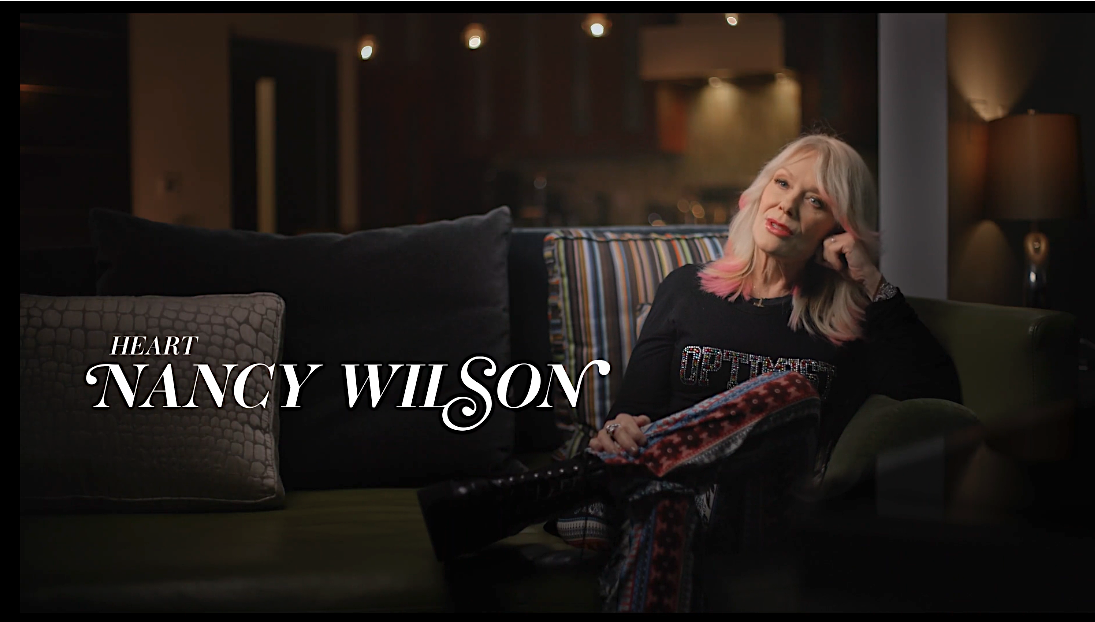
Nancy Wilson at the Sunset Marquis (photo courtesy of Bungalow Media + Entertainment)
Any other stories about crossing paths with interesting celebrities at the Marquis?
I got to make some beautiful eye contact, walking through the lobby once, with Jimmy Page. I’d met him a couple of times and made some other eye contact before, but usually in passing along the way. He’s one of my muses, one of my heroes, so it was so cool to just touch base, even if it was just eye contact. You saw a lot of Hollywood stars, a lot of actors. Billy Bob Thornton was always cruising around in there. Like he says in the documentary, “Between my divorces, I would just go live there. I wasn’t sure when to go home.” He kind of liked it there better, because it was a safe place away from the divorce situation for him. When I was in a sad space about getting separated and divorced, I came into my room and it was kind of the under-construction area of the hotel. I was upset, and Francois, the really kind bellman/concierge guy, saw the mood I was in. And he said, “No, no, no, no, no. This will not do for Nancy! Ms. Wilson will stay in a much nicer room! There will be no price difference. You will stay in this nicer, quieter part of the hotel.” Stuff like that that they did out of the goodness of their heart.
They knew me well enough to see what state I was in, even though I was trying not to be noticeable about it. They knew me well enough to go, “Wait one second. Hold on. Don’t take any bags off yet. We’ll get you a better room.” And it just meant the world to me, because I had to go on tour. I had to leave. It was separation anxiety, 100 percent, on every level — not just leaving town, but leaving a relationship, with kids involved and stuff like that. So, it was very meaningful that they treated me so kindly. The kindness thing is more important in the world than you might ever imagine, especially today in the climate we’re all trying to get through, live through, survive. The political climate in particular is so unkind. Kindness is the ethical way that the universe will need to bend towards, in the next cycle coming in. And I am such an optimist that I believe it will. I want to believe it will.
Didn’t Ann have some kind of medical emergency when she was staying at the Sunset Marquis, and the kind staff also took good care of her?
Yeah, she did. She had a little scare early in the morning. They just whisked her away to the emergency [room] and made sure everybody was not aware, so that it wouldn’t be a plague to her trying to get well from the situation she found herself surprised to be in.
When did this occur?
It was around early 2020s, 2016 or ‘15 or something like that, or 2010 maybe. It’s hard to recall, because she’s perfectly fine now. But it was just kind of a little surprise medical slip-up.
I’m glad they took good care of her then, and also glad to hear you say she’s doing well now, because obviously she had some serious health issues recently.
She’s doing well now. We just recorded the album, and she sounds amazing. We did 118 shows together, which were great. So, she’s fine. All of her medical stuff is completely sorted out nowadays, which is really a big victory, because she wasn’t sure for a while there, a couple of years back, if she wasn’t going to be taken by the big C. But her scans are fewer and farther between, because everything keeps on coming up clear. I think she actually beat it. You keep checking, but it keeps on getting more and more positive all the time.
And it’s really added a lot to her expressive way of singing these days. I think it’s my favorite Ann Wilson sound on this new album that I’ve maybe ever heard, because she’s always been so pyrotechnical-capable, she had no limits to what range and what kind of whizzing-around fireworks she could accomplish, but in her current state of play as a singer, it’s way more translatable. There’s a humanity and an expression to it now that’s much more fulfilling to listen to, I think, than all of the vocal pyrotechnics of the past. When you think of Ann, you think of almost like a banshee singer. She’s not a crooner now either, she still punches beautifully and she’s still got a range, but I think she just interprets stuff better, now that she’s been through such a lot of living. You really hear the pearls of wisdom in there now, more than they ever were. As a singer, she’s just more soulful these days.
Did Ann’s cancer bring you two closer together?
I do feel super-reconnected now. We kind of had a separation thing that took a little bit longer to get through than I ever wanted, but she needed to have her own independent stuff away from Heart. And it was good for me to have my own independent stuff away from Heart as well. So, now the reunion is really sweeter than ever. A lot of the drama that was kind of swirling has come to a halt.
You say Heart’s estrangement, or hiatus, or whatever you want to call it, was longer than you expected. I’m curious why that was, or why you thought that.
Well, after she got cancer, I wasn’t sure that I was needed, because she was so kind of closed-off about going through that. She had moved from Florida into a new place in Nashville, where she still lives now, and I’d never visited her in Florida because I really didn’t feel welcome there at all. And so, there was just a whole thing that had to kind of melt away. When she moved to the Nashville area, I could tell that she was happier where she was living. … She’s more of a city girl by nature.
Was it a gradual coming-together, organically, or was there a specific breakthrough moment when you sat down and hashed things out?
Well, we got back on the road together in 2019. Really, it was between 2016 and 2019 that things got kind of fubar: f***ed up beyond recognition. But then we got back out on the road, and it was like, “OK, this is like riding a bicycle.” There was still a lot of tension, but we kept on planning to keep going. It’s taken a while, but right now it couldn’t be better, because I just feel like Ann has kind of settled into who she’s becoming, where she gets to live now, and getting past all of the scary stuff with the cancer. She’s really exhaling enough to give energy and pay attention to our relationship again more. And I’m really happy about it, because when I got to Nashville to finish up some songwriting together that we’d been doing remotely with our collaborator, Sue Ennis, when we got in a room together it was like, “Oh, this is second nature. There’s no drama here.” It’s usually just the people around you that create the drama. There’s a lot of jealous little vendetta things that we couldn’t be bothered with anymore.
Did Ann’s health issues make you newly appreciate this rock ‘n’ roll dynasty that you two have built?
It completely did bring that to the surface of our relationship, because it was like, “Wow, we’ve done this for 50 years!” And pretty successfully, off and on — enough so that we’ve made an imprint where every rock show we play is like a singalong these days, which is really cool. It’s all about these songs. It’s what we were born to do, and do together. It’s what we’ve always done together, and it’s second nature. So, getting back into that with Ann one-on-one was extremely meaningful and really fulfilling for me. … It made me extremely happy to make this album.
And I’m extremely happy to hear that you and Ann have, for lack of a better term, made peace with your past. But changing the subject a bit, since so much If These Walls Could Rock focuses on the ‘80s, have you made peace with that period of your career? That was Heart’s most lucrative era, but you’ve had mixed feelings about it because you were pushed into this sort of hair-metal scene.
Yeah. I think there’s a lot of people that came into knowing about Heart at that time, and then they later discovered the ’70s version of Heart. The [‘80s] songs that still sound pretty timeless and little less dated are the ones we play live, like “Alone,” “These Dreams,” and “What About Love.” It was making the videos, mainly, that was the most challenging part of that decade for us — because it took the importance right off of the music itself and it slapped you in the center of a visual aspect. All these stylists would show up at the big soundstage with the camera crews and the smoke machines and the lighting and the dancers and all that other kind of stuff. It was so not exactly about the music anymore.
I mean, they made a molten-metal mold of your body in the “These Dreams” video…
Well, that’s definitely memorable! We’re still talking about it today. The gold mold, like the “golden goddess.” It was a big piece of Styrofoam, and in the Styrofoam they drew [my] shape and then carved [my] shape out. You go lay down in there after they spray-painted it. The culture itself had switched over from the late ’60s and the ’70s, where it was more mind-expanded with pot. … The drugs changed in the ’80s over to the cocaine era, so it was much more of an egocentric type of “me, me, me, me, me, me, me,” and all about how you looked. It was an egocentric drug time, instead of a mind-expanded drug time where everybody’s cool — even if you’re Mama Cass, even if you’re fat, that’s great. But not in the ’80s! Ann was “too fat” for the ’80s. That was really hard. It was pressurized. The glamorization in the ’80s was so high-pressure that they would stretch the [television] frame.
Yes, I think it was the “Never” music video where the image ratio was compressed, like squished narrower, presumably to make Ann look thinner.
And it was not lost on Ann, obviously. Emotionally, that was pretty tough for her, having just always been a big baby and a big-boned girl, always larger; some kids are born a little bit larger. Living through that made her more self-conscious and made it harder to stay on that diet. It was kind of a vicious cycle of attention on how she looked, instead of how the music sounded and what her talent really was all about. And they would stick me out the front because I was the “blonde bimbo.”
And they’d turn you into a golden-goddess statue.
Yeah, it was just a little shallow for our taste, because we were hippie chicks from the ’60s, basically.
Did the fact that record executives were pushing you more to the front create any friction or jealousy or rivalry between you and Ann? If I was in Ann’s shoes, it’d be hard not to resent that.
Yeah, it definitely hurt her feelings because she started the band; I was always going to be in the band, but I joined after I went to college a little bit first. And then I got kind of stuck up front, and they put her more behind me, like in photo shoots: “Bring the blonde forward. Hide the brunette behind the blonde!” That really hurt her feelings, and it hurt my feelings for her. It also hurt my feelings to be typecast in sort of a bimbo role that I’ve never felt described me at all. I’m not a space cadet. I studied a lot of things in university, poetic stuff. I don’t define myself by my looks at all. I’m a really competent musician, producer, and writer, and an OK singer. It hurt both of our feelings in very complex ways, to get through that image-making machinery of the ’80s that was kind of unfair to music.
Heart were never a hair-metal band, but you were on MTV when those bands were prominent, and during that time most of the women on MTV were the “video girls,” the girls in cages or whatever. I was laughing hysterically during this If These Walls Could Rock scene with Russell Mulcahy, who directed Rod Stewart’s decadent “Tonight I’m Yours” video by the Sunset Marquis pool. He has a laptop and he’s re-watching that video with all these fleshy party girls in bikinis, and he’s wincing, almost like, “I can’t watch this. Close the laptop! This is not my best work!” But that’s what was happening in the ‘80s, so it makes sense that MTV would treat you like you were video girls — even though you were actually the musicians.
That’s a really good way to frame it. We just felt like we were objectified and not appreciated for our talents at all. It had to be about the look. It was more of a Hollywood system: Churn out the hot chicks and make the dudes look like a lady. Everybody had the same blonde hair, the same hairdresser.
On the subject of hair, since we were talking about your pink tips at the start of this interview, and to take it back to If These Walls Could Rock, I understand you ruined many Sunset Marquis towels with your hair dye.
There’s so many anecdotes about the Sunset Marquis, but we really did go through a lot of towels! We ruined a lot of their towels and washcloths because of our hair color, all of the different hair colors, the purple, the fuchsia. There was every shade of red or orange. There was bright yellow. There was canary yellow for a while. Us and Cyndi Lauper [who also appears in If These Wals Could Rock] probably ruined a lot of towels.
And probably made the showers look like a scene from Psycho.
Yeah. “Something happened in that shower! What happened in there? Who bleeds purple blood anyway?”
Well, with all the other rock ‘n’ roll shenanigans going on at the Marquis, having to clean up bit of hair dye was probably the least of the staff’s worries! You mentioned the ‘60s/’70s marijuana era making way for the ‘80s cocaine era, but didn’t you once claim the hotel was haunted by a “pot ghost”?
Yes, in the main part of the hotel off the lobby where the elevator is… by the cheaper rooms, there was always a smell of pot. But there would be nobody there! There would be no sound. Most of the doors would be open and the maid would be cleaning, or there would be no people at all in there. And then once at the villa when we were recording with Ben Mink, recording Fanatic or Red Velvet Car, we were like, “Wait, is somebody smoking pot outside?” Our villa was all by itself, but there was still a pot ghost. Whoever that was, that ghost is still smoking pot to this day, I’m sure.
I wonder who it was? Which marijuana-smoking rock star that’s no longer with us would be mostly likely to haunt the Sunset Marquis?
Probably somebody like Jim Morrison.
That’s a good guess. Do you have any other memories of the hotel?
Well, I was thinking about it after I saw the documentary, that I never went in that pool! Not one time! Everyone else in the documentary went in the pool at least once, and some jumped from the balcony. But I never even went in the pool. I guess it was too public for me, and I’m too shy.
Did you go in the jacuzzi, though?
No! And I think it was a really good idea to not go in that particular hot tub.
This Q&A, which has been edited for brevity and clarity, originally appeared on Gold Derby. Watch Nancy Wilson’s full interview in the video at the top of this page. If These Walls Could Rock premieres Aug. 14 on Apple and Amazon.