
Six years ago, smack in the middle of the COVID-19 pandemic, teen siblings Matt and Issey Cartlidge began busking in London — doing Kinks and Libertines covers “out of necessity,” because there was nowhere else to play due to lockdown restrictions.
“We’d go out to Brixton, Soho, around Oxford Street, and there was a load of protests at the time, either anti-lockdown ones or anti-ID,” Issey, now age 20, tells Licorice Pizza’s LPTV. “We’d go out on the street and play all the rallies, like play ‘I Predict a Riot’ by the Kaiser Chiefs or [the Sex Pistols’] ‘Anarchy in the U.K.,’ things were fitting. And then as soon as everything opened up again, we just said yes to every opportunity. And everything led to something else.”
That journey has ultimately led the Cartlidges, now better known as punk revivalists the Molotovs, from the streets of London Town to Hollywood’s Sunset Strip — where they’ve immediately acclimated to the rock ‘n’ roll city by visiting the Chateau Marmont, Viper Room, and Rainbow Bar & Grill before their big show at the Roxy — and over the hill to Studio City’s famous Licorice Pizza record store, for their big LPTV interview.
And along the way, they’ve won the respect and praise of many of their heroes — including the actual Sex Pistols, with whom they played Royal Albert Hall at a Teen Cancer Trust benefit (the day before Matt’s 17th birthday), and Teen Cancer Trust co-founder Roger Daltrey, who wrote the Molotovs a personal thank-you letter. Later, Pete Townsnend even gave Matt the best birthday present ever: a Rickenbacker guitar.
The massive buzz about the Molotovs being punk’s great blonde hope and Britpop’s new saviors has — as is often the case with the U.K.’s mercurial music press — generated an inevitable backlash. (“Get a Life,” the opening track on the band’s spunky, punky debut album Wasted on Youth, is seemingly an open letter to their haters.) Matt, bristling with all the confidence of a now-18-year-old rock star, claims, “I don’t feel the weight of past heroes on my shoulders” when asked about the pressure that comes with endorsements from rock icons like not only the Pistols and the Who, but also Debbie Harry, Paul Weller, Iggy Pop, Yungblud, and the Damned. However, he admits that a well-meaning Channel 4 feature hyping up the Molotovs as “bringing back gigging in real life” for Generation Z “did loads of bad, actually. People spun it like we’d said that, and they were like, ‘What the fuck do they think they are?’”
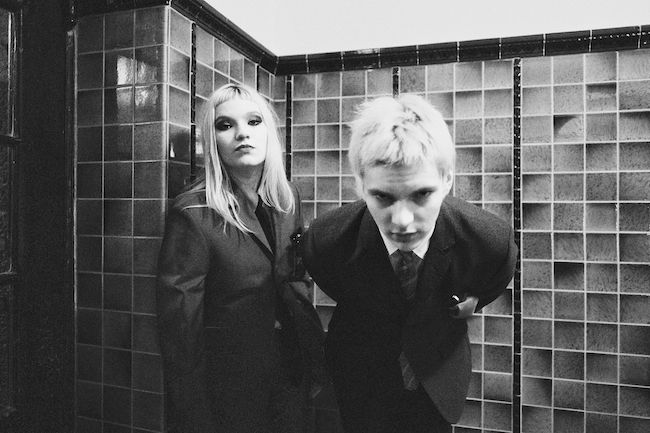
photo: Nick Benoy
While Channel 4’s headline was obviously an exaggeration, the Molotovs do deserve some of that credit. In an age of algorithms, they have built their fanbase the good old-fashioned way, through relentless touring, with more than 600 gigs already under their studded belts. And their early busking days helped them hone their live skills. “It was a really good test, because you’ve got to grab people’s attention really quickly; you’ve got maybe about five seconds when they’re walking past,” explains Matt.
“We got rid of a lot of fear as well,” says Issey. “You’re not on a stage, you’re not on a pedestal — you’re at the same physical level with people. To make fools of yourself out on the street, you had to be completely delusional and so into it at the time. And I think that’s kind of translated to how we perform now. There really are no inhibitions when we play.”
“We’re not delusional anymore,” Matt grins.
As London’s stay-at-home orders eased a few years ago, the Molotovs began to build a buzz on the club circuit — Issey smilingly recalls impressionable young fans turning up to their gigs dressed in the band’s signature Mod style, which was a promising sign. Eventually, the siblings used their platform and launched an initiative called Youth Explosion to support struggling post-pandemic venues.
“We wanted to set up these all-ages gigs, really accessible with £3 tickets, just to get a kind of new generation into music, because they weren’t exposed to it. They’d never been to a gig before,” Issey explains. “We’d curate the lineup with other bands on the scene, which there were a lot of and still are; there’s some great guitar bands in London at the moment.”
“We got a lot of younger fans because they were at the right age when lockdown was [happening], where they weren’t doing much anyway. They didn’t go out, and they weren’t of pub-going age,” says Matt. “So, now that they’re out of [lockdown] and they’ve seen us coming up, they’re of that age where they can go see gigs. And I’m really proud of that, because I’ve been in their shoes at that age. … It’s a nice feeling, because I’ve always been the baby of all the bands that I’ve seen or been around or been on a bill with; I’ve always been the youngest one. And for the first time in history, I’m not the youngest one anymore! And I feel like such nonce even being around them.” (Matt, still clearly too young, too stubborn, or too punk-rock to be media-trained, then adds quickly: “I’m not, by the way. I feel a bit weird having to clear that up.”)
“I think part of our success has been because people have really taken to us as individuals, through the gigs and feeling a kind of loyalty, and from the people that they meet in those [rock venues’] rooms. You can’t get that kind of sense of community through online and social media,” says Issey. “And that can’t die, those sort of third spaces.”
It was at one all-ages benefit gig at a historic West London third space, Bush Hall — with all proceeds going to the struggling grassroots music venue, which was in danger of having to close — that the Molotovs made their first connection with the Sex Pistols, when Pistols drummer Paul Cook hopped onstage for an impromptu jam.
“I saw him in the crowd while the support band were playing, and I just said to him, ‘Oh right, Paul, are you getting up for a tune?’” Matt chucklingly recalls. “And he was like, ‘Nah, I’ll leave this to the kids.’ I was like, ‘Yeah, all right, everyone’s got to be a punter sometimes.’ But towards the end of the set… I just saw that he missed it, that he missed this feeling of all these young people jumping and going mad, that excitement and unity in a room of youth and arrogance. And he just went, ‘Yeah, we’ll do “God said the Queen.’” I mean, he knew it!”
The Molotovs’ rise comes at a troubled time in British history, a post-Brexit age, that has obvious parallels to the bleak period of unemployment and unrest that fired up the Pistols in the late 1970s — so the connection between the two bands, despite their generation gap, makes sense. The Molotovs have “a “bit more hope” than the Pistols, who once famously declared that England had no future — “I mean, we think there is a future, and we think we can contribute to that,” Matt stresses — but Matt also acknowledges that “we’re in a sort of weird time in the U.K. at the moment, and I think in the world. … We’re definitely in a decline at the moment, but always in history, I think great art and great music comes out of that.”
When the Cartlidges — who, perhaps unsurprisingly considering their impeccably peroxided style, are the children of hairdressers, and resent how blue-collar jobs are still “frowned upon” and seen as “stupid” and “lesser-than” in Britain’s “entrenched” class system — are asked about the greatest concern about their young fanbase, Issey answers: “Everyone wants the same thing, which is stability. Young people want job stability. They want to be financially independent. They want to have friends and a community identity. This is all the sort of stuff that no matter where you are politically, it rings true. We want to champion that through our songs and through our gigs as well, and give people that kind of space and find something to energize them.”
“I think just money. Money more than anything,” Matt answers more bluntly.
“And isolation as well,” Issey adds, as she and her brother reflect on the challenges that Gen Z, who came of age during COVID, face today. “I think a lot of people are isolated and feel hopeless and helpless. … There is definitely a pessimism at the moment and that kind of same [’70 punk-era] nihilism, and you see that in voter turnout, especially for young people. But I think there’s some great movements at the moment in the U.K., and I think music is driving it forward and providing hope to people that they do have a power. And it’s [up to] them to start enacting it, having agency to go and do things.”
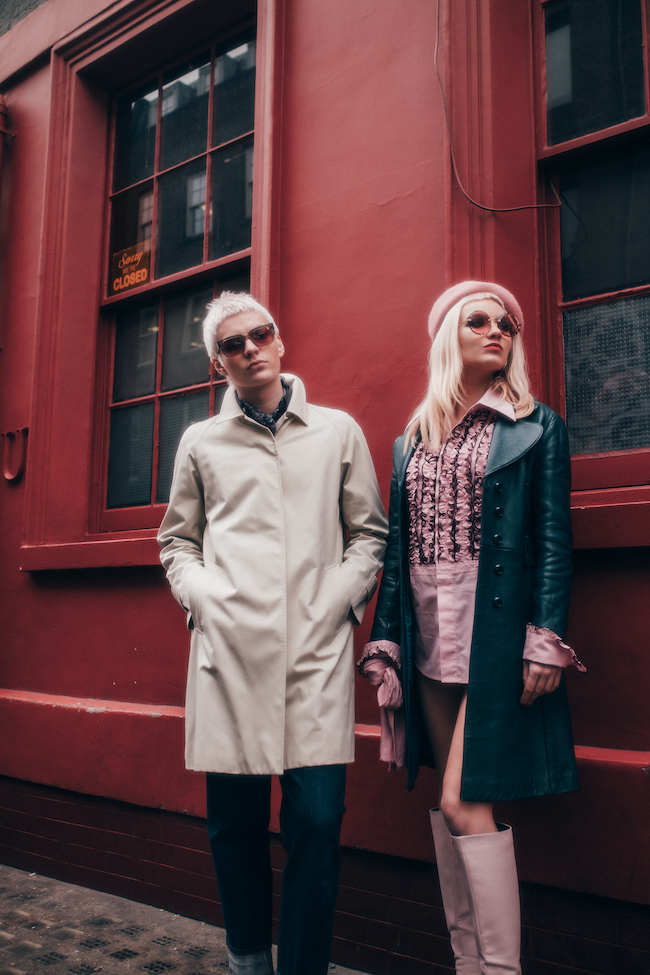
photo: Derek Bremner
“But there is a whole lot of [apathetic young people who think] ‘what’s the point?’ as well. “What’s the point in registering to vote?’ or whatever,” Matt interjects. “My best mate doesn’t vote… and I think that’s such a lazy view to have. It’s like, you might not have much faith in the system, but you’ve gotta have fucking some, because otherwise, what else have you got? What else are you doing to make it better? … At least believe in bad and worse.”
“Totally,” Issey agrees. “That laziness will be the killer of us all.”
Matt and Issey are obviously the polar opposite of lazy. And while not all of Wasted on Youth (which draws from the old-school influences gleaned from their stylish father’s record collection, like the Jam, Boomtown Rats, Buzzcocks, Squeeze, Elvis Costello, Undertones, Stiff Little Fingers, Specials, and Small Faces, but also brings to mind NME-championed “the” bands of the indie aughts, like the Fratellis, Subways, Futureheads, Wombats, Kooks, and Cribs) is overtly political, they do audaciously describe the album as a “youth manifesto.”
For instance, one Wasted on Youth track, “Daydreaming,” blasts Britain’s education system and the myth being sold to Gen Z that getting a “flashy degree” will guarantee a bright future. (Matt found Career Day “fucking useless” when he was in school, because counselors always advised him to attend university in case his Plan A, music, didn’t work out. “What about all these people that go to university? Do you tell them, ‘Maybe you should learn an instrument, just in fucking case’?”) However, “Newsflash,” a protest song that dates back to the Molotov’s circa-2020 roots, is the album’s boldest statement.
“It’s actually not a song that really gets talked about a lot on the album, so I’m glad you brought it up — a lot of people just talk about the singles and ‘Geraldine’ really, because they go, ‘Who’s Geraldine?’” says Matt, the band’s primary songwriter. “‘Newsflash,’ that’s a sort of anti-lockdown song. … When I was writing it, it was so scary to realize how compliant people were, and how they’ll go forth with anything that the government says.”
“[That song is about] how disproportionate [Britain’s pandemic stay-at-home policies were] on young people,” Issey elaborates. “They were left out of the conversation, and now they’ve been left behind.”
“I mean, in your formative social years, that’s when you learn to actually interact with people,” says Matt. “So many young people are starved of that experience and those teachings, and they won’t recover from that, never will, because they’re too far gone and they’re socially inept now.”
Going back to the Molotovs’ origin story, obviously the COVID-19 pandemic was a creative and productive time for the siblings. But when they took to the streets to perform, Matt recalls, “We had trouble with the police. … We had neighbors calling the police on us for playing music and things like that. Once we got asked [to pay] a 10,000 pound fine by these police officers — they said we were ‘inciting a social gathering.’”
“We showed up and played, but we were going to pack up and go and then we did one last song, and [the cops] got really arsey because we said to the crowd, ‘This is our police! This is what they’re focusing on!’” Issey explains. “And they did the fucking Colombo, came back and were like, “Oh, we’re going to give you a fine.’” (Matt jokes that he instead offered to give the officers the 50 quid’s worth of tips in his guitar case; in true punk-rock style, the Molotovs never actually ponied up the £10,000.)
The Molotovs have maintained that rebellious sprit throughout their burgeoning career. Another track on Wasted on Youth, an album released not on a major label but through Marshall Amplifications’ independently distributed imprint, is “Rhythm of Yourself” — which is about how industry big-wigs once advised the band to tweak their image and sound to better fit in with the pop marketplace.
“It was a medium-wig, I think. …. ‘Cunt’ is a good word for him,” Matt quips of the song’s shady “small man” who tried to sign the Molotovs. “He presented us with a contract which was so fucking insulting and scary; it was like, ‘You’re mad if you ever thought we’d agree to anything like that!’ It was a really eye-opening experience, that this is what the music industry can be like when you’re so young. I must have been 14 or 13 when I wrote that song, and it was like, ‘Is that really what you can do to a pair of kids?’
“The fact that they’d happily tie you off in a contract for 15 years, but they don’t like anything about what you do. They just think you’re good models for it, which I think is so insulting,” Matt continues, getting more riled up. “It was like, ‘Change your clothes, change your face and hair, change the guitars you play and what you sound like.’ They were trying to get us to get all grungy, getting baggy jeans and saying, ‘Oh, we’ll get you a sponsorship with Vans.’ I don’t want a fucking sponsorship with Vans!”
“It’s a song about a personal experience, or inspired by Matthew’s personal experience in the music industry, but it’s also just a wider claim — for people to march the beat of their own drum, dance to the rhythm of yourself,” adds Issey.
And so, the Molotovs have continued to defy expectations and the odds. They’re especially proud that they went to No. 3 in the U.K. charts with a physical, vinyl release. “It just shows that there’s still the consumer base there for this sort of stuff, and people are still very much interested in vinyl; it’s not dead yet, and we should acknowledge that,” Issey declares. “We love to champion physical media. This is what cultivates a scene. This is what brings people together.”
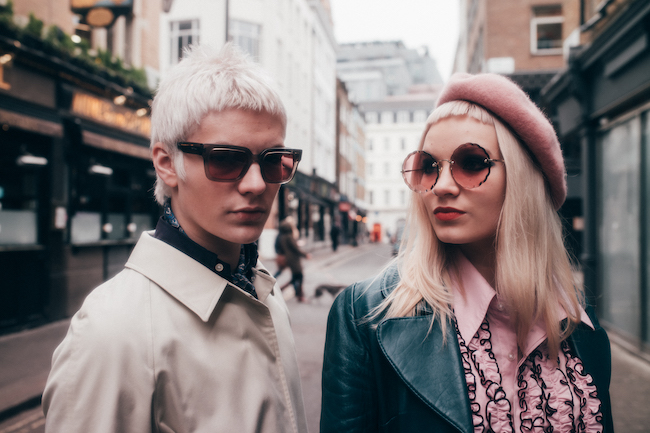
photo: Derek Bremner
The Molotovs have already begun work on their sophomore album, but as they continue to draw accolades from both their peers and predecessors, they have a few dream collaborations in mind. Matt says he’d love to work with fellow bottle-blonde Sabrina Carpenter (with his wry and dry British sense of humor, it’s unclear if he’s joking, but that would probably be awesome), and Issey wants to work with The The’s Matt Johnson, one of her favorite songwriters that she think would be “a very interesting person to just even just talk with.” But the collab that seems most likely to happen one day is with Matt’s early hero, Green Day’s Billie Joe Armstrong, who is reportedly already a big Molotovs fan.
Matt almost got his chance years ago, when security guards at a Green Day concert almost picked him to come onstage to jam on guitar, but instead invited another audience member with (hard as this may be to believe) a “better haircut.” Matt was “gutted at the time” and found it “hard to enjoy the rest of the gig,” but is now relieved to not be known as the viral kid who “got picked by Billy Joe to come onstage and play one cover song. … I’d never get fucking away from it!” And now, as a rock star in his own right, with a fantastic coiffure, he seems ready for the opportunity.
“The closest we got is [Armstrong] played a pub in Covent Garden called the Marquee, which we’re at all the time. You can see in all the videos, Matt’s bleached-blond head just outside the window, bobbing up and down, just wishing to get in, pressed right up against the glass,” laughs Issey. “And while [Green Day] were coming in, [Armstrong] gave [Matt] a little nod of acknowledgement. He definitely saw him.”
“Yeah, that’s about it. He sort of pointed, like he knew who he were,” Matt chuckles. “If he sees this [interview], hopefully he can make it happen.”
Regardless, the future is obviously bright for the Molotovs, who are going to keep calm and carry on with their vision. “I’m not going to tailor [my music] to an American audience; I can only write about what I see and my environment,” Matt asserts.
“As long as we make something we’re extremely proud of… if we can make something that we think is extremely poignant or touching on our feelings about the times we’re in now, and people relate to that and connect with it, then I think we’ve done our job,” Issey states proudly. “It doesn’t matter what then the press says about it, because we know that we’ve done what we’re here to do.”
Watch Matt and Issey Cartlidge’s full LPTV interview in the video at the top of this page.