

You can take the girl out of Saudi Arabia, but you can’t take Saudi Arabia out of the girl.
Syrian-born singer-songwriter Azniv Korkejian — better known by her stage name, Bedouine, which loosely means “desert dweller” in Arabic — blissfully lived in a gated American compound in Saudi Arabia until she was age 10. Then her family won a green card lottery, and they abruptly uprooted and moved to the United States. Three decades later, as she discusses her fifth album, Neon Summer Skin, it’s clear that she’s still trying to find her way back home, if only metaphorically… and that maybe, this album got her a little bit closer.
“That was life-shattering for me,” Bedouine confesses to Licorice Pizza Records’ LPTV, semi-joking that her childhood relocation to America is “mostly what I’ve discussed in therapy! … My world was literally turned upside-down.”
Neon Summer Skin, Bedouine’s first album since 2021, was inspired by a recent bittersweet trip to see her family in Saudi Arabia, and it explores themes of displacement and belonging, or longing to belong; it is even described in a press release as “mourning the end of her childhood.” Bedouine recalls: “I was feeling a lot of things and I was really emotional about it, and I just thought that I better sit down with this and try to understand what it is and unpack it. And that’s when the songwriting started.”
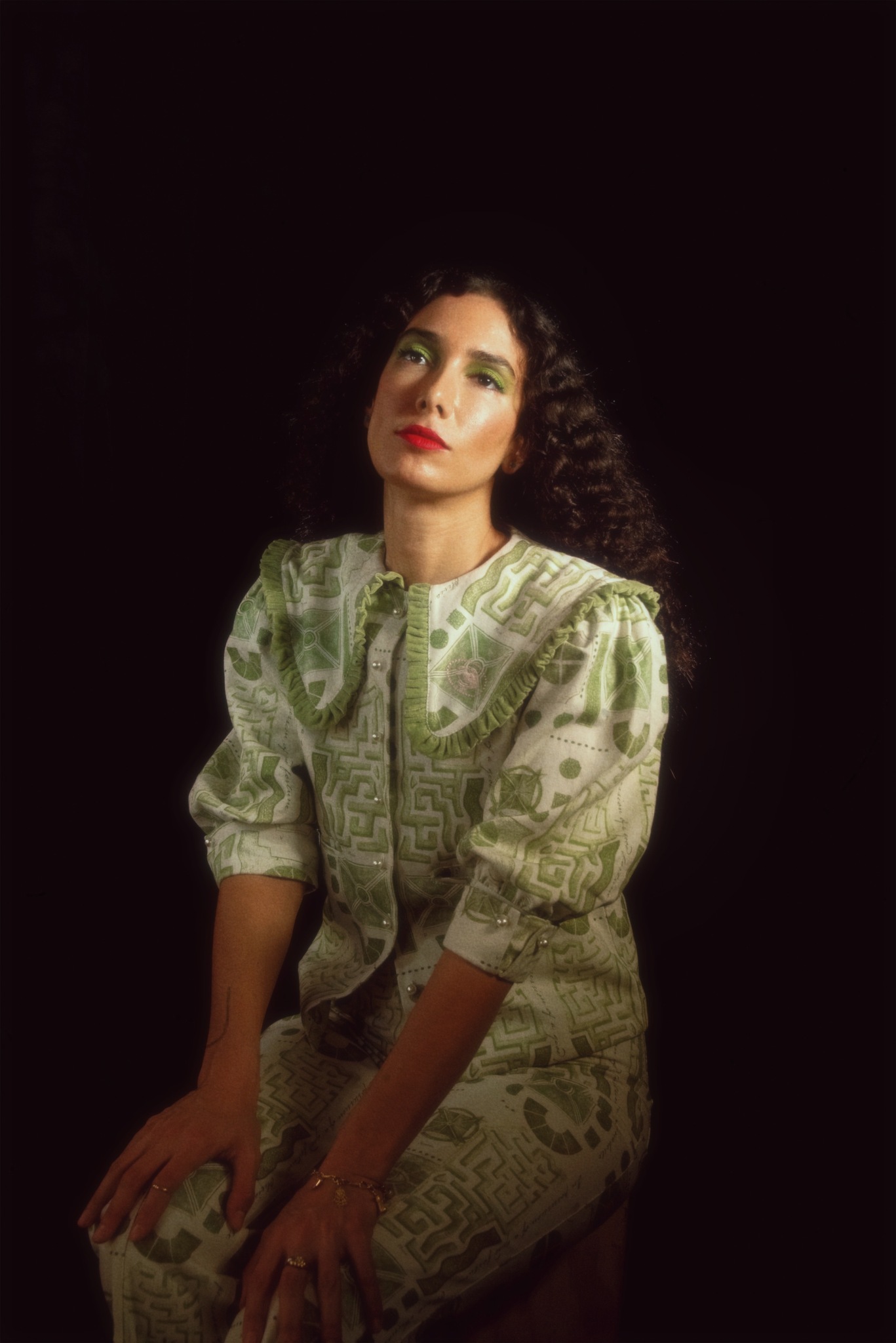
photo: Janell Shirtcliff
At the heart of that creative process, and of the album itself, was a stunningly candid conversation Korkejian had with her mother — recorded audio of which Bedouine later incorporated into Neon Summer Skin’s centerpiece, “Canopies” — about her mom’s harrowing childhood in a Syrian orphanage. That track, which Bedouine made available for early purchase on her Bandcamp page in April for Armenian Genocide Remembrance Day, is followed on the LP by only the second Armenian-language song Korkejian has ever recorded, “Deghma Cheega,” which is about “the resilience of immigrants and coming to terms with the fact that you might not find a place to call home in the same way, but you just accept it and keep moving,” she explains. “There’s a little bit of cognitive dissonance… the placement in the record, it being right after my mom’s interview at the end of ‘Canopies,’ where it’s just like, ‘That’s life. We’re doing our best.’”
Korkejian tells LPTV that she now realizes that “belonging to a diaspora… having had an American education in an Arabic country, having an Arabic background or Western Asian background in an American country,” and her nomadic existence in general, ultimately “primed” her for a life as an artist and musician. “I think that my initial move from Saudi Arabia was so jarring that I was like, ‘Well, now it doesn’t matter where I go.’ So, it gave me a sense of freedom, like, ‘OK, nothing’s going to be worse than that, so I may as well just have fun with this.’ So, I just kind of went where life was taking me.”
However, after living in Los Angeles for 15 years (the longest she’s ever stayed in one city); becoming a mother herself (she and her longtime romantic and creative partner, record producer Gus Seyffert, welcomed their daughter Vera in 2024); and processing her family trauma on her most personal album yet, Korkejian does finally feel more grounded. “I’m slightly less nostalgic than I used to be — but still nostalgic,” she smiles.
In the extended LPTV video above and the edited Q&A below, Bedouine sheds some light on Neon Summer Skin.
LPTV: Neon Summer Skin is your first album in five years. You don’t normally take such long breaks between albums.
BEDOUINE: Well, a lot of life has happened since my last record, and a lot of pandemic too. It’s just a lot of rebuilding and it took time, so it’s been a while.
Yes, a lot has happened since 2021! And that’s what this whole record’s about. So, you took this trip to Saudi Arabia to see your family. I know you’ve lived all over the world and you live in L.A. now, but you grew up in Saudi Arabia until you were 10. The whole theme of childhood, and revisiting your childhood and the pain that can come with that, is at the core of this record. Tell me about this trip, and how and why it inspired you.
Well, I didn’t expect to visit my parents so much in Saudi Arabia when they moved back from the States, but unexpectedly, I started to tour Europe every year or so. And every time I toured Europe, I tried to stay behind and tag on a visit to them, so it became kind of a regular thing. I would go see them and spend more time on my old stomping grounds than I ever expected to as an adult, and it rekindled this relationship with the place where I grew up, which I already had such a soft spot for because I’m such a nostalgic person to begin with. Every time I went back to visit my parents, I’d basically revert to my childhood. My parents are very old-school, doting, immigrant parents where they’re doing my laundry, they’re bringing me lunch — they’re offended if you do your own laundry. And I’m fine with that! I actually really like spending time with them. So, I felt at a huge loss when I came back, and it slowly dawned on me that it might have been my last visit, because my dad was going to retire and they would no longer be living there.
Both of my parents were born in Syria, and my dad was just an immigrant worker. He took a job as an electrician in Saudi Arabia and stayed there and kind of worked his way up with this company, and he was essentially given room and board for his family at what was an American compound when we were living there. We all grew up in this really sheltered environment, and that’s where I got to go back to, because he was still working with that company. When it was coming time to retire, we were kind of folding it all up, our whole everything, the whole childhood, and I had really big feelings about that. It dawned on me that I might not ever go back, because even though I’m really sentimental about those places, it’s really the people, just as much as the places, that make them what they are. I was feeling a lot of things and really I was emotional about it, and I just thought that I better sit down with this and try to understand what it is and unpack it. And that’s when the songwriting started.
You’re of Syrian descent and were born in Syria, and your early childhood was in Saudi Arabia, but you were living on this American compound and even went to an American school. And then your family eventually moved to America. It seems you had your foot in two different worlds.
Yeah, absolutely. I feel like I was kind of primed for this experience because it dawned on me also the other day that was like belonging to a diaspora: You always kind of feel in between. It dawned on me that I was kind of primed for [this life], having had an American education in an Arabic country, having an Arabic background or Western Asian background in an American country. It’d always been a blend. This is all I know.
There’s a feeling throughout this album of displacement or not really having a home. I know that even though you were young when you left Saudi Arabia, you’re still nostalgic for it, and you were really sad about leaving. You’re maybe still a little sad about it.
I mean… [laughs]
Not in a bad way!
Absolutely. No, no, no, I don’t think it’s bad to be sad. I fully believe in leaning into your sadness and trying to understand it and not distracting yourself from those kinds of feelings. I’m just laughing because it’s like, you don’t have to give me a disclaimer. I’m fully on board. I’m OK with that. Yeah, that was life-shattering for me. Like, mostly what I’ve discussed in therapy is leaving Saudi Arabia when I was 10 years old, because my world was literally turned upside-down.
Your parents entered and won a green card lottery to come to the U.S., so obviously they wanted to come here..
Ish?
So, my dad actually was trying to get us Canadian citizenship.
That’s the green card lottery I’m trying to get in on!
Exactly! He was trying to get us there, and there were a few reasons for that. … We were in Saudi Arabia and the politics were starting to get a little funny; we lived there for the Gulf War, and I think he was just feeling like it’s time to get out. He couldn’t get us Canadian citizenship, and his friend just made an off-the cuff-suggestion, like, “Why don’t you try to get American citizenship?” And he was like, “Oh, I don’t want to go to America. That place is a business, not a country.”
That’s a good line. That’s a lyric, almost.
Exactly. I mean, I thought that was a really profound thing to hear as an adult. And so, his friend was like, “Just try, you won’t get in anyway.” And he did, and we did. And thank God we did. I’m very grateful for it. But we made our way to America after going through this really rigorous process and vetting and all this stuff, and ended up moving when I was 10.
Even in the U.S, you didn’t stay put — you live in Los Angeles now, but you’ve lived in Texas, Georgia, Boston, Kentucky, all very different parts of America. Are you still searching for a sense of home? Did making this record maybe make you get there, or closer to that?
I think that my initial move from Saudi Arabia was so jarring that I was like, “Well, now it doesn’t matter where I go.” So, it gave me a sense of freedom, like, “OK, nothing’s going to be worse than that, so I may as well just have fun with this.” So, I just kind of went where life was taking me and I kind of used school as a way to bounce around, follow where I could get scholarships or grants and things like that and have fun with it, while I discovered what I wanted to study. I was just kind of pulling threads and trying to figure out where to go. This is the longest I’ve stayed put since then; I think I’m going on 15 years now in L.A.
You’re an L.A. native now!
Yeah, I guess so. I mean, I don’t know. I definitely have slowed down. I’m not like I was in my twenties or early thirties, when I was kind of restless and wanted to stay light on my feet. A sense of home is really important to me, and it’s not maybe as heavy as it was before, but a place to be comfortable or hang your hat for a while. But I don’t think I would be as attached to any place like I was to Saudi. So, it’s in a sense liberating.
I found it really interesting and surprising to find out that you didn’t really start playing music or writing music until you were about college-aged. And it was relatively late in your life that you actually started releasing solo music. You were doing stuff behind the scenes in film and video games, but in terms of being “Bedouine,” you were in your thirties.
Yeah, I was 32 for the first record. … I never once expected for this to be realistic, like a realistic ambition, so I wasn’t actively pursuing it. But I feel in the back of my head, I always thought if the opportunity ever presents itself, I want to be prepared. You know how they say “luck is opportunity meets preparation,” or something like that? I always kind of wrote and played and just did this thing for myself, and I thought if I ever met someone that wanted to put my record out, I would have something to share. And in the meantime, this is just how I express myself, which I think is very important. I think everyone should figure out how to express themselves, so they don’t bottle up their feelings. But no, I moved here to be in post-production. I studied sound design, like sound-editing essentially for film and TV, and I moved here for an internship actually just down the street [from Licorice Pizza]. I’d come to Studio City every day, got my hours to get into the union, and then I pivoted to music-editing for film. And I was just getting my footing there when I met someone that wanted to put my record out. It was a very, very gradual development.
I wonder if that gradual development had anything to do with the fact that your first introduction to playing music was strict, militant piano lesson as a kid, which kind of soured you on playing music.
Well, when your mom forces you to do something, it’s a very easy thing to rebel against, right? She made it too obvious that that’s what she wanted me to do; if she had played it cool a little bit, I probably would not have quit. And I wish I didn’t, but she had me practicing piano so strictly that when we did make the move to Saudi Arabia, I was so just emotionally wounded that I was like, “This is how I get them back. I’m going to quit the piano! I’m not going to continue my piano education!” Boy, did I show them [laughs].
Well, that brings me to the final track on Neon Summer Skin. There are two versions of “Canopies” on the album, but the last song is an instrumental piano version [played by Drew Erickson, who’s worked with Lana Del Rey and Father John Misty]. Was there some kind of full-circle meaningfulness to doing that, especially since it ends the album?
That’s a really good observation. … Some of that was just a sonic curiosity, and then otherwise, there was an emotional meaning to it too, returning back to my first instrument, the relationship that alludes to with my mom and just the coming-of-age of it all. It felt like a really nice nod, like a ribbon to tie the whole record with.
But the other version of “Canopies” is the real centerpiece of the record, because of the story behind it. You a recorded conversation with your mom when she was living in Texas at that time, and used that audio on this song.
Yeah, we were just running an errand, going to get some food or something, and I caught myself asking her the same kind of questions I did about her past or upbringing. And I just thought, “I better record this, because I want to remember the details.” I’m not so good at that to begin with. And you get to an age where you’re also more aware of your parents’ mortality, so it felt like something important I should have.
Your mom went through some pretty traumatic stuff in her own childhood. Sometimes you’ll talk to a parent or a grandparent and they’ll start telling you something about their childhood and you’re like, “I never knew all this. How am I just finding this out now that you went through this?” So, how much did you know about her story about being in an orphanage?
I vaguely knew that she was put in an orphanage. In Lebanon, your custody defaults to your mother until you’re age 7, and after that the father has some rights to basically just kind of pluck them out of their household. And my mom’s dad was abusive and her mom was trying to protect her from him, so she decided the safest place to put her was in this orphanage in Lebanon. They fled Syria and she put her there and she stayed close by, and it was like the ultimate sacrifice she made for her [daughter’s] own safety. [My grandmother] stayed close by at a relative’s house and would visit [my mom] during visiting hours. I vaguely knew because when we visited Syria as a kid every year, we’d sometimes take this overnight bus to Lebanon, and my mom would go visit the orphanage and sometimes donate it to it when she could. So, I had been there, but I think I was too young to really appreciate the gravity of it. This felt like the first time that I was really, really hearing it. And she opened up in ways she hadn’t before and shared details with me that she hadn’t before; those really struck me, and that’s what inspired the song.
What specific details surprised you?
Namely, it was really that phrase that her mom would say. Her mom would sit at this balcony nearby and say something that translated to “the waves of Beirut flutter and blow my daughter’s scent to me, her essence to me.” She would sit there and just take in the air and just think of her daughter. [My mother] says it in Armenian on that recording, and it sounds so beautiful and so poetic that I knew at some point that I would have to build a song around that. And it eventually became basically the heart of that song.
What does your mom think of “Canopies,” and how did she feel about the fact that you wanted to put her actual voice on it?
My parents, they’re so subtle. I imagine a lot of musicians’ parents are like this — they’re just not ever sure what we’re up to.
They don’t really get it. You could win a Grammy and they’re like, “Oh, good for you.”
“Oh, that’s sweet.” [laughs] I think that I was fortunate enough to have a TV performance with my first record on Seth Meyers’s show, and that was maybe the first time they were like, “Oh, OK.” But I think it’s still relatively unclear to them, which I don’t blame them; I hardly know what I’m doing half the time! I think she’s delighted, but it’s like pulling teeth getting them to talk about themselves. It’s like this immigrant survivalist thing, where you have to really take some pulling to get at some heavier stuff.
I think a lot of Boomers and members of the Silent Generation have that suck-it-up mentality. Like, “Oh, it wasn’t so bad. Yeah, I was in a soup kitchen with no shoes, but it was fine. No big whoop.” Anyway, it’s cool that they’ve supported your career, even if they don’t quite grasp what you’re doing. When you initially wanted to go into music, whether it was behind or in front of the scenes, were they cool about it? Because a lot of parents, of any background, would be like, “That’s not a stable career. You’re not going to make money doing that. You should go to law school, or marry a rich man, or become a doctor” — literally anything besides becoming an artist.
There was a little bit of that. They were like, “What are you doing? Does it pay?” I think there was a certain amount of trust involved, because they did see me get my degree and maybe that was just enough for them. … They definitely want the best for me and want stability for me, but I think that they were also dealing with so much of a culture shock moving to America that they were still learning English. So, maybe part of them was just trusting that [their kids] would find our way.
Is the song “Always on Time” about that cultural or generational gap?
I think it’s more about personal milestones or starting a family, feeling like you’re behind in general or feeling like you should be further along and the tendency to compare yourself to other people. It’s just a reminder that there’s no right or wrong way. It was a reminder to myself, at least, that there’s no right or wrong way to go about anything, and that you can only really compare yourself to yourself. It was just a cathartic thing to write.
How many siblings do you have?
Two. And they’re both brothers. I’m the youngest.
What are the dynamics of being the baby of the family and the only girl?
I mean, I don’t know any other way, so it is what it is, but I probably was toughened up a bit as a kid. I saw how they operated, and maybe it calloused me a little. … I think maybe I was a little bit boyish growing up because of them.
I assume your family has heard this record…
Actually, no! I don’t think they’ve heard this whole record! They’ve heard the singles. Actually, my mom’s heard the song in Armenian because she asked me, “Have you been writing in Armenian again?” She was kind of tickled by that, because I only have one other song in Armenian.
Has she actually heard “Canopies,” though?
Yes. And actually, it occurred to me that for “Always on “Time,” I made a music video that kind of alludes to “Canopies” by having a locket — like, the focal point of this video is this locket where I lose the photos that are supposed to go inside of it, and the photos are my mom and her mom. So, it kind of alludes to “Canopies.” I watched it [with my mom] the morning the video came out. I was video-chatting with her, just catching up, and she said, “I saw you have a new video out. I’m going to watch it as soon as we get off the phone.” I said, “You know what? Can you watch it while I’m on the phone with you?” … It occurred to me that it actually might have some weight to it for her. I even recorded a screenshot video of her watching it, and I saw it affect her. And that’s a pretty rare moment. It doesn’t always occur to me to share things with them.
I feel you and your mom need to perform “Canopies” together on a late-night talk show, like Seth Meyers again.
I would love to involve her. I would love to do something like having a little cooking segment where she teaches us her Armenian dishes or whatever. Actually, she’s making some merch for me because she loves to crochet, so she’s crocheting these coasters and these scrunchies and stuff.
That’s really wholesome. Tell me about the song in Armenian that is on the album.
It’s called “Deghma Cheega.” It’s a track about, I guess you could say, the resilience of immigrants and coming to terms with the fact that you might not find a place to call home in the same way, but you just accept it and keep moving. There’s a little bit of cognitive dissonance between the tone of the track and the lyrics, and I think that rub is very intentional. And also, the placement in the record, it being right after my mom’s interview at the end of “Canopies” where it’s just like, “That’s life. What do you do? That’s life. We’re doing our best.”
Was doing a song with that kind of theme, or this album in general, in any way inspired by what’s going on in our country right now with immigrants and ICE?
It’s really difficult to separate the two. I feel like there’s some awkward shapeshifting that happens when you don’t have any reflection on what’s happening in the world. But I will say that this album was so deeply personal; I think it’s easy to apply it to things that are happening right now, but it’s really, deeply personal. I wasn’t quite thinking about things like that. And also, it was written years ago, maybe like three years ago. I’ve been sitting on it for a while. So, it’s not super-topical, but I still think it applies, absolutely.
Well, what’s happening with ICE is terrible, so I think it’s good timing that a song with that kind of perspective is coming out now, even if it’s coincidental.
For sure. And I think those things, they don’t expire, sadly. They seem to be cyclical or something.
So, you have only ever done one other Armenian-language song in the past?
Just the one other called “Louise,” which has a similar subject matter as well. I didn’t expect to do another one… It kind of feels like the cousin to this song.
It seems a lot of Armenian or Armenian-American artists who usually primarily sing in English — System of a Down probably being the most high-profile one — tend to cover Armenian songs in concert, but they don’t do many studio recordings in Armenian. Do you ever cover classic Armenian songs?
I don’t, but I would love to, actually. That’s something I thought about doing, like having an album’s worth of older Armenian songs. I hope that’s something I actually get to do, but I haven’t done it. The singing is quite different, so it would be a very different challenge.
How is it different? How is it challenging?
Just the kind of vamping that goes on in the vocal lines and stuff. It’s just very different muscularly and it would take some practice, but I’m down. I’m down to try. The songs are beautiful.
I understand that you speak in the Western Armenian dialect, but even though L.A. has the world’s biggest Armenian population outside of Armenia itself, that dialect has been an obstacle for you here.
Yeah, for sure. It’s very different, and sometimes there’s a language barrier when you come across someone that assumes that you’re Armenian, because my name is very Armenian. So, when they try to open up a conversation, there’s like a little bit of hanging on for dear life and then you’re kind of like, “Oh, I don’t really understand. I’m from this place.” And there’s a little bit of, like, shaming that’ll happen sometimes.
Is there a stigma if you’re speaking the Western Armenian dialect?
I have experienced it, yeah, which is frustrating because we’ve had very different trajectories, Western Armenians and Eastern Armenians, but we can both celebrate Armenian Genocide Remembrance Day — like, that’s the reason our dialects are so different! It’s a tricky one, because there is the biggest population here, but I don’t necessarily always feel connected to it. It’s a very different culture.
I guess that sort of ties into a lot of the themes we’re talking about with this album, of never fitting into one place or one community.
What kind of music did you grow up with? Obviously you had an Americanized/Westernized upbringing, but what types of music from around the world were you listening to?
Really, it was very Americanized, my exposure to music, because of the time difference. Like, we would come home and watch The Simpsons and The David Letterman Show and wake up to MTV music videos. I would wake up early and have my little handheld tape recorder and tape the music videos’ sound. It was a lot of Nirvana around then. And then I would go to school with my little tape recorder and play it back during recess and walk around the soccer field like an angsty teen, when I was just like 8 or 9. I remember also my first records were Boyz II Men and Mariah Carey’s Music Box, and I had some Michael Jackson and whatever was on MTV at the time.
That’s interesting, because a lot of music critics reviewing your records namecheck all these ’60s and ’70s folk artists, like Joni Mitchell or Nick Drake. Were you into that music too?
I wasn’t at all! I don’t think I even knew Nick Drake until after my first record was out and people were saying I sounded like Nick Drake. Now he’s one of my favorite songwriters and I consider it an honor to be compared to that.
How do you think that classic folk sound got in there, then, if you were raised on Nirvana and Boyz II Men? And how did you react when those comparisons started happening?
My reaction was just, I don’t know, I felt kind of detached from it, because there was a lot of really great, positive feedback and I just didn’t really want to feel too reactive to it or affected by it. … It’s super-flattering, but I don’t know if I always heard the references myself. I think probably my producer had a lot to do with it, Gus Seyffert and his method of recording, which was on tape and keeping things pretty minimal and stoic. But also, I think the format — just the way that I gravitated to guitar was finger-picking, for some reason, and so everything kind of had inherently this very simple, throwback folk thing to it.
How did you and Gus meet?
When I started working from home doing sound editing, I all of a sudden had more time on my hands, and I started picking up the guitar more often. I started writing a lot. … I was doing more and more voice memos on my phone, and around this time I was listening to Sybil Byers’s records, and it was a ’60s record of basically her on, I believe, a nylon string [guitar], on like a reel-to-reel tape machine. And I really liked that idea. I knew of Gus, I didn’t know him very well, but he was “the analog guy” in Echo Park. And so, I just hounded him and asked if I could maybe borrow his TASCAM machine. I finally got over there and asked him a bunch of questions, and he was running this small house in Echo Park which he’d essentially turned into a studio where there’s pedals in the kitchen drawers — there’s no food anywhere, but there’s guitar pedals in the cabinets and there’s an amp in the bathroom, one of those kind of places. … All of his stuff was set up and we did a song called “Solitary Daughter”; we did two takes of it, and that ended up on [my debut album in 2017]. And so, the first song we did together ended up on the record, and we kind of had an understanding that we would continue to work together.
The last song on Neon Summer Skin that I want to ask about is “One Thing Right.” We’ve talked a lot about family in this interview, but that song is about chosen family. And that’s a big thing, particularly in Los Angeles. There are so many people who live here who were not born here, weren’t raised here, have no family here. I was wondering if there was any L.A. inspiration behind that song.
Yeah, totally. When I do feel at a loss with my family or they just feel so far away, I try to remember that I have a few friends really close by that do feel like family, and that we do have that in our control. Because as close as I am to my family, not everyone has that sort of relationship, and chosen family is just as important, if not more important, to a lot of people. [That track] is a bit of an outlier [on the album], but I think it still works.
Your Neon Summer Skin press release says this album mourns the end of your childhood. That statement jumped out at me. So, what kind of closure or understanding or processing, that you maybe you didn’t have before, did you come to have while making this record, or when you listen back now?
I think just working through it long enough to write all these songs was really cathartic. I think any time you write something, you get to put away the feeling. It’s like seasonal clothing, like putting your sweaters away. Not that it’s gone completely, but I think that there’s something to compartmentalizing things like that, and also facing them long enough in order to do that, like sifting through it. I’m a big believer in sitting down with your feelings. So, I think just sitting down with it was a huge help. I’m slightly less nostalgic than I used to be — but still nostalgic.
I think nostalgia is a good thing, as long as you don’t fall prey to the mindset that everything was better in the past.
Yeah. I don’t think everything was necessarily better then. I just feel like a kid and honestly, it connects me more to my parents. … It’s that realization that everyone has at one point or another: that their parents were just people, and maybe they felt like kids once, and maybe they still do. Because I always feel like a kid, and maybe in a way that just connects me to everyone.