
Alt-rock singer-songwriter Whitney Tai may have just released an unexpected cover of the theme song to That Thing You Do!, but her most recent full work, the epic concept album American Wasteland, is a movie unto itself. Created with producer Tom “Tommy Hatz” Hatziemanouel between 2021 and 2024 — obviously a tumultuous time in the world, but also in Tai’s personal life, as she dealt with the death of her addict father and the end of a toxic long-term relationship — it’s her most personal and defining artistic statement yet.
“I would say this album is the most me,” says Tai tells LPTV, sitting at Studio City’s Licorice Pizza Records before performing American Wasteland live in its entirety, with a full band, for the first time. “It’s the most organic and rustic and folky. I’m very inspired by ’70s folk music, but I’m also a ’90s kid, so I love grunge and alternative metal. At the end of the day, you wash a pop sensibility over that from my ‘90s experience, and this is the amalgamation of this album has become. It’s all my influences, all the things I want to sing and perform, wrapped into one. And I don’t feel like there’s any compromises on myself in this record.”
In the edited Q&A below and extended video above, the renaissance woman opens up about the family that has shaped her (the death of her mother from cancer when Tai was 10, her fraught and complex relationship with her dad, the vaudeville in her blood, being parentified, and how her grandfather encouraged her to pursue her dreams); her return to music after giving it all up for a 9-to-5 life; how her past architecture career and her love of nature influence her aesthetics; and how making American Wasteland saved her life and became her “peace.”
LPTV: American Wasteland has been described as a concept album. Is that accurate? And if so, what’s the concept?
WHITNEY TAI: American Wasteland began sort of like this subconscious journey into my own personal trials and tribulations, dealing with abuse and narcissism and just people and situations that were causing me mental health issues. For a while I was writing this record and I didn’t even realize that while I was writing it — that I was working through circumstantial triggers and problems around me. My body could feel that there were issues going on, but it didn’t really know, on the outer cortex, how to process those yet. And as things started to come into fuller focus, the concepts I was dealing with interpersonally started to connect to those outer worlds. So, it’s like looking at things around us — like, people around us could treat us like trash, they can manipulate us, they can abuse us, but it’s also happening at a larger scale from corporations, from big tech and healthcare organizations. It’s just everywhere we look; we are being reduced to a piece of waste. And so ,this album is really just to reclaim that sense of purity. … The title track was written at the end of the process of writing this album. I sort of tied it all together because it was like our anthem song. It was like: “Fuck you. Yeah, we’re waste, but we’re also not waste.” Like, you can bury as deep down as you want, but we’re still going to climb the fuck out. It felt good to reclaim and tie the record together from it not just being a microcosm, but a macrocosm at the same time.
This record was written between 2021 and 2024, which was a really tumultuous time in the world and this country. But your father also passed away during this time.
Yes, at the end of the record being done. It was almost like this chapter closed on everything. My dad was one of my earliest musical pushers or inspirations to go into music, but he was also one of the most complicated people in my life, because of how his struggles with alcohol abuse and drugs impacted me as a child and caused me to go through a lot of suffering. And so, there’s a song on the record called “King of Wands,” and at the beginning of the song, there’s an old voicemail he left me where you can hear him kind of guilt-tripping me yet again I put it in there because there’s a sadness — like, my dad loved me so much, but he was a victim of his own problems and he could never escape himself. He never worked on himself. I feel like our generation is the generation of working on themselves, cycle-breaking. And our parents, the Boomer generation, they’re kind of stuck in their ways and don’t know how to take mental health seriously or even see that they’re contributing to a problem at large. And so, that affected our relationship for many years. But it also empowered me to never be like that and make sure that if I do anything in the world, that it’s with love and passion and tenderness, and that I’m not going to fall back into habits. Because he was an amazing guitar player, an amazing musician, and he never saw those things through because he was stuck in his issues. Him passing away, it was almost like the initial aggravator of my childhood trauma was gone. I was really sad, but I was also in a way free, because I didn’t have to keep being tormented by someone.
Were you and your father close at the end, if you don’t mind me asking? Was there any closure him with about all of this?
There was never closure, but I think there was an unspoken understanding that my dad knew that he effed up and he just really never got a chance to reclaim our relationship. But I loved him anyway, and I showed up to accept him as he was in those last years, because I think he was also realizing the mortality and the finality of life. I’m fortunate that we were amicable, but I had to keep my distance just to protect myself, because as everybody in the scene knows, dealing with substance abusers is really difficult, because their behaviors are extremely manipulative and narcissistic. It’s hard to reason with that when there’s constant lying. I feel like I’ve built up such a hard shell around myself, like armor, throughout my life because I’ve always had to be the parent. I’ve had to be the mature one. My sister is special-needs, so I had to take care of her when I was a kid, and I’m taking care of her again now that he’s passed. So, it’s like my life has been dedicated to just being the strong eldest daughter.
And I know you were a caretaker to your grandfather as well. You said your dad was one of your early musical inspirations – I’ve read that the first music thing you ever did was singing 4 Non Blondes’ “What’s Up” at age 7 with your dad accompanying you on guitar — but then it was your grandfather, much later in life, that encouraged you to re-pursue your musical dream, right?
Yep. He was very father-like to me. There was this love and this nurturing there that I never really got, so that nurture just reminded me of who I was. Because I’ve had to be so hard for most of my childhood, having that softness and nurture really reminded me that I can lay back into my feminine and be myself, and I don’t have to be so guarded and running away from what it is that I desire. And that takes time. I went to art school, I did architecture, and I was practicing that for many years. But that also led me back to music. All of those things colliding reminded me that music is my true path and that I needed to be surrounded by people who loved me in a way that was gentle and unconditional, to be able to make those [career] choices again.
Was there a specific conversation with your grandfather when said, “Don’t wait, go for it now, go to back to L.A. and do music again”? I don’t think you were living in Los Angeles at that time.
He would say that very often. He was like, “My dream is to see you perform in Madison Square Garden one day.” He just loved when I would sing around the house. He never got to see me perform live; I was hoping that would happen before he passed. But he’s the one who gave me the ability to chase my dreams, because I was in survival mode when I lived in my house. I did not have any way of accessing or having time to do something like that. And so, having the time to be an artist and to dig back into music, I was able to rediscover my purpose. I think it was just his everyday slow love that allowed me to really know what was right for me.
Are there any songs on American Wasteland that are about your grandpa?
I would say that the closest song that reminds me of my grandfather would be “Sequoias,” because my grandfather was very gentle. He was kind of like that gentle voice of reason, that soft listener, that funny little banter that you need to be shaken up. And there’s a lyric in “Sequoias” that’s like, “Do you see the skyway, or are you distracted by the billboards far above the sun?” It’s kind of just a reminder of like, you have this beautiful world in front of you. Why are you looking at the materialism? Focus on love, focus on nature, focus on what matters, because all that shit’s going to fade. And my grandfather was that. He really cared about things. He cared about his family. He cared about us. My grandparents, both of them, were just all about love, and they’ve lost all their children. So, for them to even still be walking around like statues of love, after everything’s been taken away from them, inspired me when I was young. I was like, “If they can go through this shit and still choose to love and show up correctly, then that’s a choice we all can make, and I’m not going to be a victim of my circumstances.”
You say your grandparents lost their children… I know you lost your mother at a young age. Was that something that contributed to you being hard so hardened?
Yes, that definitely contributed to it. My mom was a tough chick and a businesswoman, entrepreneur, artist, and for her to go at such a young age, while I was at a young age and my sister was a young age, definitely changed the way I see the world and approach the world. I promised myself when I lost her that I was never going to do anything without the utmost purpose, intensity, and passion. Even if I have to die for the thing that I love, I would do it, because I don’t know when my last day is, just like she didn’t know hers. And my mom was very healthy. She was athletic. She was positive-minded. And she got swept away too soon. That’s why music for me is everything, and it’s the one thing that’s saving me right now after all that shit.
You have music and art in your blood, right? Your dad was a musician, albeit not professionally, but don’t you come from a long line vaudevillians, tap-dancers, et cetera?
Yes. My mom’s grandfather was a vaudeville performer and he was a part of the Borden’s Milk Quartet, who used to go around the whole country singing. My grandmother was a tap-dancer who used to dance with the Marx Brothers. Show business is in my family, and everyone’s very musical. My grandfather used to sing lots of weird songs around the house when I was a kid. I was like, “Where the fuck are you getting these songs?” They were made-up. He was a songwriter in his own right. He just loved making up little ditties and I was like, “Wow, these are really, really catchy.” It was nice to be around that.
Why did you delay your own musical career, then? You mentioned that you had responsibilities that made things difficult, but were there any other reasons why you were a relatively late-in-life professional musician?
It was a couple of things. I didn’t grow up in a neighborhood like that; there was no community around me encouraging that. It was Yonkers, New York, and there’s not a big music community there. When I was young, I wanted to be a dancer and a figure-skater. I had many passions, but I’ve always sang. I think it was when I was working for an architecture firm, a friend of mine kind of poked me and reminded me to go back into music. I started working with a producer in Europe and then my voice, hearing my songs produced and understanding what I could do and being shown the capacity of where my music could go, really made me switch something on and go, “Oh, so I can do this!” I didn’t know what was possible at the time, because I didn’t have a fruitful community around me showing me what I could do. So, it’s really just having access. That’s why schools I think should have access to music from a young age. … I think I could have benefited from having a more music-driven community.
But since you initially went into architecture, how does that inform what you’re doing now? Obviously you’re very visual, so that had to have fed into how you present yourself now onstage, in videos, in photographs, et cetera.
I think architecture and music are identical as concepts. They are applied differently, but they take the same amount of process. You need to understand harmony and composition and scale and density and empty space. There are so many concepts you use when you’re planning a space that you would use in a song. All the parts and pieces have to be harmonious. They need to make sure that they’re not fighting each other, so that each thing can shine on its own. And so, when I’m making songs, I see them like little spaces, little buildings that I have to configure to make everything work. From the melody to the chord structure to everything, it all has to flow. I think at the end of the day, most mediums, whether it’s art, painting, music, architecture, requires the same process to arrive at a beautiful, harmonious piece of work.
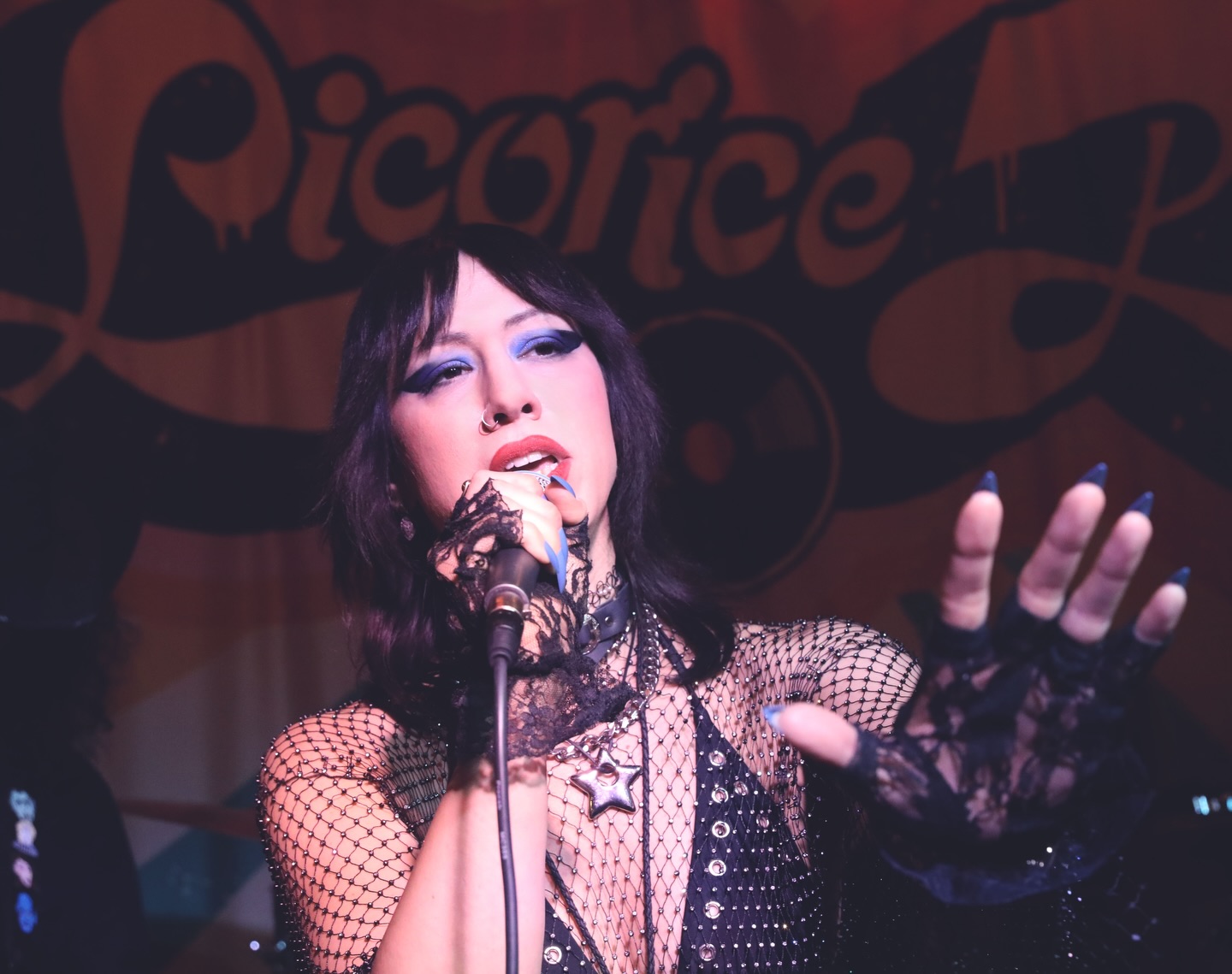
Whitney Tai performing at Licorice Pizza Records (photo: Facebook)
If you put your architecture skills to use, the sky was the limit and if you were playing Madison Square Garden on a Lady Gaga-scale tour, what sort of amazing stage set would you build?
If I was doing my own set, because I’m like a nature buff, I would probably recreate an Icelandic landscape and just have maybe low-lying fog at blue hour, and then maybe lots of stars and cosmos and beautiful moss strewn upon the stage, and then bioluminescent objects. I’d really love it to feel magical and ethereal. The lighting would be almost as if it’s in a winter kind of wonderland. I could go a million ways with it, but I’d want to keep it more organic.
Yes, I know you’re a big nature buff. Maybe people would look at you and not think you’re a granola girl or hippie or bohemian attire, but nature is also a theme on this record. That’s evident in the photography and the videos you’ve done with Joseph Cultice for American Wasteland.
Yeah, that was really fun. I had this vision in the beginning that I wanted to be this modern-day wasteland, an Ophelia that’s like drowning in this disgusting moat. I just really wanted to portray the glamor in the decay. That was really was the concept of the main album covers, the glamour and the decay… that things aren’t what they seem. We’re suffering out here. We’re going through a lot of shit. And you slap some latex on it, you put some nice lighting and you put some chains and it’s like, “Oh, things may be OK,” but it’s not. Because deep beneath that latex is a body that’s been soaking in dirty water from the L.A. River for some time.
What ended up happening as we evolved the imagery was that I wanted the closing of the record, which is “Sequoias” — the bookend song where she’s restored, she’s back in the ivy, she’s pure, and she doesn’t have to identify with that part of her past anymore. She’s evolved and metamorphosized into something that even she herself could not see, because she was so tarred by the gross shit beneath her and flowing in from all places. And I think Joey did a really good job at understanding that evolution, even just musically, because we never really discussed how that was going to take hold. I think he just absorbed these songs for so long and knew where it was going: that this is us at our lowest point where we don’t know who we are, and this is us reminded again of who we are and how we’re never lost. We wander down a path that we shouldn’t for some time, and that’s OK. Because the return is what’s beautiful.
How does American Wasteland differ from your previous two records?
I would say that the first two records are a little bit more electronically driven. I’ve always been more of an alternative/grunge sort of artist, and it’s taken me a long time to find my sound. I know what I love to listen to what I’ve been influenced by, but it takes making records to get closer and closer to who you are and what you have to say, because you’re also growing as these albums are happening. You’re going through phases of your own evolution. And so, I would say this album is the most me. It’s the most organic and rustic and folky. I’m very inspired by ’70s folk music, but I’m also a ’90s kid, so I love grunge and alternative metal. At the end of the day, you wash a pop sensibility over that from my ‘90s experience, and this is the amalgamation of this album has become. It’s all my influences, all the things I want to sing and perform, wrapped into one. And I don’t feel like there’s any compromises on myself in this record. I was able to have 100 percent creative control alongside Tom [Hatziemanouel]. We were able to do this with our hearts fully in it, and there was no ego and no fighting at all. The entire album process was so harmonious that it was amazing.
Since you mentioned ’90s and grunge, I must ask about the Alice in Chains cover you did, “Brother,” because I believe there’s a direct Alice in Chains connection there.
Yes, my good friend, Michael Rozon is a pedal steel player for Jerry Cantrell, and he and I have worked in other capacities. He’s produced me in the Beauty in Chaos project, which is the president [Michael Ciravolo] of Schechter Guitars’ project. I found out that he plays pedal steel and I was like, “Oh my God, dude, you’ve got to get on this record!” We did a session one day and it came out insane and I just loved the outcome. I felt it was the organic thread that the record needed to bring you back to some sense of the Wild West.
You mentioned Tommy Hatz, your producer, and it’s my understanding that when you first started working together, you didn’t necessarily plan on making a whole album.
No, we didn’t! I met Tommy through Schechter Guitars as well. He started showing me some demos back in 2020, and then he wanted to do something like my song “Starfish. He sent me “Perfect Storm,” and that became a whole soul/pop song and it didn’t even go in that direction. I was like, “I want a choir; I want everything,” and it became what it is today. It’s funny that from there I was like, “Well, let’s just keep writing and see where it goes,” and at some point we’re like, “Um, think this is an album. I think we’re writing an album right now.” And we just kept going.
There are a couple of other songs I want to ask you about. I feel like the single “Rhea” is an especially important centerpiece of the album.
It is. When I was writing it, Tom goes to me, “Is this song about your mom?” And I was like, “I don’t know. I’m not really sure.” Because I thought it was about my breakup really, because there’s a parallel to being lonely — it’s like, there are some people that make you feel more lonely when you’re with them than when you’re alone. And that reminded me of when my mom passed away, because there is a strange loneliness that overtakes you when you lose a parent at a young age, and it never really goes away. It’s like a hole that’s driven into the center of your chest, and you can’t ever fill that hole, so what you do is just try to live as deeply and passionately as possible. And over time, that hole closes. You’ll be reminded of what that feeling was, but then there’s people that really make you feel more fucking lonely than you actually should feel. It was a reminder to me that I need to surround myself with people who never make me feel alone. And so, “Rhea” is a broader question of “Do we belong together? Are we forced to be alone out here forever? Am I alone by my own design, or do I get to choose whether I’m whole already?” Rhea is one of Saturn’s moons, and poetically, all the moons are tidily locked around a planet, so their back is always to the darkness and one is always to the light. So, it’s like you’re finally getting to see your moon from both sides. I guess that’s a funny way to see it. It’s like having a full, 360 understanding of how I don’t have to have my back anymore to the sun, or I don’t have to have my back to the darkness anymore. I can turn around. I don’t have to be locked into this position. It’s my choice. I’m a quantum object in this field, and I can make the decision to feel whole again.
I also want to discuss “Slumber Party,” because you’ve said before that that song “saved your life.”
“Slumber Party” is literally just a song about waking up for manipulation. A lot of people don’t really know a lot about manipulative people and how they move through the world and understanding the nuance of how cognitive dissonance works. And “Slumber Party” really attacks about how our body is smart enough to tell us when something is wrong. So, it’s like, what if we never leave the state of slumber we once believe was our reality? It’s like, you don’t really understand how much control you have over your own mind until you’re pushed to the point of no return, where you’re at like the ledge of the cliff and you’re like, “Oh shit, I’m alive. I’m here. I’m breathing. I can fight back!” It’s being pushed to the edge of a cliff and then realizing at that final moment: “I can wake up and say no and ‘fuck you.’ I can leave this place.” I think we’re in a state of cognitive dissonance in many situations in our lives where we comply with things that harm us because it’s a familiar feeling. We’ve been abused in the past and we conflate love with abuse and think that they can be one thing. But they’re not, and they should never be in one sentence together. So, “Slumber Party” is telling you to love yourself more and just show up and just say no. You don’t have to RSVP. You can just bounce.
Well, obviously there was a lot to unpack with this record, and it was over the course of several years and going back into things of your childhood. I imagine it was a very healing process to make this record. What was the biggest thing you learned about yourself during the making of American Wasteland?
I would say that I should have been kinder to myself. I should have loved myself more. I should have realized my power and not have it usurped by certain people around me who maybe were opportunistic. I try to implement a sense of care to the people around me, but sometimes it’s at my own expense. And I think that I’ve learned over the years that I’m never going to sacrifice my peace ever again. And so, American Wasteland is my peace. It is the one thing that saved me, because it reminded me that I already have all the power I need within me and I don’t have to look elsewhere to create or build that reality. It exists in my heart and my soul already.