
“Every time with this band, every time we get hit with this almost career-stopping thing, something amazing happens,” the Struts’ frontman Luke Spiller marvels, sitting onstage at Los Angeles’s Grammy Museum with his bandmates Adam Slack, Jed Elliott, and Gethin Davies to discuss and celebrate the 10th anniversary of their landmark debut album, Everybody Wants.
“It should have been called Nobody Wants the Struts, at that time,” jokes Davies.
“I think that’s why we called it Everybody Wants. We just wanted to be ironic,” quips Spiller.
Spiller and Davies are self-deprecatingly referring to a period of limbo between the first edition of Everybody Wants, which was released overseas in 2014 on Virgin/EMI with “zero promotion,” and the retooled U.S. version that came out on Interscope exactly 10 years ago. The latter edition eventually spawned a platinum-certified top five Billboard rock/alternative hit, when the British rock ‘n’ roll brigade’s fist-pumping empowerment anthem, “Could Have Been Me,” was released for a third time.
“Well, one was finished, and one wasn’t,” Spiller says drily, when asked to explain the difference between the two Everybody Wants releases.
“[Virgin/EMI] essentially said, ‘There’s no more money being spent on [the first version of the] the album, so it’s got to come out as-is.’ And then I guess they paid for the CDs to be made, and we just knew it was inevitable we were going to get dropped,” Slack shrugs.
It was a setback that might have discouraged many other young, fledging rock groups, particularly in a pre-Måneskin, pre-Greta Van Fleet, pre-Yungblud era when almost no new rock music — in any country — was cracking the charts. But the Struts (who lead singer Spiller and guitarist Slack formed in Derby in 2009, with bassist Elliott and drummer Davies solidifying their enduring lineup in 2012) were never a typical rock group. So, they were determined to keep calm and carry on. And they had a plan.
“Radio stations weren’t going to play our music. No one was going to write any reviews about us. So, we just knew that we just had to impress people the good old-fashioned way,” explains Spiller. “We knew that we had to hit the ground running and take every single show that we could, and learn how to become a really exciting live band.”
The Struts clearly fulfilled that mission. Fronted by dandy Englishman Spiller (whose showman influences include Mick Jagger, Michael Jackson, James Brown, Robert Plant, Bon Scott, the Darkness’s Justin Hawkins, and the icon to which he’s most often compared, Freddie Mercury), they went on to become one of today’s most flamboyant, electric live bands — so much so that Dave Grohl once famously declared them the best support act the Foo Fighters ever had. But if the Struts’ story of resilience was ever turned into a biopic or an episode of VH1’s Behind the Music, it was one fateful gig, one fateful phone call — involving opening for an even more massive rock ‘n’ roll group — that would inspire that film’s big, triumphant, turning-point scene.
The Struts were getting ready to play a “glorified pub” called the Lincoln IMP in the industrial Lincolnshire town Scunthorpe (“the only town name in the world that has the consecutive letters C-U-N-T,” Elliott chuckling points out). And as Spiller recalls, they were having “a real coming-to-Jesus moment where we were like, ‘What the fuck are we doing with our lives?’ We were running through all these different scenarios and things that we could do or whatever, and we sort of felt like we were at what could have been potentially an end.”
“We were all sat on the mattress on the floor,” Gethin recalls.
“Yeah, which was probably flea-ridden. Oh, if that mattress could talk!” Spiller laughs.
“Have you seen the movie Trainspotting? It was like that,” Elliott adds.
“And then we got the phone call from our American manager at the time,” Spiller continues. “We’re all lying on this mattress, and he’s like, ‘Get ready, because in 10 days’ time, you’re opening up for the Rolling Stones!’” As a last-minute replacement after Primal Scream pulled out, the Struts had been booked to open for the Stones in Paris, for an audience of 88,000 — certainly a major step up from the 300-capacity Lincoln IMP basement. And suddenly, the Struts had renewed purpose.
“Believe me, we went downstairs and played that show in Scunthorpe like it was fucking 88,000 people,” Spiller grins. “Yeah, it was pretty good.”
The Struts’ reputation as a killer live act soon swiftly spread. Spiller reveals that, unlike the Stones or Foos, some headliners (“I’m not going to name names!”) came to feel intimidated by the Struts, understandably worried that they’d be too easily upstaged, so the Struts didn’t get every A-list tour they applied for. “It’s such a fucking wild thing to say, because how big does your ego have to be to be threatened by four British guys?” he laughs incredulously. But the international buzz still helped the band’s cause (France was the first country where the Struts received significant radio airplay), and by the time they made it to this side of the pond, “Could Have Been Me” clicked quickly with U.S. radio listeners.
“That [song’s] message really seemed to resonate,” Elliott reflects. “We would slug it out on tour for 11 months of the year, obviously very fortunate to do so, but a lot of sacrifices come with that. That’s where the message of ‘Could Have Been Me’ [came from]: trying to break as a rock band, and sustain a career in music doing this thing.”
“I don’t think we actually realized when we came to the U.S. how big it was,” admits Davies. ‘I remember the first time we heard [“Could Have Been Me”] on the radio, I think we were in an Uber somewhere. And we said to the Uber guy, ‘Oh, just keep charging us. Just drive us around the block so we can hear it.’ That was a cool moment.”
Eventually the entire band relocated to the States — to Hollywood, specifically, just a couple of hours north of San Diego, where Elliott amusingly once dreamed of living after he saw a Blink-182 music video as a young boy — a joint decision made during an “emergency band meeting” at the Sunset Strip’s world-infamous Rainbow Bar & Grill. (That would be another great scene for the biopic.) Spiller reveals that the move was partially inspired by his late friend, Taylor Hawkins, after he celebrated Thanksgiving with the Foo Fighters drummer in Los Angeles. “He just sort of said, ‘Man, why don’t you just move out here? Everybody loves you here. No one gives a fuck about you in the U.K.!’ And I looked around at this beautiful house, surrounded by his beautiful family and friends, and I thought, ‘Yeah, he’s got a point, actually.’”
Spiller confesses that if the Struts “had really cracked the U.K. first, then Europe, we’d have been like, ‘Why the fuck do we want to go to America?’” But while “breaking America” is usually a near-impossible goal for most British bands to achieve, the Struts had more of a U.S.-centric career trajectory, much like ‘90s English rockers Bush.
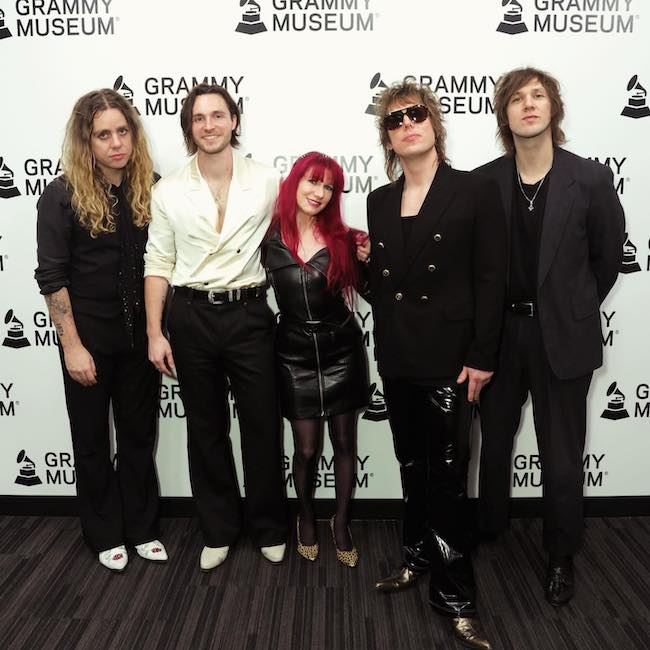
Adam Slack, Jed Elliott, moderator Lyndsey Parker, Luke Spiller, and Gethin Davies at the Grammy Museum. (photo: Rebecca Sapp/Getty Images)
“We’ve got friends in the U.K. that are huge in the U.K., huge in Europe, and it’s just such a mammoth task to tour the USA that they’re like, ‘We can pay our mortgages and see our families all the time if we stay in home,’” Elliott explains. “Whereas for us, we were like, “Well, this is the only place that we’ll have us!’”
“We had no choice,” Davies chuckles.
“And we were young enough to not have mortgages and families,” adds Slack. “So, we were like, ‘Fucking finally, something to do! We’re going to go on tour.’”
“It’s more about a sense of belonging. Like, I’m sorry, England, but we feel way more welcome here. We’ve done some of the biggest festivals in this country, charted on the biggest charts in the USA, and we just haven’t had that same experience in our home country,” Elliott says of the Struts’ loyal American fanbase. However, Elliott and his bandmates haven’t given on their British dream. “In the grand scheme of a rock band’s career, we’re still young. You look at the ambitions we have and a sustainable rock music career, and we’ve still got a long way to go. So, we’ll get our homecoming.”
Going back to the signature anthem that first broke the Struts in the States, Spiller understands now why “Could Have Been Me” connected so deeply with U.S. audiences, and why it continues to do so a decade later. (To celebrate Everybody Wants’ anniversary, a fourth version was recently released, featuring their Queen idol Brian May, who actually declared it one of the greatest rock songs of all time.) “It’s far too of a positive message for a normal British band!” Spiller quips, while Slack snarks, ‘It’s very ‘American dream,’ isn’t it? ‘Let’s go! You can achieve anything!’”
However, Spiller admits that he “didn’t even particularly like it that much” at the time, and that he thought other, more ostentatious Everybody Wants cuts, like the mini-rock-opera overture “Roll Up,” better represented the over-the-top aesthetic of a band whose backstage warm-up playlist regularly features the Spice Girls, Robbie Williams, Donna Summer, and other “gay bar-meets-12-year-old school disco” classics.
“Anything in that sort of bizarre, musical theater kind of caliber, something that was really sort of left-to-center, I was like, ‘Yeah! That’s what it’s all about!’” Spiller laughs. “‘Could Have Been Me’ and ‘Kiss This,’ just like many other sort of singles that appear, they were written very late. Earlier on, you sort of scratch all these itches of being as pretentious and outrageous as you want. Then you do stuff which is a little more simple. But at the end of the day, time can only tell what your band becomes known for.”
The Struts actually haven’t always been known for one thing — or they’ve at least tried to be break away from typical expectations and preconceptions. They’ve in fact ruffled a few stodgy rockists’ feathers by collaborating with pop stars like Kesha, the above-mentioned Robbie Williams, and Paris Jackson, and Spiller’s acclaimed debut solo album, Love Will Probably Kill Me Before Cigarettes and Wine, swapped the band’s crunchy, glittery guitar riffs for orchestral, Scott Walker/Bryan Ferry-inspired Bond balladry.
“Personally, I hate whenever I get that feeling that people think that they know what to expect and how we sound and how I look or what we’re saying. That’s when I have to change it. And what could be more hilarious and cocky than getting Michael Jackson’s daughter on a cheeky little rock song or something? It makes people ask questions,” says Spiller. “If the songs were bad, I would agree with people [who object to the Struts’ pop experimentation]. I’d be like, ‘Yeah, we shouldn’t have done that.’ But they’re all great tracks.”
And so, as the Struts prepare to record their fifth studio album, which Spiller says will be “probably be the most cohesive and thoroughly thought-out record that we’ve ever done up to this point,” expect the unexpected — and maybe even a sound that will resonate more in the band’s native England, the birthplace of glam rock, than in the States.
“It’s going to be somewhat of a visual concept record,” Spiller teases. “It’s going to be extremely camp. … It’s not going to be like an album that’s made of tracks that are narrative as such, but it will all make sense. There’s going to be this really unique world around the record that people will be like, ‘Oh, really? OK, this is interesting. I can’t stop watching. I can’t stop listening.’ That kind of thing.”
And whatever happens next for the Struts — who’ve bounced from Virgin to Interscope to the Big Machine Label Group, and are currently on their own again after being drooped by Big Machine almost exactly a year ago — they’re just going to keep calm, carrying on, and rocking out. “To be honest, looking back on [our career], everything happened for a reason, exactly how it was meant to play out,” Spiller says with a smile, surprisingly revealingly that the Struts’ experience recording the full-circle new version of “Could Have Been Me” with Brian May made his newly grateful for everything he and his bandmates have endured together.
“There was a really beautiful moment, when [May] has a Dolby Atmos kind of suite, and they had recently just remastered and remixed the debut Queen album. And he was like, ‘You boys wanna come listen to it?’ It was kind of like a DVD as well, so it had all these unseen pictures,” Spiller reflects. “And I could kind of see on [May’s] face when he was, I guess, reliving a lot of these memories. There was something beautifully somber about it, and the energy in the room changed. I remember saying, ‘Brian, these pictures are amazing. I’ve never seen that picture of Freddie.’ And he was like, ‘Yeah, good ol’ Fred. One of the best. Didn’t fucking know it at the time…’
“I think when you just spend so much time with each other [in a band], more time than with your closest friends and family, it’s very easy to forget the unique bond that you have,” Spiller elaborates. “So, I kind of walked away from that with a new gained appreciation for my fellow bandmates, thanks to Brian.”
“Wow, that’s the first we heard of that!” jokes Elliott, as Grammy Museum attendees burst into laughter — to which Spiller grinningly confesses, in true frontman style, “I can only do it in front of an audience.”