
Rocker Michele Bettencourt may be the subject of the documentary Beautiful Lie, but the fact that her more-fascinating-than-fiction story hasn’t yet been adapted for a biopic — or better yet, a Hedwig-style off-Broadway musical — is downright mind-boggling.
“Oh, I’m not sure how interesting that would be to a lot of people,” Bettencourt chuckles humbly, sitting with LPTV at Studio City’s Licorice Pizza Records on Halloween night as she prepares to make her live public debut with her new band, Vampire Time. “I mean, I’ve lived it, so it seems kind of routine to me. It doesn’t seem that special.”
Bettencourt’s nonchalance aside, her life has been anything but typical, even it once seemed that way from the outside looking in. She was once a Silicon Valley CEO leading billion-dollar tech companies, and she also got married, twice, and raised four children. But behind her suburban/corporate façade, she was harboring a deep, dark secret.
Michele, then known as Anthony or “AB” [editor’s note: Michele often deadnames herself in conversation, and has granted permission for this article to include that context], was still grappling with the gender dysphoria that had caused her so much secret shame and pain during her difficult boyhood, back when she was growing up as the only child of a mentally ill mother. And so, at the late-blooming age of 57, Bettencourt blew up her life — leaving her career and marriage, estranging herself from her family, and beginning what she has described as her “emotionally and publicly jarring” transition.
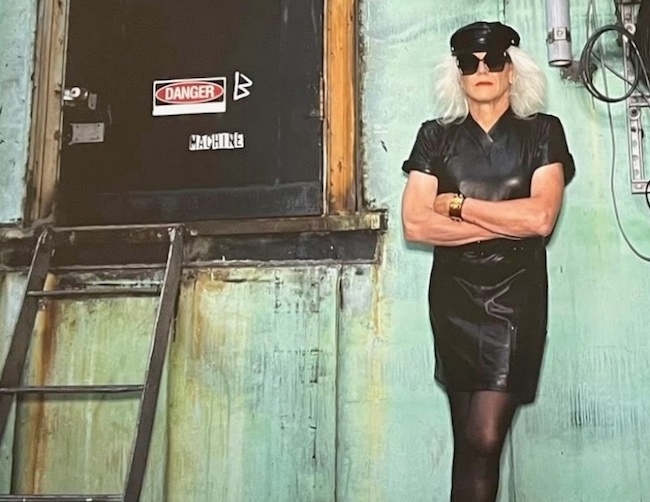
photo courtesy of Licorice Pizza Records
“It’s a boys’ network,” Bettencourt says, ruefully recalling how the tech industry ostracized her at the time. “I was a joke for about a year. I was a meme. It was a comedic thing for people to bring up: ‘Oh, your CEO is now a chick!’ It was upsetting, and I thought, ‘I’ll never work again. I will never get hired in the [Silicon] Valley again!’”
But eventually, Bettencourt not only rebuilt her career and reconciled with her wife and children after a two-year separation, but also pursued the deferred dream of rock stardom that she’d had since age 13, when she’d taught herself to play drums. And in that process, Michele found her real voice. That voice is loud and clear on her debut album, Vampire Time, which features such esteemed collaborators as Carmine Rojas (David Bowie, Rod Stewart), Steve Ferrone (Tom Petty and the Heartbreakers), and Russ McKinnon (Barry Manilow, Tower of Power).
“When we wrote [Vampire Time], we kept thinking of Joni Mitchell and Neil Young and Crosby, Stills & Nash — if it were 1969, but now, what would they write?” says Bettencourt, who is on the board of the Sam & Devorah Foundation for Trans Youth, is the founder of the Michele Bettencourt Foundation for Fair Transgender Employment, and is involved in many LGBTQ+ causes. Her protest album features political anthems like “10,000 Flowers,” “How Close (Will You Stand by Me),” “Freak Show,” and “Taking Out the Trash,” but its centerpieces is the single “Everybody Loves a Circus,” which has become a surprise late-in-life radio hit for Bettencourt, landing on five charts. And the album’s autobiographical title track, which certainly could be the Tony-worthy theme for a Vampire Time rock opera, has also racked up more than 4 million plays on YouTube alone.
In the video interview above and the Q&A below, LPTV and Bettencourt go deep during a conversation that took place backstage at Licorice Pizza on the record’s release day, Halloween 2025. That explains my True Blue-era Madonna costume, but here, Bettencourt just remains true blue to herself, no longer having to hide who she really is.
LPTV: My first question is an obvious one, about the Vampire Time cover artwork and what it symbolizes.
MICHELE BETTENCOURT: Well, it symbolizes a very upside-down White House right now. And then the first single that we put out is called “Everybody Loves the Circus,” and that just talks about politics. It is a bit opaque in the lyrics.
And that song is a surprise hit! Congratulations, especially because this has been a long time coming. I don’t know really where to start when asking you about this record and your life. I mean, your life should be a movie. It should be a biopic. It should be a rock musical, actually.
Well, it’s certainly a drama! [laughs]
You’ve had quite a journey. You grew up with music your whole life. You were playing drums at 13. But you’re a relatively late bloomer when it comes to having a band and doing music full-time.
Super-late, yeah. We did a record, a CD, in 2018, which was never released. We printed it, but I gave it away. It was very personal, while I was transitioning. And then I stopped, because it was very exhausting process.
So, you transitioned in 2018?
I transitioned from 2017 to 2019.
I guess you were a late bloomer in that way, too.
Yeah. I was 57 at the time.
Wow. Let’s just go back to the beginning. Like I said, you were into music as a kid, which was probably an escape for you. I know your childhood was rough, and I imagine you were going through some gender dysphoria.
I was confused. In 1968, there wasn’t a discussion about trans people at all. And when you’re caught [wearing] your mother’s stuff and it becomes a very sad night of screaming and yelling, it’s never discussed again, for 50 more years. Then you hide it.
It’s kind of interesting that — even though these people weren’t trans — in that era of the late ‘60s and especially early ‘70s, there was so much of what people called “gender-bending.” There was glam rock, Alice Cooper, the New York Dolls. These were men who identified as cis and mostly straight, like David Bowie or whoever, but they were dressing in makeup and sequins and heels. So, were you into the glam thing? Did that connect to you in any way?
No… in fact, by the ‘80s, I was married at age 21. I had triplet daughters when I was 27. And I was hiding. I would go to work, and then I would not think about it. It was a struggle. For whatever reason, I did not connect [with glam-rock]. We were raising kids, and so my life was very suburban. I worked for a tech company — was a VP of sales at age 24, VP of sales at a public company age 35, and a CEO of a public company at age 42.
Lots of people reinvent themselves, but certainly not to the degree that you did, both personally and professionally. But everyone has a sliding-doors moment in their life. And maybe you could have transitioned much earlier in life, or you could have gone into a rock career sooner. But instead, you were in this white-picket-fence world and became this Silicon Valley hotshot. So, was there a crossroads moment where you were like, “I’m going to choose my own adventure”? And if so, why did you choose the life you chose at that time?
I never considered transitioning when I was younger. Never thought I would do it. I never thought it would happen.
They called it a “sex change operation” back then, in the ‘70s and ‘80s.
I never imagined it. We had triplet daughters that were babies, and then they were growing up and I thought, “I can’t, no, I just can’t.” So, I just put my head down and worked. And I was really good at that. And then I built a bifurcated life. There’d be “Anthony” in the day, and then in New York, there’d be “Michele” at night.
Were you going out to clubs as “Michele”?
Yes, I would literally I’d fly into town, I would do my calls, have my meetings, and then I would change, put on hair and makeup, and go down to the bar and work. And I met a lot of interesting people who were curious. Some were kind of angry about, but it was really a cool social experiment for me. In a lot of cities, I had friends who knew “Michele,” but not “Anthony.”
Wow. Like I said, this is a movie…
Oh, I’m not sure how interesting that would be to a lot of people [laughs]. I mean, I’ve lived it, so it seems kind of routine to me. It doesn’t seem that special.
No, it’s an amazing story — especially when since we haven’t even gotten to the best part yet, which is when you become a rock star! But walk me through when you were living that double-life. Were you happy? Were you tormented inside?
I was pretty tormented, because you feel guilty because you’re going out at night — you’re not telling your family, and you’re [adding] two days onto a [business] trip so you can stay longer to go out and not tell anybody. But I was working; I wasn’t out screwing around. And then what happened later in life is with music, I was in a really crappy blues band and in 2006, my daughters were on MTV’s My Super Sweet Sixteen. I was a 235-pound penguin on that show, at 5-foot-8 in a tuxedo. Season 2, Episode 2, “The Triplets.” And they were 18 at the time! [laughs] I got the band Sugarcult to play, and they let me play with them.
Oh, wow! I have to go back and watch that episode.
It was wonderful. We had a place near my home in a winery, and I remember we had a dinner and I tried to get [Sugarcult] hired as a band. So, they brought their manager, I brought a friend of mine who helped me get the deal done, and I was trying to explain to them that I’ve got my three daughters — they’re lovely kids, they’re 18, they’re not brats. And [Sugarcult guitarist] Marko [DeSantis] and the band all told me afterward that they didn’t like me coming in because it was like, “OK, here’s some asshole rich dad who we don’t want to deal with.” I spent a lot of time saying, “No, my kids are really sweet. You’ll love them! … And my daughters think my band’s going to play [on My Super Sweet Sixteen], and they think that’s pretty cool, but I want you to play instead.”
But you could have been on MTV with your “crappy blues band”!
Yeah, but what [Sugarcult frontman] Tim Pagnotta said was, “Well, why don’t you learn a song and play with us?” And I said, “I can’t. I’m not that good.” They’d just opened for Green Day, the big tour. And then Kenny Livingston, who became really one of my best friends now, the drummer, said, “Dude, you’re not going to take over my day gig. Just learn a freakin’ song! And if you suck in a soundcheck, you can’t play.” And so, I didn’t suck in the soundcheck. I mean, I looked like I was about to have a heart attack when I played, but I think it was “Destination Anywhere,” the song we did, and I nailed it. And then the next day I thought, “I’m going to be in a band!” So, I formed a band, Zen Vendetta. I found people on Craigslist. … We rented out [Stray Cats drummer] Slim Jim Phantom’s club, the Cat Club, and we played our set. It was pretty good. I mean, it was stuck in the ’80s, but good! But when you’re doing music and you’re stuck in ‘80s… then we opened for Journey, Def Leppard, Foreigner, UFO, a bunch of bands.
So, at this point, it’s like you’re leading a triple-life. You’re a Silicon Valley CEO, you have this hidden life as Michele, and then you’re also doing this Hannah Montana rock-star-by-night-thing, all at the same time.
Yeah, I was CEO of a company and I had to leave [the office] early so we could open up at the Mountain Winery for Foreigner! … We were pretty good, but I was the drummer and I took one drum lesson at age 13, so I had my limitations. But in the midst of that, I met Jim [Phantom], and then I met [Sex Pistols bassist] Glen Matlock. I spent a lot of time with Glen, and then I met [David Bowie guitarist] Earl Slick. I’m on Glen Matlock’s album [Good to Go], but I play tambourine. And then I would eventually have all of them come to my meetings at work. We had 500 people in Texas for a sales meeting, and they’d come and play and I’d buy Earl’s guitars, and I’d make it like American Idol and [the business meeting attendees] would vote. Then [the famous musicians] would play a 45-minute set and come sit and have dinner with us all.
Now, that’s a reality show I would watch — along with your rock musical/biopic! So, you were living a pretty already quite interesting life. And then, in 2017…
Yeah, I was CEO and chair of a company worth $1.6 billion. It was a thousand employees, $300 million of revenue. It was a cybersecurity company, very public. I opened the New York Stock Exchange for them. I then opened the NASDAQ for them. And then an investor realized that I was being sloppy with my social media…
Did you have separate social media for your different names?
I did! I had an “Anthony” [account] and a “Michele” one. [The whistle-blowing investor] put $140 million of his firm’s money into my company, and he was pissed. He was worried that I wasn’t paying attention to work. I’d left my wife. I’d moved to New York. I’d bought an apartment. We were separated, and I was a bit messy. But I was not unfocused, I just probably wasn’t the best version of me for work.
So, this guy was transphobic?
No. The thing was, he went to my board. There was a meeting he went to, and he met with one of my board members and dumped on him: “Your CEO, something’s going on. It’s gender, and they’re not focused enough.” It caused a lot of problems for me with the company — not that they wanted me out, it was just they didn’t know how to explain it. I did not know how to explain it! And one of my board members said, “Why didn’t you tell us?” I said, “What am I going to tell you? That I wear dresses and go out? What am I going to tell you? I don’t know what it is.”
They said, “You can just hire a president and put them in California, be the CEO and chair in New York. Run the company, and sell it at some point.” And I was pissed at their response. So, I cleverly hired someone who could be CEO, and then I went to the board and said, “Make them CEO if I’m out. I’ll be chair of the board still, and I’ll leave when I can.” And I left. I left in February of 2018, and then I kind of got more serious about transitioning. And then I came home in 2019. My [second] wife and I struggled at first to date [again], but then we fell in love again.
Yes, your reconciliation with your wife is another amazing chapter of your story. It seems like everything eventually worked out, but your bio says that this time in your life was “emotionally and publicly jarring” for you. Can you elaborate on that? There was that one investor guy who basically outed you, but in general, what was the reaction in the tech world?
It’s a boys’ network. I was a joke for about a year. I was a meme. It was a comedic thing for people to bring up: “Oh, your CEO is now a chick!” It was upsetting, and I thought, “I’ll never work again. I will never get hired in the [Silicon] Valley again!” Because I know how it worked. Like, I was a board member on a great company board and the company was $350 million and eventually sold for $12 billion, and the CEO was gay and he was terrified of people finding out. And I remember when I was CEO of another company and I wore a black T-shirt, skinny jeans, and earrings at that point — I was starting to telegraph, I guess! — one of my board members said, “Anthony, you’re not turning gay on us, are you?”
Yikes.
Yeah. I thought, “Crap, if that elicited that response…” So, when I came back to California, I wanted to go back and work in the Valley because that’s what I did, and I thought I wouldn’t be able to. I got very, very fortunate. Instead of becoming a CEO, I took board seats. I landed on three boards. We went public in one, opened again the NASDAQ. I became chair of the board and we sold it last year for $1.6 billion.
Well, congratulations. Like I said, it all worked out, on your own terms. But you were already leading this interesting triple-life in all these very different worlds. What made you not want to just stick with the status quo and go, “OK, I’ll be ‘Michele’ on my off hours, and I’ll be a rock person from time to time, but I’ll be ‘Anthony’ most of the time”?
I was tired of hiding. Because you live a life and all of a sudden you’re not truthful 50 percent of the time. You can’t tell your family. How would you explain it? Can’t tell your kids, can’t tell anybody at work. If people find out, you think it’s going to wreck everything. And when that investor went to the board, it played my hand. And it was OK. I mean, I sat down with him. His name is Jesse Cohen. I’ll tell him this: Jesse’s a wonderful guy. He called me about six months after it all got messy for me. We’d meet at the Peninsula for drinks when things were normal and I thought I could handle him as “Anthony” and manage him. And Jesse apologized. He said, “I wasn’t trying to attack you or anything. I was worried about the investment.” And I wasn’t kind to him; I was probably cool and a bit dismissive. And then I called him back three months later, met with him, and I said, “Look, you didn’t get the best version of me. I get it.” He and I still talk. I mean, he bought the album! [laughs]
So, life has turned out to be brilliant. I’m grateful for everything. I feel bad sometimes, though, because my life is a bubble. Just look at what I do now. My life is a bubble. I’m trans, but maybe not as “trans” as people want someone to be. … I’m a dad, I’m a husband, I’m so many things, and it isn’t always consistent with how a lot of trans individuals see life. So, I don’t even fit. But that’s OK.
It’s interesting to me that use you she/her pronouns, but you still refer to yourself as a “husband” and “father.”
I’m probably just as confused sometimes, because I can’t go backward and say I’m a “wife.” I’ve got really lovely wife, and I’ve got a wonderful ex-wife. We all spend holidays together with all the kids, and I’m just lucky. And I don’t have to be in that really bad pool where things are difficult.
Right. When you say you live in a bubble, it’s like, even though you’ve gone through hardships and have dealt with transphobia, it’s not in the way that the average trans woman has.
Yeah. When I lived in New York, my apartment was on 62nd and 3rd, and five blocks away there was a club called Evolve. I didn’t know where to go when I lived in New York, so I went to Evolve, and they had a transgender night. It was really these really cute, sweet kids who were forced to be prostitutes. … I had all these Herve Leger dresses that I bought that fit at one point in time, and I gave them all to the girls. … I remember sitting at the bar the first time I was there and a guy comes up to me and he touches my wig. I had a wig at that time; it looked like everyone’s grandmother when I was in a room! And I looked at him and I said, “If you touch my hair again, I’m going to break your fucking neck.” And the bouncer came over because the guy looked at me and said, “What?” The bouncer came over and walked him out. And I thought I was going to get kicked out. I saw how bad it was.
Are you involved any activism to help transgender people who are not as fortunate as you?
Yes, I’m on the board of the Sam & Devorah Foundation for Trans Youth. … And I’m involved right now in a documentary called As You Are. David Siegel’s producing, and I’m co-producing with Janet Zucker and Jerry Zucker. It’s about the 15,000-plus trans individuals in the military who are being fired by Trump for being trans. [The Vampire Time band has ] a song, “How Close (Will You Stand by Me),” that we wrote for the documentary.
One would assume it is easier for people to be openly trans now than it was when you were young, because now we actually have that language, and we see famous trans people in entertainment. But when you mention the military ban, I feel like things are regressing. And that sort of ties into your album cover. What are your thoughts about what’s going on with trans rights right now?
Well, they’re being rolled back. And according to JD Vance, I’m a “domestic terrorist.” Look, I’ve got a BB gun from 1946 that belonged to my father that doesn’t work. I have no weapons. I’m not a terrorist. It’s just one of those things where it is upside-down and backward right now, and it’s full of hatred. And the trans community is about 1.5 percent of this country. It’s the weakest cohort. So, the lyrics for the single we put out, “Everybody Loves a Circus,” are: “Find a wedge and use it wisely/Distract them with a parlor trick.” It’s all about [the Trump Administration targeting] group by group by group. That’s what they’re doing.
I feel like there’s a lot of scapegoating going on, when so much of the far right’s vitriol is disproportionately focused on a part of the population that’s such a small minority.
Yeah, we’ve caused a lot of bad shit to happen, apparently! Government shutdown? Trans people. My car’s out of gas? Trans people! Yeah, we’re guilty for everything. It’s just bullshit. It’s absolute bullshit.
Would you say that Vampire Time is a political album? Is it a protest record?
It is. When we wrote it, we kept thinking of Joni Mitchell and Neil Young and Crosby, Stills & Nash — if it were 1969, but now, what would they write? And so, we started writing a song called “10,000 Flowers,” which is about apathy. What happens is 10,000 flowers become one, if no one does anything. We have a song called “Freak Show,” which is about the administration. We have a song called “Taking Out the Trash,” which is more deliberate and about both sides screwing everyone. Both sides want to make it red against blue or blue against red, when really, we should be up against the oligarchs and the politicians and the bankers.
You mentioned Joni and Neil and that very idealistic era. People really did think in the ‘60s that rock ‘n’ roll could change the world, with the youth culture that came up with the Woodstock generation and the Summer of Love and all that. But there’s another faction of people who are like, “Just shut up and sing. We don’t want to hear what celebrities think about politics. We don’t want to listen to music about politics.” Do you think that music can still make a difference? Do you think it’s an obligation of musicians to speak up?
I think yes to both. I think it can make a difference. We sit around as a band and talk about the songs we’re writing and the messages we’re trying to impart and how evocative we want to be. We don’t want to be polarizing. We don’t want to create music that forces one side of the country to hate us — even though they may, because of me or something else. But we don’t want to do that. We want to try to unify and get rid of the division. That’s our intent. And maybe we’re a bit naïve, but we think it could make a difference.
What’s interesting is it seems a lot of classic rock fans, and some classic rock artists, are actually quite conservative, even though they may not have been so conservative when they were young.
Well, that’s an Alice Cooper talk, right? I mean, things come out.
Yeah, Paul Stanley has said a couple things about trans kids that were a bit weird. Why do you think that is? I mean, even if they were cis and straight, like I said before, these men wore women’s clothing and makeup, or were at least very androgynous, so you’d think they’d be empathetic.
I think people fear what they don’t understand, oftentimes. And when you really ask the rank and file, how many people have met a trans person — it’s not many. There’s not a lot of us. … So, I would think my job is to be an ambassador. If someone asks a question [about being trans], I’m going to answer it, and I’m not going to be upset. I’m going to give them a real answer. That way, if a trans person walks into the room after me, I want them to be treated better.