
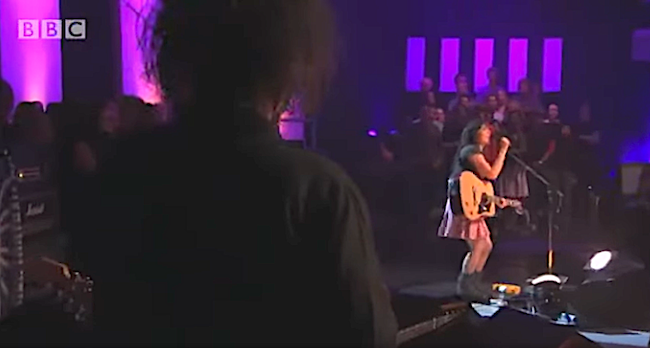
Robert Smith watches the ‘Later… with Jools Holland’ performance that launched KT Tunstall’s career.
Twenty years ago, on Feb. 7, 2006, Scottish singer-songwriter KT Tunstall released her debut album, Eye to the Telescope, in America. Three months later, runner-up Katharine McPhee covered the LP’s first single, “Black Horse and the Cherry Tree,” on American Idol Season 5, which was the top-rated show of 2005-2006, averaging more than 30 million viewers a night.
McPhee actually performed Tunstall’s relatively obscure folk song on two of those nights: on the top five episode, and as a reprise for the top two finale. It was an unexpected song choice, back when female pop contestants still mostly stuck to Mariah, Whitney, and Celine ballads, and McPhee’s breakout performance subsequently catapulted “Black Horse” from the bottom half of the Billboard Hot 100 all the way to the top 20.
“It suddenly changed America for me,” says Tunstall, speaking onstage at the Grammy Museum. She notes that she did eventually get to meet McPhee. “And I did say thank you!”
One American artist that Tunstall still hasn’t had the chance to thank, however, is Nas. The hip-hop star was accidentally instrumental in securing Tunstall some “Black Horse” television exposure on the other side of the pond, which was even more important to her then-fledgling career.
Tunstall says it “completely changed [her] life overnight” when she appeared on Britain’s in-the-round variety series Later… with Jools Holland, as a last-minute booking after Nas canceled. “The rapper pulled out, and I got his spot. Obvious choice!” she chuckles.
“I had 24 hours’ notice to get down to London and do it,” Tunstall recalls. The fact that she was a “portable” one-woman show, utilizing loop pedals to create a layered, full-band sound in real time, made it easy for her to pack up quickly and accept the BBC’s invitation. But she had no idea that her looping would make her such a TV sensation.
“I’d been doing it for a bit, like for maybe six months, playing in coffee shops and setting it up myself. Everyone would kind of look up from their lattes and be like, ‘All right, that’s cool,’ but no one was going crazy,” she shrugs.
The next day, “after trying to get somewhere for 10 years, all through my twenties — I was just really lucky that I looked 15 when I was 29,” Tunstall found herself at BBC Studioworks’ Television Centre, sharing that hallowed circular stage with music’s greats. “It was Anita Baker, Jackson Browne, and the Cure… and me! It was crazy.”
The Jools crew then made the brilliant decision to include an over-the-shoulder camera angle of Robert Smith standing in iconic “Boys Don’t Cry”-style silhouette, as the Cure frontman observed Tunstall’s career-making performance with intense interest. “You could see me through Robert Smith’s hair,” Tunstall laughs. “It was like I was a little egg in a nest.”
Afterwards, Tunstall was still in shock, as she processed what had just happened and tried to make small-talk with Smith. “He was the first famous person I ever met. After the show he was so nice, and he gave me a quote for my press release about how much he loved the performance. And I was just completely overwhelmed and didn’t know what to say to him,” she recalls. “I was trying to think of what to say to him, so I said, ‘What are you doing this weekend?’ He said, ‘Oh, I’m going to my parents for lunch.’ I didn’t know what to say next, so I said, ‘What do your mom and dad think of your hair and your lipstick and everything?’ And he said, ‘Oh, I don’t usually put that on when I go home.’ Incognito — much like Stevie Nicks, he can disappear. So, if you saw Robert Smith without, you would not know that was him. It’s genius!”
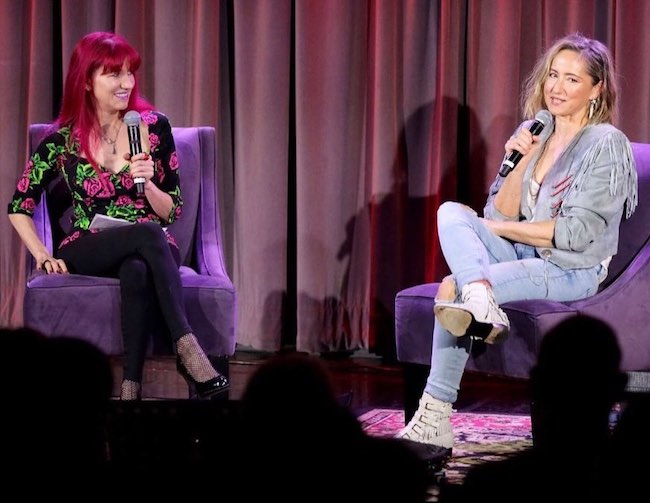
KT Tunstall chats with Lyndsey Parker at the Grammy Museum about her career. (Photo by Rebecca Sapp, courtesy of the Recording Academy/Getty Images)
After Jools and Robert Smith’s endorsement, Tunstall’s website, which she was still running on her own, “totally exploded,” receiving hundreds of messages a day from new fans. “My favorite email I got was from this guy who said, ‘I’m fiftysomething. I can’t tell my friends that I’m sending you a message because I’m a punk. I just need to tell you that I love your music. I can’t tell anyone else.’”
Adding another twist to this story of happy TV accidents was the fact that Tunstall’s just-completed but not-yet-released Eye to the Telescope didn’t even originally include “Black Horse and the Cherry Tree,” because it had been written after the LP was recorded. “The Jools Holland scouts had come to see me at rehearsal… and my label boss was like, ‘Play that new one.’ I was like, ‘OK,’ and that was that. I didn’t hear anything from them. Then when it came to the show, my label boss said, ‘Play that ‘woo-hoo’ thing,’ and I said, ‘But it’s not on the record!’ He said, ‘Don’t worry about it.’”
Tunstall reluctantly complied, but she admits that she “thought it was a terrible mistake” at the time. “I was like, ‘Why on Earth wouldn’t I play the single from the record?’ Obviously, it went mental, so he made a great call with that song. And so, the first 10,000 copies of [Eye to the Telescope] have the audio from the TV show, because they rush-released the album and we didn’t have a recording.” The official studio version that appeared on later pressings of Eye to the Telescope was named Best Single of 2005 by Q magazine, and received a Best Female Pop Vocal Performance nomination at the 2007 Grammy Awards.
Tunstall’s Jools performance aired just a few months before YouTube launched, and McPhee’s Idol performance aired about a year after that, so Tunstall was actually one of the early pop stars to go viral, at a time when “going viral” wasn’t even a thing. The irony is not lost on her, even after all these years.
“Really, if YouTube hadn’t existed, I probably wouldn’t be here, because I was always about the music and didn’t particularly want to be about the image. I just wanted to be a musician and a player,” she says. “And actually, in the end, it was people seeing what I did that was the thing that blew it up.”