


In May 1980, legendary Minneapolitan music savant Peter Jesperson discovered the Replacements and went on to become their A&R rep, manager, producer, mentor, self-described “babysitter,” and the man sometimes described by fans as the “fifth Replacement” (although he’d humbly rather give that title to guitarist Slim Dunlap). It was a decision that not only changed the course of Jesperson’s life (as detailed in his fascinating 2023 memoir, Euphoric Recall), but changed the course of alternative rock, indie rock, college rock, and rock ‘n’ roll in general.
When Jesperson recently visited Studio City’s Licorice Pizza Records to celebrate the new four-LP deluxe edition of what many critics consider to be the Replacements’ greatest work, their 1984 breakthrough Let It Be (featuring unreleased studio and live recordings, alternate versions, outtakes, and all sorts of ‘Mats goodies), he shared enough stories during his live Q&A to fill a second memoir.
In the video above and the (edited-for-brevity-and-clarity) text below, Jesperson dishes about his first reaction to the band’s 1980 demo tape and why they had few other believers in Minneapolis early on; how they evolved so drastically over the next four years; the band’s disastrous first gig and many other notorious shows, including one that caused Gene Simmons to walk out; Peter Buck’s solo on “I Will Dare” and Bob Stinson’s solo on “Unsatisfied”; the stories behind l “I Will Dare” and other landmark tracks like “Androgynous” and “Unsatisfied”; the stories behind about the Let It Be album title and cover photo; the weird way that the Replacements’ hero Alex Chilton first discovered them; why the Replacements refused to play the music industry game, and why that was both a blessing and a curse; why it took so long for the band to get their due and how frustrating that was, especially for frontman/primary songwriter Paul Westerberg; Let It Be’s unique appeal to female listeners; the band’s Rock & Roll of Hall of Fame chances; and even a possible ‘Mats biopic, spearheaded by a certain Stranger Things star who just hosted Saturday Night Live nearly 40 years after the band’s infamous SNL appearance.
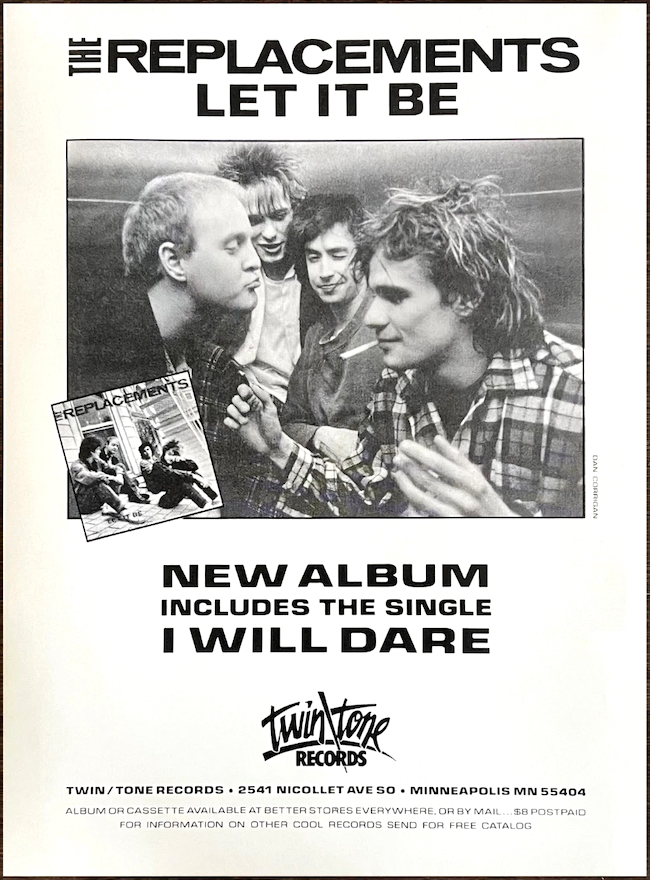
courtesy of Rhino and Twin/Tone Records
LPTV: A lot of rock scholars cite Let It Be as the Replacements album on which Paul Westerberg came into his own, or very rapidly matured, as a songwriter. I’d love your insight on that. Was this a conscious thing, like, “It’s time to grow up”? How did that come to be?
PETER JESPERSON: I think it was a gradual thing. I think Paul was a great songwriter right from the get-go, from the first tape I got. I got a four-song demo in the spring of 1980. He walked into the record store. I’d never met him before. He handed me a tape. When I listened to it… I’ve done A&R all my life, or “talent-scouting,” and I don’t know that I ever had an experience quite like that. It was probably 20, 30 seconds into the first song where I just felt like somebody put my finger in an electrical socket. I actually stopped the tape and rewound it. I was actually at a record store — I managed a record store in Minneapolis [Oar Folkjokeopus], and I was listening to a bunch of demos while I was doing paperwork for the store. And so, as the tape started, I was probably slightly distracted. I thought, “Time to put my pen down and just listen.” And so, I played the first song all over again, and really, my first reaction was that it sounded to me like some kind of modern update on Chuck Berry with dirty words — not that Chuck didn’t have his share of dirty words at certain points! I was so excited about it. It took me a couple of days to calm down and make sure about my reaction, that I hadn’t overreacted.
And so, I called a couple days later and I remember a female voice answering the phone; I believe it was his mother. She hands the phone to Paul. I identify myself: “I’m the guy at the record store he gave the tape to. I really love the tape. Were you thinking about doing an album or a single?” And there was a long pause and he said, “You mean you think this shit is worth recording?” Because at the same time as we had [the record label that Jesperson co-founded] Twin/Tone in motion, I was also DJing at a club where I had some sway with the booking agent, and so a lot of people gave me tapes just to try to get gigs at this club called the Longhorn. It turned out that that’s why Paul brought me the tape; he was trying to get a gig! But he got a gig and a record deal at the same time.
The original demo tape Paul gave to Peter Jesperson back in 1980 (as seen in the Sorry Ma… (Deluxe Edition) booklet). #TheReplacements #SorryMa #OriginalTapes #DemoTape pic.twitter.com/mbWhjDtWiU
— The Replacements (@TheReplacements) January 6, 2022
I think I’ve read that the first Replacements gig was, ironically, at a sober club.
Yeah, they’d never played a real, bona fide rock club before we got together. They were sort of taken under the wing of a band called the Dads, who were a sober band back in the day — the only sober people I knew, to be honest! But they played the Longhorn quite a lot, and they were good guys and a good band. They had taken the Replacements under their wing and they’d played places in the suburbs like keggers and house parties, but they had gotten a gig in a sober club in downtown Minneapolis in a church. That was actually supposed to be the first [Replacements] gig that I saw. I remember walking up the stairs to the church and there was this kid sitting near the top of the stairs, kind of looking dejected with his head hanging down. As I walked by, he said, “Are you Pete?” I said yeah, and he said, “Well, I’m Chris. I’m the drummer. We ain’t going to play. We got kicked out.” I didn’t know why initially. And then Paul walked out and I recognized him from the store. He had [late guitarist] Bob Stinson with him, and he introduced me to Bob and said, “Yeah, they found liquor and pills in our stuff,” and [the concert organizer] was not happy about it. The guy had actually said, “I’ll take sure you guys never play Minneapolis again!” — which of course didn’t happen.
So, they were causing trouble from the start.
Yeah, yeah. It was a funny deal because I think they thought they’d blown an opportunity. And I hate to admit it, because sobriety or a lack of sobriety is not anything to laugh about, but at the same time when I walked away, I kind of chuckled. They sure didn’t scare me off.
You had such conviction about this band, but I know a lot of people in the Minneapolis scene were sort of were mocking, like, “What are you doing with this band with a 13-year-old bass player?” They didn’t take the Replacements seriously, but you saw the potential, which manifested itself on Let It Be, from the very start.
It was a slow, growing awareness of their talent, I think. But at the beginning, I was just so knocked out with what I heard. … I remember somebody giving me a hard time about how much I was blabbering about them, and I said, “You hang on for a second. Someday people are going to be writing books about these guys.” It was probably inflated hyperbole on my part at the time, but at the same time, I think deep down I had an inkling.
How many books, besides Euphoric Recall of course, have there been about the Replacements at this point?
Three or four main ones, I think!
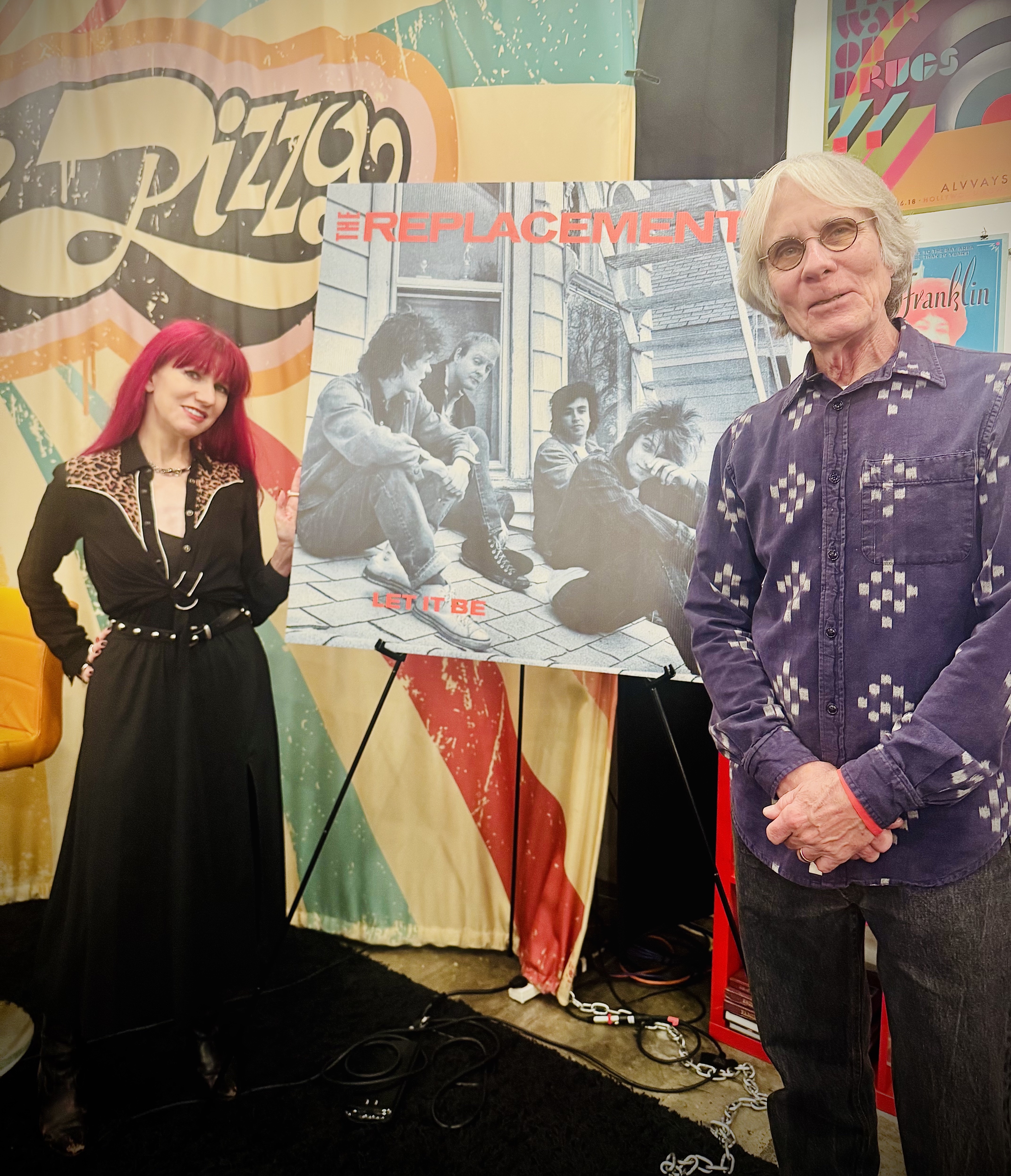
Peter Jesperson at Licorice Pizza with LPTV host Lyndsey Parker
So, eventually they get to work on Let It Be, a period of time that overlapped with when you were working for R.E.M.
Right. Before we went into the studio to start Let It Be, I had gotten an offer to do some road-managing work for R.E.M. in between Replacement dates. R.E.M. had been playing Minneapolis for a couple years by then, and they really took the town by storm. … We got to be friendly; [R.E.M. guitarist] Peter [Buck] and I are very similar people , and he ended up crashing on my couch many times and staying up till the sun came up listening to records, because that’s what we love to do. And so, he offered me this temporary road manager position and I thought, “This would be great to do, but I can’t do it unless the Replacements are cool with it,” because they were my priority, obviously. And so, we had a meeting and I explained the situation and they all said, “Hey, this is cool, go ahead and do it.” I had kind of explained it as [R.E.M.] were a few rungs up the ladder from what the Replacements were doing, so maybe it would be an opportunity for me to kind of learn the ropes and meet people in higher positions. And so, I presented to the band that way.
And then they kind of changed their tune — or Paul did. The other guys didn’t really, but it was Paul who I think, looking back on it, wanted to be No. 1, and it hurt his feelings that I was paying attention to somebody else, to some degree. So, that made it a little tough there for a bit. But what happened was the [Replacements’] songs had started to advance at such a rapid rate, and I recognized it and I thought, “Paul’s having some kind of a breakthrough. He’s gone up several levels here, very quickly.” And I think he recognized that I recognized it, and so that brought us back together. We were probably closer during the making of Let It Be than we had been even before.
And then Peter Buck was involved in that record. I don’t know if it was an urban legend that he was at one point tapped to produce it…
He was never really on the bubble to produce, and we hadn’t really talked about somebody from the outside coming in, necessarily. He just wanted to come and hang out for the recording session. That’s why we put a guitar in his hand, when Bob Stinson was having a little bit of trouble playing the right kind of solo [on “I Will Dare”]. I mean, Bob himself even didn’t feel like he was nailing the right kind of solo. It wasn’t like Westerberg said, “Hey, you’re out, Peter’s in”; it was like Bob stepped aside and said, “Yeah, go ahead and let him try it.” Peter did the solo, and it was the right thing.
Didn’t Paul have “I Will Dare” in his arsenal for a while by then? Wasn’t it supposed to maybe be on Hootenanny?
Yeah, he called up as we had just finished Hootenanny and sent off the audio to the pressing plant and the package to the printer. A couple days later he called me and said, “I’ve just written the best song I’ve ever written, and we need to pull the record back and add it!” We couldn’t do that. It would cost a fortune to kill the project and it would delay it and slow the whole project down. He was not happy about that, but he understood deep down. And so, we held it from the record. But it was, I think, the first thing we recorded when we started Let It Be. I’d been out on the road with R.E., literally flew in from a gig at Six Flags in Georgia on a Friday night, took a red eye- home, got a couple hours of sleep, and then jumped in the van and picked up the band and drove to the recording studio. And then Peter [Buck] flew in a couple days later. In fact, I brought a couple of his guitars with me, which was also added to my luggage! I’m trying to manage all this other stuff, and I thought, “Oh man, I’ve got the Rickenbackers with me here.” I didn’t want to see somebody steal them or whatever.
But anyway, we started recording and “I Will Dare” came real fast, because they had been doing it for close to a year by that time. One of the interesting stories about it — I don’t think we’ve talked about this too much in other interviews — was at one point after [Buck] had done the guitar solo, Westerberg just said, “God, it would sound kind of cool if there was a mandolin on this.” He didn’t seem real serious, but I kind of filed it away in the back of my head. My older brother was in a bluegrass band, so he had a mandolin player. I called him up and I said, “Any chance I can rent your mandolin?” And the Replacements didn’t have the reputation they do now, or did then, for breaking things, so he trusted me with the thing. I gave him 10 bucks to rent the mandolin from him. The next day, Paul and I were going to the studio and I went to pick him up and he looked in the backseat and saw this little case and said, “What’s that? ” I said, “Well, it’s a surprise for you!” … I don’t know if he’d ever played one before, so it was really cool. He figured out that part out real soon and real fast. And so, that’s how the mandolin ended up on there.
So, Paul had told you “I Will Dare” was his best song yet. When you heard it for the first time, what was your reaction? Did you agree?
I did. … A couple of weeks after he had called me, we had a show at a place called Goofy’s Upper Deck in downtown Minneapolis, which was mostly a hardcore bar, but the Replacements were punky enough that they fit in and we got booked there quite a lot. I remember the set there being strong and we had a good crowd, and about seven or eight songs into the show. I heard them start a song that I didn’t recognize — a quick-strummed, kind of bouncy intro. It caught my ear because I knew their material so thoroughly, and as soon as the song kicked in, I suddenly went, “Oh, this is the one he called me about!” I mean, it sounded like a hit to me. It really did. And I don’t really think that way usually, especially with the band like the Replacements! But I thought, “Man, he’s written the song. This could be the one.” I was very excited about it.
Another Let It Be track I have to ask about is “Androgynous.” It’s crazy that song came out more than 40 years ago; I think it’s more meaningful or topical now than it was in 1984. I interpret it as a very positive depiction of what would now be called a gender-neutral or gender-queer couple, and it has been covered by Joan Jett with Miley Cyrus and trans artist Laura Jane Grace, and also by trans singer Ezra Furman.
I couldn’t tell you what the inspiration was, and I didn’t ask him, but I know that when Paul first played it for me, he was very surprised by it and a little nervous about it. And I was really surprised by it too. He hadn’t written anything like it. And as you know, from the beginning, when I first met him, it was all rockers. When I first met him, it was like they wanted to be Johnny Thunder’s Heartbreakers. That was their thing. The first show I ever saw them do, they did three Johnny Thunders songs. … So, “Androgynous” was a real outlier. It wasn’t a song that anybody saw coming, and I think it was a very forward-thinking song and certainly is getting a lot of attention now.
Was there any kind of weird, transphobic public reaction to it when it came out?
No, I don’t remember any kind of bad reaction. I think that people were kind of excited by the expansion of topic.
I also want to ask you about “Sixteen Blue.” I believe it was inspired by the awkward age of bassist Tommy Stinson, Bob’s younger brother.
That was a funny one. … I remember were at the Paradise in Boston where they were opening for R.E.M., and during soundcheck, they did this new song. I was walking around at soundcheck and hearing the words, and all of a sudden I went, “Holy shit, he’s written a song about Tommy!”
How did Tommy react to it?
We didn’t really talk about it. It was one of those things. I mean, everybody kind of got it that that’s what it was about, but it wasn’t something that was a big discussion point.
You mentioned the Replacements used to do Johnny Thunders covers, and there were some great, and surprising, covers during the Let It Be era, like Hank Williams’s “Hey, Good Lookin’.”
There was a live version of that on the flip of “I Will Dare,” the 12-nch. We had two songs on the flip: “20th Century Boy” by T. Rex and then the Hank Williams song.
And somehow that cover has something to do with Big Star’s Alex Chilton connection, who the Replacements later wrote a whole song about. What’s the connection there?
That was funny because we had been in Madison, Wis.; there was a club there run by a husband-and-wife team who were really, really good people and took a shine to the Replacements and booked them a lot. … I’ve sort of only half-jokingly referred to it as the Replacements’ Hamburg, because Madison is really where was where they cut their teeth, playing for people that didn’t watch them go through all their growing pains. And so, somebody, maybe one of our roadies, had thrown a tape that’d been a mixtape in our van to record the show, and “Hey ,Good Lookin’” was the last song they did. Maybe it was an encore; Bob’s solo is just so ridiculous, it sounds like he’s playing the wrong song. But we thought it was really funny. And so, on the way home in the van — I mean, this is another crazy thing, but when we used to go to Madison to play a show, we didn’t have money for hotels or anything, so we’d drive back afterwards. We’d leave Madison at 2 in the morning, and I’d be dropping them off when the sun came up. But anyway, as we’re driving back, Westerberg was riding shotgun and he kept playing that [newly recorded live Replacements] version of “Hey, Good Lookin,’” playing the solo and then rewinding it and playing the solo again and rewinding it and playing it again. And there was like this wrestling match in the van with Bob trying to get to the tapedeck. because he was going to chuck it out the window. So, it was like, hog-pile on Bob to keep him away from that tape.
The tape made it home, fortunately. So, when we decided to put it on the B-side of this 12-inch, Steve Felstead, the engineer, and I were transferring it from the cassette to a quarter-inch reel, and right when “Hey, Good Lookin’” ended, the mixtape that was on it previously popped out. It was almost like it was meant to be: There was the beginning of track one, side one of the first Big Star album, which the song “Feel.” You hear this dun, dun, dun, dun, dun, dun, dun, dun, dun, dun, and I thought, “That’s so cool! Let’s just put on a few seconds of it and fade it out.” It was a little Easter egg because everybody knows about Big Star now, but at the time they were not known at all. It was our little tip of the hat. And interestingly enough, the next year when meeting Alex Chilton, he said that was the first thing he ever heard by them. He’d been driving from Memphis to New York and stopped at a friend’s house in Baltimore to spend the night before he went up to the city, and the guy said, “Hey, do you know about this band the Replacements? Look what they’ve done here!” And he played it for them. So, that would’ve been his intro to them.
What a great story! Now, I also have to ask about Let It Be’s cover of KISS’s “Black Diamond.” This was recorded in early 1984, long before people were admitting to liking KISS, ironically or unironically. No alternative rock bands were playing KISS songs back then, except Redd Kross. And I think Gene Simmons might’ve seen Replacements do “Black Diamond” in concert once?
Yeah, Gene came to CBGB. … It was actually not a great show. Alex Chilton was opening up; it was the first time we met him. I think that the Replacements had a few extra cocktails because they were so excited, and it was a pretty messy show. Also, they’d just been on the cover of the Village Voice and there were a lot of A&R guys in New York that were like, “Who’s this band we’ve never heard of?” So, it was packed with record executive.
This was a common occurrence, right? Where the Replacements would have a big show and not be at their best, but then they’d play some other show for like 10 people, and it would be the best show you ever saw in your life?
Yep, that’s exactly right! But anyway, while they were playing, [the sound guy] kind of nudged me — the club was packed, wall-to-wall, and there was a tall guy standing to our right — and he said, “You know who that is? ” I said no, and he said, “It’s Gene Simmons!” Of course I wouldn’t recognize him.
This would have been around the time that KISS makeup came off. It came off in 1983 at an MTV press conference.
I wouldn’t have recognized him with his makeup on! [laughs] But anyway, and there was a little talk-back system at CBGB, a little microphone on the board that you can talk to the band through the monitors. And so, when they finished a song, I hit the button and said, “Hey Paul, Gene Simmons just walked in, no shit.” And without missing a beat, they crashed into a really terrible version of “Black Diamond. “
Which is not a Gene Simmons-penned KISS song. Paul Stanley wrote that. Do you think maybe they should have done one of Gene’s song?
Well, I don’t think they knew very many. But anyway, he turned and left very quickly.
Oh, man!
But you’re right about the non-ironic part of it, because they also did [the Simmons co-write] “Rock and Roll All Nite.” I remember seeing them do that at another club in New York where it was a big crowd and they didn’t know whether the Replacements were making fun of it or whatever, but did such a great version of it that it didn’t really matter. … Actually, we recorded four covers during the Let It Be sessions, and we had to pick one. We didn’t want to put two covers on, but we thought one would be fun. I think that the band was kind of leaning towards the T. Rex song because they did a great version of “20th Century Boy.”
What were the other two?
The Grass Roots’ Temptation Eyes and “Heartbeat, It’s a Love Beat” by the DeFranco Family. … When we were deciding what’s going on in the album, I had the T. Rex song on there, and then I started thinking, “This is kind of obvious.” So, when we had a little band chat about what songs various members liked and what they didn’t like, I said, “I think it’d be cooler to put on the KISS song, because it would be so unexpected.”
The last Let It Be track I want to discuss is an original, “Unsatisfied,” which is considered to be another one of the Replacements’ greatest songs. You were mentioning how Bob Stinson didn’t do the solo on “I Will Dare,” but it was a complete opposite story with his guitar playing on this song.
Yeah, he did a great guitar solo on this one, and that was a studio concoction, really. Paul had written it, brought it to the band, taught it to Bob, and they recorded it right away. I don’t think we even did more than one version. We had one good backing track. Paul took a couple shots at the vocal, but there was only one really good vocal. The interesting thing about that one was when we recorded it, it didn’t have the acoustic guitar intro and we didn’t use things like click-tracks or anything, and there was no count in. And so, when all of a sudden Paul said he wanted to put a 12-string at the beginning, it was really difficult to record the 12-string and then line it up so it sounded right.
Another interesting thing about “Unsatisfied” is I remember after the record was out, we were driving through somewhere in Kentucky or Tennessee on a two-lane road and stopped to get gas. There was a payphone across the street, so while the van was gassing up, I ran across to call back to the office in Minneapolis, to just check in any names for the guestlist, that kind of stuff. Dave Ayers was a guy who was doing some A&R while I was away so much with the Replacements, and Dave said, “Hey, we got a call from Debby Miller, a writer from Rolling Stone. She loves the album and they’re going to review it, but she doesn’t understand one lyric.” She wanted to know if I could tell her what it was. … It was the line, “Everything you dream of is right in front of you,” but she couldn’t figure out what he said right after that. So, I’m standing there in the payphone booth and I’m looking across the street, and there’s Westerberg standing a couple feet from the van smoking, of course — which is good idea in front of the gas pumps. So, I shout across the street, “Hey, Paul, Rolling Stone is reviewing the album. They don’t understand this lyric, ‘Everything you dream of is right in front of you.’ What do you say after that? And he shouts, “Liberty is a lie!” from across the highway. I thought, “That’s a fucking great line!” So, I read it into the phone, and Debby Miller put it in her review.
I’ve read that “Unsatisfied” is at least partially about Paul’s frustration with where the band was at that time. Some people might’ve thought a band with their reputation didn’t want mainstream success, but I feel Paul did. Did that inspire this song at all?
There wasn’t a lot of talk about, “Where did this song come from? What did you mean? What were you feeling, Paul?” Those were not conversations we had. But I was shocked, and I’m shocked to this day, that it took them four albums before the major labels really got serious about coming after them. So, I think if you’re Paul Westerberg and you’re writing “Color Me Impressed” and “I Will Dare” and “Unsatisfied” and you’re not getting the kind of attention that you think you should be getting, you’re probably not very satisfied.
Obviously, the Replacements got to a certain level of success, especially critically, a type of success that many bands would be thrilled to have, by the time they broke up. But like you said, you thought “I Will Dare” sounded like a smash, and that Let It Be took the band to a new level. Did you guys think, even in the back of your minds, “This is the album, this is the one that’s going to do it”? They did get signed to a major label, Sire, after Let it Be, so I assume this record attracted attention of Seymour Stein or whoever. Were you thinking, “OK, now things are going to happen”?
I don’t know that that was really the way we thought. I think that everybody wanted to be more successful. Everybody wanted to be making a better living or whatever. But the idea was just to make the best records we could, and to tour as much as we could. And even though they did a lot of shows that were falling-down drunk, they didn’t go out there on purpose to do a shitty show. It was just kind of the luck of the draw. There was something cool about that, in a way, that they couldn’t fake it. And so, on a night where the chemistry wasn’t there onstage, sometimes they’d maybe flush it down the toilet a little bit and just be goofy. Or we played a lot of places where there were big punk-rock audiences and they’d do everything country-style, just to piss them off.
Did that piss you off sometimes? Here you are, their manager who’s believed in them since the first 20 seconds of their demo tape, getting opportunities like being on the cover of the Village Voice or playing important, buzzy shows attended by rock stars and A&R execs, and they sort of blow it. I imagine that could be frustrating.
Well, if you’ve got a bunch of people standing in front of you saying, “This is what we want, this is what we expect from you,” they are the kind of band that’s going to go the other way. I mean, that’s just the way they work. I was more frustrated when they just played shows that sucked because I knew that they were much better than that. There’s a lot of bands that go out there and they’re great every night, like a Bruce Springsteen kind of thing; they give it their all every night. Not everybody can do that. So, I kind of admired [the Replacements] for not playing the game in those ways. … I just think that there’s a purity to what they did in a way, that they didn’t kiss people’s asses at record labels. They did quite the opposite. I think that’s part of what makes people interested in them still. But who knows how that happens? It’s like that question they asked John Lennon many years ago, “To what do you attribute your success?” And he said, “Well, if we knew we’d form another group and be managers!” I think it’s that-X factor thing.
But it’s been brought up many times that if the Replacements had played the game more, the world could have been their oyster. And this goes beyond Let It Be — like, it applies to the “Bastards of Young” music video, which is now a classic, but was not playing the MTV game. I don’t know if that’s something any of them or you ever grappled with, the idea of what might have if they’d just fallen more into line.
I’m sure everybody thinks about it. But we might not be talking about them now, had they done that kind of thing.
There might have been fewer books written about them. Or, those books would have been a lot less interesting.
I think of the eight records they made, Don’t Tell a Soul [released by Sire Records in 1989] is the one where they really did try to play the radio game and all that. And I think that’s their least interesting album. I think it’s got some real duds songs on it.
Fair enough. So, I’m going to put you on the spot. Given the fact that you never knew what you were going to get with them, what is, in your opinion, the best show you ever saw the Replacements do? And just for kicks, what were the worst?
God, there were a lot… I mean, I saw them hundreds of times, and they were great more than they were bad. I know a musician, Joe Henry, who when I met him said he was a big Replacements fan and he saw them eight or 10 times and never saw them do a good show! And I thought, “Well, that’s too bad. I’m sorry about that, but I’m glad you like the records.” He
Joe Henry gave them a lot of chances!
But I guess I remember after the CBGB show where Gene Simmons turned up, the reason we had to play CBGB was because we’d been booked in a bigger room about a week and a half later called Irving Plaza. That was a big deal at the time. CBGB was booked first, so when we got the Irving Plaza gig, they said, “Well, there’s a no-compete [clause], so you can’t do this show.” I said, “What if we do the show under a fake name?” They said that’d be OK, so the Replacements actually played as “Gary and the Boners,” which wasn’t really all that much of a secret. And oddly enough, Alex Chilton, who was just coming out of retirement, said, “If they’re going to play under a fake name, I am too!” So, he played as “The Deteriorating Situations.”
I had to convince [CBGB owner] Hilly Kristal “Look, there’s going to be a huge crowd [at CGBG]. You’re going to sell lots of liquor. Can we do this [Irving Plaza show] under a fake name?” And Hilly and I got along really well; he’d never liked the Replacements, but for some reason he and I always had a good relationship. So, he said, “Peter, I’ll do this for you.” We ended up a week and a half later going to Irving Plaza and it was like they had something to prove. because they knew they’d done a bad show before [at CBGB]. And they walked onstage and opened with “Rock and Roll All Nite”…
And Gene Simmons was not there!
But they just killed it. That was a brilliant show all the way through. So, that would be one of the best. There’s also a club in Trenton, New Jersey — there’s a bonus 10-inch that comes with this new Let It Be Package that has six songs from a recording in Trenton, New Jersey, at a place called City Gardens. That was another one where the PA was so good. The monitors were so good. They could really hear themselves, and they played their asses off every time they were there. I mean, some drunk shows of course too, but …
I think the bad shows are maybe the ones that people remember more, because that was part of the band’s lore.
It became more of their lore. And it is kind of a frustrating thing where people come up to a band member or me or whatever and say, “I remember seeing them in Tulsa and you were so drunk you couldn’t play any of your own songs — and that was so great!” That wasn’t really why the Replacements were great to me.
I have some couple obvious questions about Replacements lore, one of which was about the Let It Be album title. Some people at the time might have thought it was blasphemy, but I do believe it was at least partially inspired by you and your Beatles fandom.
I think it was them needling me a little bit. Westerberg used to say, “[The Beatles] are a great rock band, but they’re not the be-all and end-all!” And I said, “No, they are the be-all and end-all, and you are wrong!” But I think what happened was, they probably were sitting at the CC Club, which was the bar kitty-corner from our record store where we all hung out all the time. … Paul’s sitting at the table with a couple of the band members and he said, “OK the next song that comes on the jukebox is going to be the album title.” And there it was: The Beatles’ “Let It Be.” And the other thing that I think was when we started making the next record [Tim], the first for Sire, right up until the last minute it was going to be called Let It Bleed. I thought that would have just been the coolest thing. to have Let It Be and follow up with Let It Bleed. And then at the last minute, Paul said, “No, I’m going to call the album Tim.” I was like, “Why?” And he said, “It’s such a nice name.” I think that was a missed opportunity!
And of course, I have to ask about Let It Be’s iconic cover photo, shot on the Stinson family home’s roof.
I was working at the record store that day that they took the pictures just a couple blocks really from where that house is. Dan Corrigan was a brand-new photographer at that time, and one of the guys that we worked with at Twin/Tone had said, “You should maybe take some pictures at their practice space, because that’s where they really became a band.” And so, Corrigan was shooting them there and then he said, “Let’s go outside.” And then all of a sudden… they got up on the roof, crawled through [Bob and Tommy’s] sister Lonnie’s bedroom window — there’s her baseball trophies in the window. When we were looking at the contact sheets, everybody just went, “Wow.” It really caught everybody’s attention. … It was like, “There’s your fucking album cover, right there.”
Like it said: Iconic. And it’s nice with reissues like this one, the Replacements are more appreciated than they were around the time of “Unsatisfied.” That 1980 demo tape through which you’ve discovered them is in the Rock & Roll Hall of Fame Museum in Cleveland, and they were even nominated for the Rock Hall in 2014. Do you think they’d ever get in? And would they care? Would they show up?
Well, Tommy and I did a thing for my book [at the Cleveland museum], and it turns out the two directors of the Rock & Roll Hall of Fame are Replacements fanatics. They were so kind to us, gave us like a two-hour private tour of the museum and couldn’t have been nicer. It turned out the main guy [Rock & Roll Hall of Fame president Greg S. Harris] used to road-manage Ben Vaughn, who opened for the Replacements several times, so we were probably sharing dressing rooms and I would have met him many years ago.
Well, there are a lot of Replacements fanatics out there who probably have Hall voting power now. Let It Be has been declared by some critics as the greatest coming-of-age album of all time, for instance.
Yeah, and I think one of the other things about this new package I’m really excited about is the liner notes written by this woman, Elizabeth Nelson, writer from the East Coast, who I think we’re just so fortunate to get. I encourage you to read them — they’re really absolutely brilliant, and if she doesn’t get nominated for a Grammy, I’m going to be really shocked.
I’m so glad you mentioned Elizabeth Nelson, because that was literally my next question! Just in terms of how they the Replacements have been historically perceived, I think she wrote something was really interesting. I’m going to quote her. “The Replacements were the ultimate rebuke to masculine punk, and Let It Be at its core is a record for girls.” I love that, because I think a lot of people think of the Replacements as being like a band for bros and dudes. But a lot of women love the Replacements, and Paul’s lyrics could be very sensitive and appealing to a female audience, so I appreciate that Elizabeth pointed that out.
I thought it made sense. I don’t know that I’d really thought about it. I didn’t ever really think they were a guy’s band, necessarily. I just thought that they were a band for people who really paid attention to good songwriting and liked to have a laugh.
With all these great stories about this mythical band, could there ever be a Replacements biopic? Have there been talks of one of?
Well, there have been several [discussions]. The [Trouble Boys] book [by Bob Mehr] has been optioned a couple times. It was optioned by Josh Green, who’d done The Fault in Our Stars, and he was determined. He promised: “This is my next movie!” He had done an X-Men movie and he’d done a 10-episode limited series with Stephen King of The Stand, so he had made a lot of money and said he was going to do as his pet project. He actually came to my house and we talked a lot about it, but he couldn’t get the film companies to agree with them and come up with financing. I mean, Cameron Crowe came on board as a producer! Anyway, that went away and then the rights went back to Bob Mehr, but now they’ve been optioned again by Finn Wolfhard.
No way! So… who’s going to play you?
[laughs] I don’t even want to think about it! We’ll figure that out. Maybe there won’t be a manager in the movie, I don’t know.
No, no, they cannot write you out of the story.
Well, anyway, right now it looks like it’s something that’s very real. I was kind of glad when the idea of a biopic went away though, because I thought, “How many good ones have you ever seen?” I haven’t seen many; there’s way more bad ones than good ones, if you ask me. But I think Bob Mehr will be involved in the screenplay and keep them on the straight and narrow. And also, the impression I get is that Finn Wolfhard is a fanatic for the band and wants to make it real and true. And so, maybe, it would be a good one.